

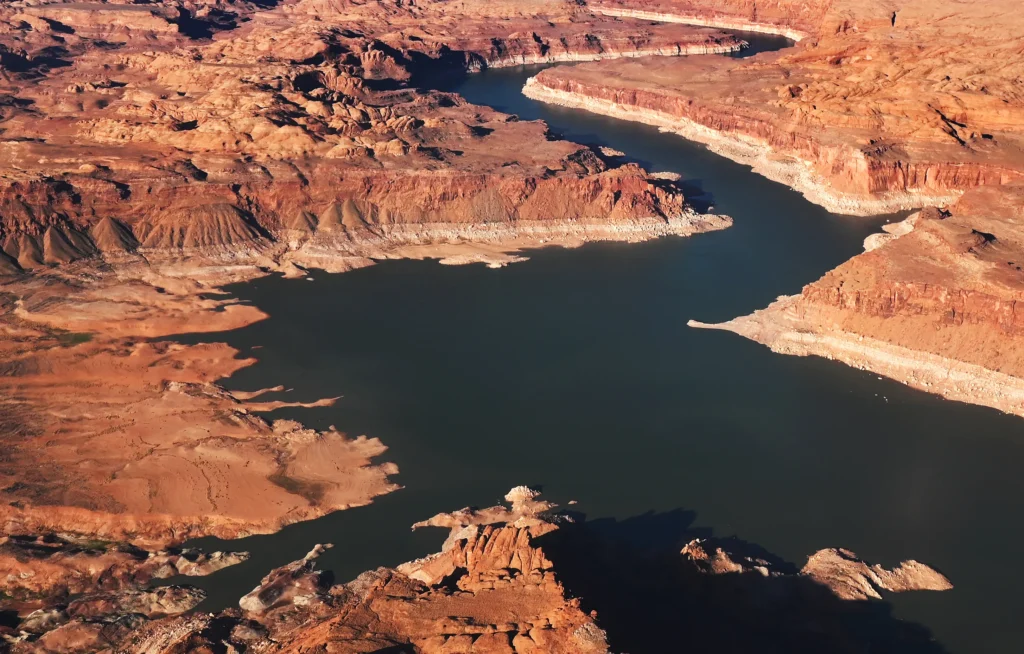
I once kayaked 13 miles down the Colorado River.
It felt endless, powerful, and permanent—like a living artery binding the American West together.
Today, that sense of permanence is gone.
The Colorado River system—on which more than 40 million people depend—is now at the center of a high-stakes political reckoning in Washington, D.C.. After years of federal hesitation and fractured state negotiations, the long-delayed conflict over who gets what share of a shrinking river has finally reached the national stage.
At Sustainable Action Now, we see this moment as a turning point. The water crisis in the West is no longer just a regional dispute. It is a national climate policy failure—and one that will shape the future of food systems, cities, tribal rights, and environmental justice.
For more in-depth reporting on climate and water policy, visit our climate coverage hub: 👉 https://sustainableactionnow.org/category/climate/
A River That Built the West — And Is Now Being Asked to Do the Impossible
The Colorado River is not just a geographic feature. It is the backbone of:
- municipal drinking water systems,
- agricultural production across the Southwest,
- hydropower generation,
- and tribal, cultural, and ecological survival.
Yet for decades, political leaders treated the river as if its flow were fixed and dependable—despite clear scientific warnings that climate change would permanently alter its hydrology.
The result is a system designed for abundance that is now operating in structural scarcity.
How We Reached the Brink
The modern water war is rooted in agreements written during an unusually wet historical period in the early 20th century. Those compacts allocated far more water than the river can reliably deliver today.
Add two compounding forces:
- explosive population growth across the Southwest, and
- accelerating climate-driven aridification,
and the entire framework becomes unsustainable.
But for years, federal leadership avoided forcing hard choices.
The Federal Vacuum
Under the Trump administration, the federal government largely adopted a hands-off posture toward deep structural reform of the Colorado River system.
States were encouraged—sometimes pressured—to negotiate voluntary reductions among themselves.
That approach failed.
Instead of producing durable, enforceable agreements, it produced delay, political cover, and widening mistrust between basin states.
By the time federal officials acknowledged the severity of the crisis, reservoirs were already collapsing to historic lows.
A New Interior Secretary, An Old Crisis
The responsibility for stabilizing the system now falls to Doug Burgum, the current head of the United States Department of the Interior.
Burgum inherited a situation in which:
- states are deeply divided,
- agricultural and municipal interests are locked in political combat,
- and tribal governments continue to fight for long-delayed recognition of their water rights.
Whether he can reverse years of federal hesitation remains unclear.
What is clear is that the window for incremental reform has closed.
The Crisis Reaches the National Stage


For decades, Colorado River negotiations unfolded quietly through technical committees and closed-door state meetings. Today, they have become a visible and politically volatile issue in Washington.
Why?
Because the consequences of failure are now unavoidable:
- cities face potential long-term supply insecurity,
- farmers face permanent land fallowing,
- hydropower generation at major dams is increasingly unstable,
- and ecosystems that depend on seasonal flows are collapsing.
The fight is no longer about theoretical planning. It is about immediate survival.
The States Are Careening Toward Conflict
The federal government asked basin states to propose their own deep water cuts.
They could not agree.
Upper Basin and Lower Basin states remain divided over:
- who should bear the largest reductions,
- whether historic use should outweigh future growth,
- and how climate risk should be distributed.
Without federal enforcement authority stepping in, each state is incentivized to protect its own political and economic interests first.
This is not cooperation.
It is a slow-motion collision.
What Makes This a Climate Crisis — Not Just a Water Dispute
The Colorado River crisis is often framed as a technical water-management problem.
It is not.
It is a direct consequence of climate change.
Rising temperatures are shrinking snowpack, accelerating evaporation, and fundamentally altering runoff timing. Even if precipitation remains variable, warming alone permanently reduces usable water in the system.
In practical terms:
The river of the future will never resemble the river that shaped 20th-century policy.
That is the uncomfortable reality political leaders must now confront.
For more reporting on how climate change is reshaping U.S. infrastructure and natural systems, visit:
👉 https://sustainableactionnow.org/category/climate/
Who Is Most at Risk
Tribal Nations
Many tribal communities still lack full access to the water rights they were legally promised decades ago. As the system contracts, unresolved claims become harder—not easier—to honor.
Climate justice in the Colorado River basin cannot exist without tribal water sovereignty.
Agricultural Communities
Much of the nation’s winter produce is grown using Colorado River water. Large-scale reductions will reshape food supply chains, rural economies, and land use patterns across the Southwest.
Urban Centers
Major metropolitan areas depend on infrastructure built around assumptions of long-term stability. Retrofitting entire water systems for permanent scarcity will take decades—and billions of dollars.
River Ecosystems
Environmental flows are often treated as negotiable. But without sustained river health, the entire system becomes more brittle, less resilient, and more prone to catastrophic failure.
Why Federal Leadership Now Matters More Than Ever
The long-standing belief that states can solve the Colorado River crisis on their own has proven unrealistic.
Only the federal government can:
- impose basin-wide conservation targets,
- guarantee protections for tribal water rights,
- enforce equitable reductions across jurisdictions,
- and integrate climate science into binding allocation frameworks.
Anything less leaves the river governed by political compromise rather than physical reality.
Can Doug Burgum Turn It Around?
As Interior Secretary, Doug Burgum now sits at the center of one of the most complex climate adaptation challenges in the country.
But he faces a structural dilemma:
Every meaningful solution will create political losers.
There is no path forward that avoids:
- shrinking agricultural allocations,
- limiting future urban growth,
- and rewriting long-standing water assumptions.
Leadership in this moment is not about negotiation optics.
It is about enforcing climate reality.
A Sustainable Action Now Perspective
The Colorado River crisis reveals something deeply uncomfortable about American climate policy:
We are far better at celebrating innovation than confronting scarcity.
For years, political leaders avoided the Colorado River’s structural imbalance because it was easier to delay than to confront entrenched economic and political power.
Now, delay is no longer an option.
The West’s water war has arrived in Washington—not because politicians finally chose to act, but because the river itself has forced their hand.
This moment will define whether the United States can govern climate-driven resource collapse with equity, science, and courage—or whether it will continue to rely on short-term political bargains until irreversible damage is done.
For continued coverage on climate policy, water security, and environmental justice, follow our reporting at:
👉 https://sustainableactionnow.org/category/climate/