In early February 2026, actor and longtime animal-rights advocate Alan Cumming launched a high-profile new anti-leather campaign with People for the Ethical Treatment of Animals—better known as PETA—under the striking title “Rebel With a Cause.”
The campaign directly confronts one of the fashion industry’s most entrenched and profitable traditions: the use of animal skins. While fur has increasingly been pushed off runways and out of luxury houses, leather has largely escaped the same scrutiny. Cumming’s message is blunt and intentionally disruptive—true rebellion today means choosing compassion over cruelty, and choosing plant-based fashion over animal exploitation.
At Sustainable Action Now, we continue to document how the fashion and lifestyle industries remain deeply entangled with the global abuse of animals and wildlife, and why celebrity-driven campaigns like this one matter in shifting public awareness and corporate behavior. You can follow our ongoing coverage of animal exploitation in fashion and beyond in our dedicated reporting on animal and wildlife abuse.
A deliberate homage to cinematic rebellion

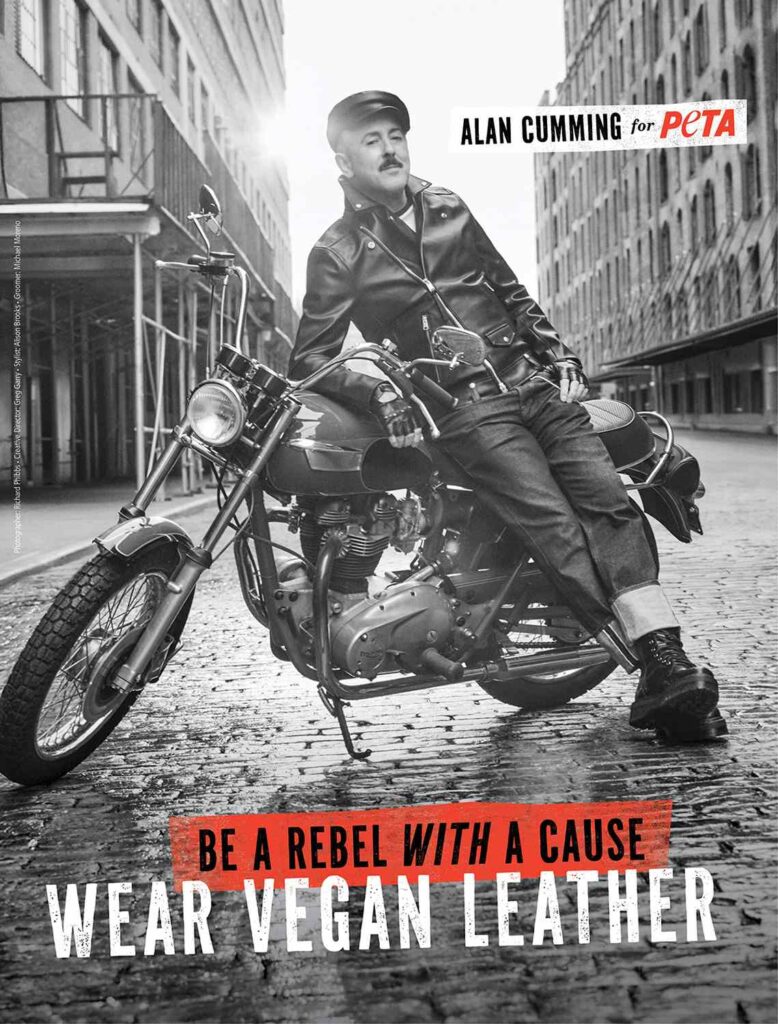
The visual center of the campaign is impossible to miss.
In the main image, Cumming channels the unmistakable posture and mood of Marlon Brando in the 1953 cult film The Wild One—leaning against a vintage Triumph motorcycle, styled as a modern outlaw.
But this is not nostalgia for rebellion’s sake.
The image is designed to deliberately subvert one of pop culture’s most enduring symbols of hyper-masculine, leather-clad rebellion and replace it with a radically different message: you can keep the attitude, the edge, and the confidence—without wearing someone else’s skin.
Cumming’s portrayal reclaims the visual language of biker culture and classic Hollywood defiance and retools it for a new ethical generation.
A full vegan look—without sacrificing style
One of the campaign’s central arguments is that animal skins are no longer necessary—functionally, aesthetically, or culturally.
Every element of Cumming’s outfit in the campaign is vegan.
The statement piece is a cactus-based biker jacket by AllSaints, made from sustainable desert cactus leather rather than cowhide. The jacket delivers the same structure, shine, and durability associated with traditional leather while avoiding the environmental and ethical damage tied to livestock production and tanning processes.
On his feet, Cumming wears classic boots by Dr. Martens, produced using synthetic materials rather than animal leather. The look is finished with a vegan leather cap—completing the unmistakable “bad boy” silhouette without a single animal product involved.
The styling choice is intentional and strategic. The campaign does not present vegan fashion as niche or alternative—it presents it as aspirational, fashionable, and culturally relevant.
Redefining what rebellion means in 2026
Cumming, who serves as an honorary director for PETA, frames the campaign around a deeper challenge to how society understands rebellion itself.
In the campaign video, he directly confronts the idea that rebellion must be performative, destructive, or rooted in outdated symbols. Instead, he positions today’s true rebellion as resistance to systems that normalize environmental destruction and animal suffering—particularly within the meat, dairy, and fashion industries.
As Cumming states in the campaign:
“You can be sexy and powerful wearing vegan leather. I’ve done it. It’s so much cooler to be a rebel with a cause.”
That message is not aimed only at consumers. It is aimed squarely at designers, brands, and fashion executives who continue to rely on animal skins despite the availability of high-quality plant-based and synthetic alternatives.
Why New York Fashion Week was the strategic target
The launch of “Rebel With a Cause” was deliberately timed to coincide with New York Fashion Week.
PETA is using the global visibility of the event to renew pressure on the fashion industry to take the same decisive step with leather that many brands have already taken with fur.
In recent years, major fashion houses and retailers have introduced fur bans across runways and collections. Yet leather—despite being produced through intensive animal agriculture and chemically toxic processing—remains largely untouched by those reforms.
The campaign’s timing is meant to force a question that the industry has long avoided:
If fur is no longer acceptable, why is leather still treated as untouchable?
Taking the message directly to the fashion capital
The campaign’s impact extends far beyond digital platforms.
Large-format posters featuring Cumming’s rebellious portrait have been placed throughout high-traffic fashion and media districts in New York City, including SoHo and the Meatpacking District—two neighborhoods closely associated with luxury retail, fashion marketing, and global brand headquarters.
The placement is deliberate.
By embedding the campaign into the physical landscape of the fashion industry’s cultural core, PETA is forcing designers, buyers, and influencers to confront the contradiction between modern sustainability claims and continued reliance on animal skins.
Leather’s hidden environmental and animal costs
While leather is still widely marketed as a natural by-product of the meat industry, that framing conceals both its scale and its environmental damage.
Animal skin production is inseparable from industrial livestock farming—one of the largest contributors to greenhouse gas emissions, deforestation, land degradation, and water pollution worldwide. The tanning process itself relies on toxic chemicals, including chromium, which contaminate waterways and disproportionately harm workers and surrounding communities.
From an animal-welfare perspective, leather is not an incidental material. It is a product of an industry built on confinement, transportation stress, and slaughter.
Campaigns like “Rebel With a Cause” are designed to expose how normalized these systems remain—especially within luxury and high-fashion markets.
Why celebrity campaigns still matter
Critics often dismiss celebrity activism as symbolic. But within industries driven by image, prestige, and cultural influence, symbolism carries real power.
Alan Cumming’s status as a respected actor and outspoken advocate gives the campaign credibility among audiences that traditional animal-rights messaging often struggles to reach—particularly within fashion, entertainment, and design circles.
By reframing vegan fashion as bold rather than apologetic, aspirational rather than alternative, and rebellious rather than restrictive, the campaign directly challenges one of the last remaining cultural defenses of animal-based fashion.
Fashion’s next ethical line in the sand
The success of fur bans demonstrated that the fashion industry can change rapidly when public pressure, cultural relevance, and brand reputation align. Leather now sits at the center of the next ethical reckoning.
“Rebel With a Cause” is not asking consumers to give up style.
It is asking the industry to evolve.
At Sustainable Action Now, we continue to track how the fashion world intersects with the abuse of animals and wildlife—and how campaigns like this one can accelerate long-overdue reforms.
The message behind Alan Cumming’s campaign is unmistakable:
Rebellion in 2026 isn’t about shock value.
It’s about refusing to let cruelty, environmental harm, and outdated traditions define what fashion looks like anymore.