
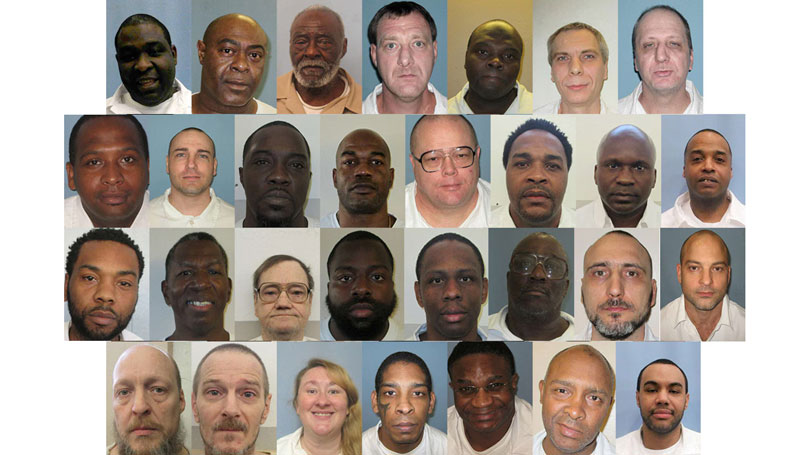
The death penalty in America is not a static policy debate. It is a living system—one that continues to accelerate in some states even as courts, journalists, jurors, and families raise urgent questions about reliability, constitutionality, and basic human decency.
At Sustainable Action Now, through our Death Penalty coverage, we examine the cases, the legal fault lines, and the accelerating pace of executions in states like Alabama and Florida. Recent developments—from the ongoing fight to free Toforest Johnson in Alabama to Florida’s aggressive execution schedule—underscore a stark reality: the machinery of death is moving forward even as doubts about fairness and accuracy grow louder.
This moment demands attention.
Why Is Toforest Johnson on Alabama’s Death Row?
On Tuesday, March 3, at noon Pacific / 3 p.m. Eastern, a public webinar will examine one of the most troubling wrongful conviction cases in the Deep South: the case of Toforest Johnson, who has spent 27 years on Alabama’s death row for a crime he maintains he did not commit.
Hosted by Death Penalty Focus, the discussion will feature investigative journalist Beth Shelburne, whose critically acclaimed 2023 podcast series “Earwitness” meticulously examined the prosecution of Johnson. The case against him hinged largely on the testimony of a paid witness who claimed to have overheard Johnson confess during a three-way phone call.
Since that conviction in 1998 for the 1995 murder of Jefferson County Deputy William G. Hardy, the evidentiary foundation of the case has steadily eroded. Jefferson County District Attorney Danny Carr and even Jeff Wallace, the former Assistant District Attorney who originally prosecuted Johnson, have publicly acknowledged that the case has “disintegrated” and called for a new trial.
Yet Johnson remains on death row.
Joining the conversation will be Johnson’s youngest daughter, Akeriya “Muffin” Terry, a middle school teacher who has become one of the most steadfast advocates for her father’s innocence. Her presence underscores what death penalty cases always involve but too often obscure: families on both sides living with irreversible stakes.
When prosecutors and former prosecutors agree that a conviction deserves reexamination, yet the state proceeds toward execution, the system’s credibility is not just questioned—it is shaken.
Florida’s Accelerating Execution Schedule
While Alabama’s courts grapple with questions of wrongful conviction, Florida has intensified its execution pace. The state recently carried out the execution of Melvin Trotter for a 1986 murder. Justice Sonia Sotomayor, in a rare written comment respecting the Supreme Court’s denial of review, formally acknowledged the gravity of what is unfolding in Florida.
In a system that had already seen dozens of executions under the current administration without a single Justice writing separately, that brief statement mattered. It signaled that at least one member of the highest court in the country felt compelled to note concerns about how Florida is carrying out capital punishment.
The executions continue. Billy Leon Kearse is scheduled for execution, with Michael Lee King and James Duckett following close behind.
The speed itself has become part of the story.
The Case of Billy Leon Kearse
Billy Kearse was 18 years and 84 days old at the time of the crime for which he was sentenced to death. Three Florida Supreme Court Justices have said his was “clearly not a death case.” His execution raises two serious constitutional concerns currently before the United States Supreme Court.
First, after Governor Ron DeSantis signed Billy’s death warrant, a juror from his resentencing publicly acknowledged that the courtroom was filled with uniformed law enforcement officers from across the state during deliberations. In a case involving the murder of a respected sergeant, that visible display of authority carried unmistakable weight. The juror admitted it affected her decision.
When a juror confirms that the presence of uniformed officers influenced deliberations, the reliability of the verdict itself comes into question.
Second, Billy presents substantial evidence of intellectual disability. The Constitution prohibits executing individuals with intellectual disabilities. Billy’s record includes low IQ scores, documented adaptive deficits, severe learning impairments, impaired problem-solving ability, and functioning at a third- or fourth-grade level. The trial court itself recognized multiple mitigating factors related to his cognitive limitations.
The question now before the Supreme Court is both technical and profound: Can a state use procedural barriers to execute someone the Constitution says cannot be executed?
If the Court declines to intervene, Florida will proceed without fully addressing these constitutional concerns.
Michael Lee King and the Question of Proportion
Michael Lee King, scheduled for execution for the murder of Denise Amber Lee, presents another constitutional challenge centered on neurological injury. At six years old, King suffered a severe frontal lobe injury that left him unconscious and bleeding. Later neuropsychological testing revealed structural brain abnormalities affecting executive function.
The jury that sentenced him to death never heard the full scope of this injury.
The law requires punishment to be reliable and proportionate. When juries are deprived of critical mitigating evidence—especially evidence related to brain injury and cognitive impairment—the reliability of the sentence itself becomes suspect.
These are not procedural footnotes. They are foundational concerns about whether the state can carry out an irreversible punishment in the absence of complete information.
Federal Developments: ADX Transfers Blocked
In a separate but related development, U.S. District Judge Timothy J. Kelly temporarily blocked the Department of Justice and Bureau of Prisons from transferring 37 federal death-sentenced men whose sentences were commuted to ADX Florence, the nation’s most restrictive federal prison.
That decision highlights another layer of complexity within the federal death penalty system: how the government manages individuals whose death sentences have been commuted but who remain incarcerated under extreme conditions.
The legal system continues to wrestle with the legacy of death sentencing even after commutations occur.
Legislative Expansion in Alabama
While courts and advocates push for greater scrutiny, Alabama has moved in the opposite direction. Governor Kay Ivey recently signed legislation allowing prosecutors to seek the death penalty for the rape or sexual assault of a child under 12, even when the crime does not involve murder.
The U.S. Supreme Court previously held that the death penalty for non-homicide crimes against individuals is unconstitutional. Whether this law withstands federal review remains to be seen. What is clear is that some states are expanding, not retreating from, capital punishment frameworks.
Cruelty, Procedure, and Documentation
Independent reporting has also raised concerns about how executions are carried out. Accounts referencing expired drugs, protocol deviations, and inconsistencies in execution logs highlight operational questions that extend beyond individual cases.
When execution methods shift and oversight diminishes, transparency becomes critical. The death penalty’s legitimacy depends not only on guilt or innocence, but on the integrity of its administration.
Even small procedural shortcuts can carry irreversible consequences.
The 34th Annual Awards Dinner: Recognizing Abolition Leadership
Against this backdrop, Death Penalty Focus will host its 34th Annual Awards Dinner on May 27 at the Skirball Cultural Center in Los Angeles. The event honors individuals committed to abolishing capital punishment through public education, organizing, and coalition-building.
Among those recognized are longtime death row spiritual advisor and writer Joe Ingle, Renaldo Hudson—who spent 37 years in prison, 13 on death row, before receiving clemency—and Stanley Howard, who spent 39 years incarcerated, 16 on death row, before being pardoned.
Their stories are reminders that wrongful convictions are not theoretical. They are documented.
A System Under Pressure
Florida’s execution schedule shows acceleration. Alabama’s Johnson case shows persistence despite prosecutorial doubt. Federal courts show intermittent intervention. Legislatures show expansion.
The death penalty system is not static. It is contested terrain.
For advocates, every petition delivered, every vigil organized, every investigative report published, and every family supported represents incremental pressure on a structure that many argue is cracking under its own contradictions.
Death is irreversible. Constitutional violations should not be.
At Sustainable Action Now, we will continue to monitor these cases closely. The questions they raise are not academic. They concern whether the state can take a life when evidence is disputed, juror influence is admitted, intellectual disability is documented, or neurological injury was never fully presented.
The machinery of death is moving. So are the challenges to it.
The outcome will shape not only individual lives, but the moral architecture of American justice itself.