There are defining moments in the history of animal welfare—moments when the trajectory of an entire movement shifts because one individual refuses to look away. For Dr. Jill Robinson MBE, that moment came in 1993 inside a bear bile farm in southern China, where cruelty was not hidden but systematized, industrialized, and normalized. What began as a single encounter—quiet, visceral, and impossible to ignore—has since evolved into one of the most consequential animal protection missions of the modern era. Today, her work stands not only as a testament to compassion, but as a blueprint for how sustained, strategic advocacy can dismantle entrenched systems of abuse and replace them with lasting, humane alternatives.
At Sustainable Action Now, the significance of Robinson’s work extends far beyond individual rescues. It represents a structural shift in how the global community approaches the abuse of animals and wildlife—moving from reactive outrage to proactive, policy-driven transformation. Her journey is not simply inspirational; it is operational, measurable, and deeply embedded in the ongoing fight to end one of the most egregious forms of animal exploitation still in existence.
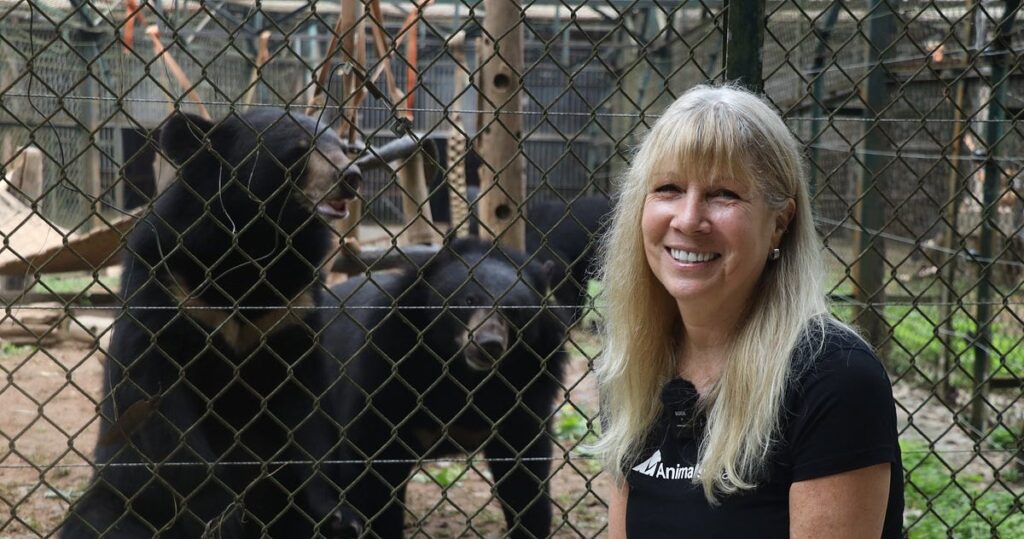
The now widely recognized “moment of connection” that catalyzed this mission has become part of modern animal welfare history. Surrounded by rows of Asiatic black bears—commonly known as moon bears—confined in restrictive metal cages designed to immobilize them for bile extraction, Robinson encountered a female bear who reached through the bars and gently clasped her hand. In an environment defined by pain, fear, and mechanical repetition, this act of contact cut through the abstraction of the industry. It was not a statistic or a distant issue—it was a direct, undeniable appeal. Robinson named the bear Hong and made a private commitment that would ultimately reshape the future of animal welfare across multiple countries. What followed was not a fleeting emotional response, but the foundation of a decades-long campaign grounded in persistence, diplomacy, and strategic intervention.
The establishment of Animals Asia in 1998 marked the formal beginning of that campaign, but its impact has extended far beyond what most advocacy organizations achieve. Under Robinson’s leadership, nearly 700 bears have been rescued from bile farms in China and Vietnam—each one transitioning from a life of confinement and repeated invasive procedures to carefully managed sanctuaries designed for rehabilitation and long-term care. These sanctuaries are not symbolic gestures; they are fully developed ecosystems that prioritize physical recovery, psychological healing, and the reintroduction of natural behaviors. The scale and sophistication of these operations have set new standards within the field, demonstrating that large-scale rescue efforts can be both humane and sustainable.
What distinguishes Robinson’s work is not only the number of animals saved, but the systemic pathways she has created to prevent future suffering. One of the most pivotal breakthroughs came in 2000, when she negotiated a landmark agreement with Chinese authorities to release 500 bears—the first formal collaboration of its kind between the Chinese government and an international animal welfare organization. This was not achieved through confrontation alone, but through a nuanced approach that combined advocacy with diplomacy, cultural sensitivity, and a long-term vision for change. It signaled a shift from isolated rescue operations to institutional engagement, opening the door for broader reforms within a system that had long resisted external pressure.
That same strategic model has driven progress in Vietnam, where Robinson secured a formal agreement with the government to eliminate bear bile farming entirely by 2026. This commitment represents one of the most significant policy advancements in the global effort to end wildlife exploitation, establishing a clear timeline for the dismantling of an industry that has operated for decades. It also reflects a growing recognition among governments that the ethical, environmental, and reputational costs of such practices are no longer sustainable in an increasingly interconnected world.
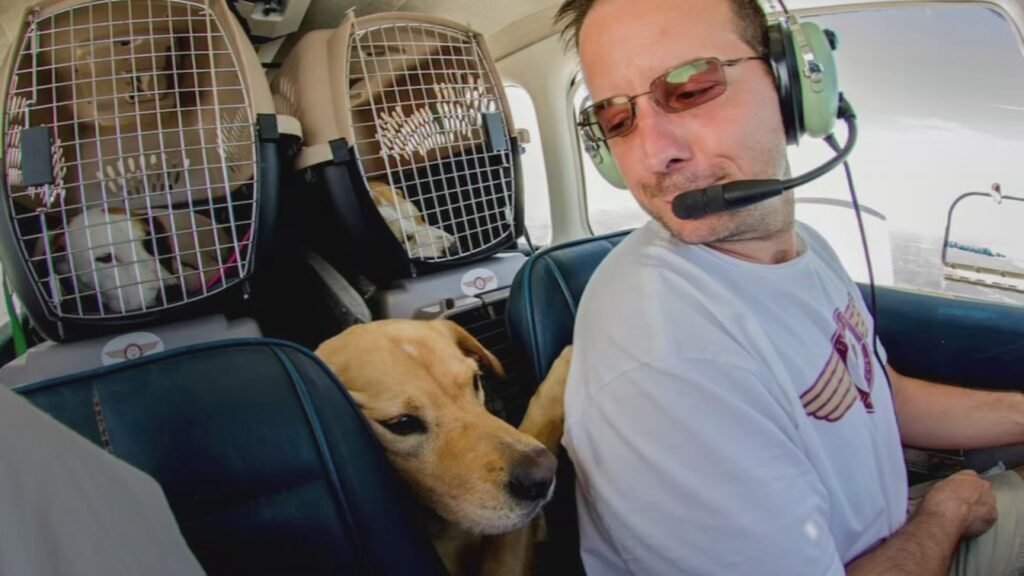
Beyond her work with bears, Robinson’s influence has extended into other areas of animal welfare that are often overlooked or marginalized. Her early development of the Dr Dog program introduced animal-assisted therapy to Asia, creating a framework for understanding animals not as commodities, but as partners in human well-being. At the same time, her continued advocacy against the dog and cat meat trades has reinforced a broader message: compassion must be consistent, and cultural norms cannot be exempt from ethical scrutiny when they involve suffering.
The recognition of Robinson’s contributions reached a new level in March 2026, when she was awarded the inaugural Jane Goodall Hope Award at a major international gathering in London. This honor is more than a personal accolade—it is a symbolic alignment between two of the most influential figures in modern animal advocacy. Both have demonstrated that meaningful change requires not only scientific understanding and public engagement, but also an unwavering commitment to confronting uncomfortable realities. The award acknowledges over three decades of leadership defined by action, resilience, and the ability to translate empathy into tangible outcomes.
What makes Robinson’s work particularly relevant in the current global context is its scalability. The methodologies she has developed—combining rescue, rehabilitation, policy negotiation, and public education—are applicable across a wide range of issues within the abuse of animals and wildlife. As industries that rely on animal exploitation face increasing scrutiny, there is a growing need for models that do more than raise awareness. They must offer viable pathways for transition, demonstrating how systems can evolve without collapse, and how humane alternatives can be implemented at scale.
This is where the broader mission of Sustainable Action Now converges with Robinson’s legacy. The fight against animal abuse is no longer confined to isolated campaigns or reactive measures. It is an integrated movement that requires coordination across sectors, from government policy and corporate accountability to grassroots advocacy and consumer behavior. The success of efforts like those led by Robinson illustrates that progress is possible when these elements are aligned toward a common goal.
At the same time, her story underscores the urgency of continued engagement. While significant strides have been made, bear bile farming has not yet been eradicated, and countless animals remain at risk within similar systems of exploitation worldwide. The momentum generated by decades of advocacy must be sustained, expanded, and adapted to address emerging challenges. This includes strengthening legal protections, increasing transparency within industries, and ensuring that enforcement mechanisms are both effective and consistent.
For readers and advocates seeking to engage more deeply with the issues surrounding the abuse of animals and wildlife, ongoing coverage and initiatives can be explored through the Sustainable Action Now platform, where the focus remains on driving measurable change and holding systems accountable. The work being done today builds directly on the foundation established by leaders like Dr. Jill Robinson, but it also requires new voices, new strategies, and a continued willingness to act.
The transformation that began with a single moment of connection has evolved into a global movement defined by persistence and purpose. It is a reminder that change does not emerge from abstraction—it begins with recognition, is sustained through action, and is realized through collective commitment. In a world where the exploitation of animals is still too often normalized, Robinson’s work stands as both a challenge and a guide. The question is no longer whether change is possible. The question is whether the world is willing to match the level of commitment required to achieve it.