
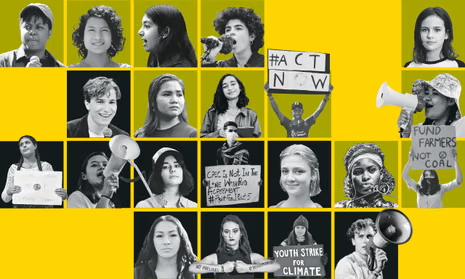
This Women’s History Month is not only a moment of reflection—it is a clear line of continuity between legacy and acceleration. The story of progress is no longer confined to the pioneers who first demanded change; it is now being actively rewritten by a new generation of young women who are stepping forward with urgency, precision, and an unyielding sense of responsibility. Across courtrooms, campuses, and public forums, these emerging leaders are not asking for permission to be heard. They are asserting their rights, challenging entrenched systems, and forcing institutions to confront the consequences of decisions that will define the livability of the planet for decades to come.
At Sustainable Action Now, the rise of youth-led advocacy—particularly among young women—represents one of the most consequential shifts within the broader environmental and human rights movement. This is not symbolic participation. It is structured, strategic, and increasingly effective. Through legal action, public engagement, and coordinated campaigns, these advocates are transforming climate justice from an abstract concept into a constitutional, enforceable reality.
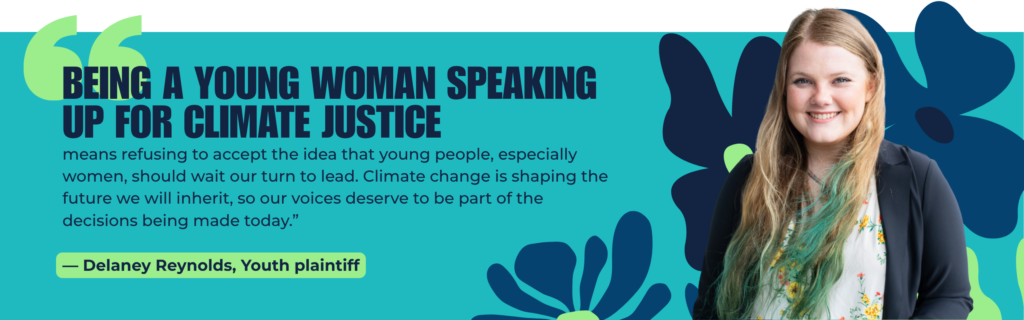
At the center of this movement are individuals who are redefining what leadership looks like in real time. Delaney Reynolds stands as a leading figure in this transformation, serving as the central plaintiff in a landmark constitutional climate case challenging the long-standing energy policies of the state of Florida. Alongside a group of young plaintiffs, she is confronting decades of systemic reliance on fossil fuels, arguing that such policies directly violate fundamental rights to life, safety, and a viable future. This is not a theoretical argument—it is grounded in lived experience, in the increasing frequency of extreme weather events, and in the tangible risks facing coastal communities.
Her advocacy extends even further, reaching into the national arena through a high-stakes legal challenge targeting federal executive actions that prioritize fossil fuel expansion while undermining renewable energy development and suppressing critical climate science. This case represents a defining legal confrontation, one that seeks to establish whether young people have the standing to challenge policies that will shape the conditions of their entire lives. It is a question that cuts to the core of democratic accountability and intergenerational justice.
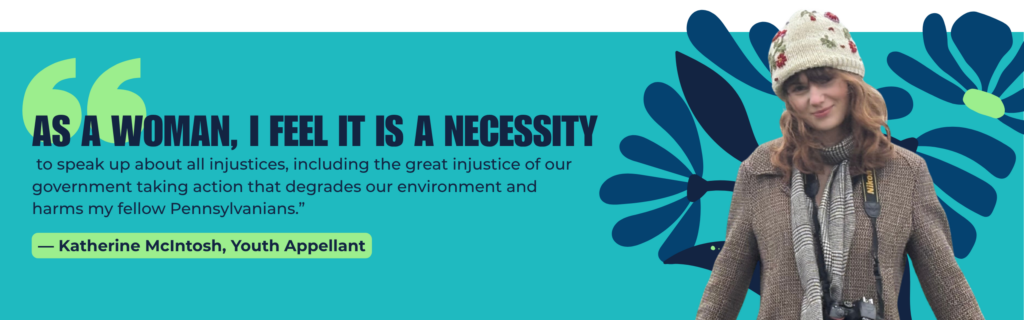
Equally impactful is the leadership of Katherine McIntosh, who is advancing a critical case in Pennsylvania that addresses the intersection of energy infrastructure, environmental protection, and public health. At issue is a proposed large-scale gas-fired power facility tied to an expansive data center development—an initiative that raises profound concerns about emissions, air quality, and long-term environmental impact. McIntosh, working alongside a coalition of young advocates, is asserting a constitutional right to clean air, pure water, and a stable climate. Her work reflects a growing recognition that environmental degradation is not a distant or isolated issue; it is immediate, local, and deeply connected to the well-being of communities.
What distinguishes these efforts is not only their ambition, but their legal sophistication. These cases are part of a broader strategy to embed climate rights within constitutional frameworks, shifting the conversation from policy preference to legal obligation. If successful, they have the potential to set precedents that extend far beyond individual states or administrations, influencing how governments across the country—and potentially the world—approach environmental governance.
The upcoming appellate hearing in Portland marks a pivotal moment in this evolving legal landscape. A group of young plaintiffs will stand before a federal appeals court to argue that they have the right to challenge executive actions that expand fossil fuel production and hinder the transition to renewable energy. This is more than a procedural milestone; it is a test of whether the judicial system will recognize the legitimacy of youth-led claims in the face of accelerating climate risks. The outcome will resonate far beyond the courtroom, shaping the trajectory of future litigation and the broader movement for climate accountability.
Surrounding this legal action is a rapidly expanding ecosystem of engagement and influence. Conferences, symposiums, and national gatherings are amplifying youth voices and integrating them into conversations that were once dominated by established political and corporate figures. In Washington, D.C., young plaintiffs are stepping onto major platforms to articulate the human rights dimensions of climate change, reframing the issue as one of equity, justice, and survival. In Los Angeles, discussions around the future of environmental policy are being shaped by the perspectives of those who will inherit the consequences of today’s decisions. These forums are not peripheral—they are central to how narratives are formed and how priorities are set.
Recognition of this work is also evolving. Events that celebrate environmental leadership are increasingly highlighting youth advocates as primary drivers of change, not as symbolic participants. This shift reflects a broader understanding that the energy, clarity, and moral authority of young leaders are essential to advancing meaningful progress. It also reinforces the idea that leadership is not defined by age or tenure, but by the willingness to act and the ability to mobilize others.
The implications of this movement extend into every aspect of society. As young women lead efforts to secure climate rights, they are also challenging the structures that have historically excluded them from decision-making processes. Their work intersects with issues of gender equity, public health, economic stability, and social justice, creating a multidimensional framework for change. This is not a single-issue movement; it is a comprehensive reimagining of how systems operate and who they serve.
For Sustainable Action Now, this moment underscores the importance of sustained visibility and engagement. The category of Our Youth is not simply a collection of stories—it is a living archive of a generation that is actively shaping the future. The individuals featured here are not waiting for incremental progress. They are demanding structural transformation, and they are building the legal, cultural, and political momentum required to achieve it.
The urgency of their work cannot be overstated. Climate change is no longer a projected threat; it is a present reality with escalating consequences. The decisions being made today will determine the conditions under which future generations live, work, and exist. In this context, the actions of young advocates are not only justified—they are essential.
What is unfolding is a fundamental shift in power dynamics. Young people are no longer positioned as passive stakeholders; they are active participants with a clear understanding of their rights and the mechanisms available to defend them. They are leveraging the legal system, engaging with policymakers, and mobilizing public support in ways that are both innovative and effective.
This Women’s History Month, the narrative is clear. The legacy of those who fought for progress in the past is being honored not through reflection alone, but through action. A new generation of young women is stepping forward with conviction, reshaping the boundaries of advocacy, and redefining what is possible. Their work is not only influencing the present—it is securing the future.
The question is no longer whether change is coming. It is whether institutions, industries, and leaders are prepared to meet the level of accountability that this generation is demanding.
| LIGHTHISER V. TRUMP HEARING IN PORTLAND On April 13, 22 youth suing the Trump administration will stand before the Ninth Circuit Court of Appeals in Lighthiser v. Trump. The case is challenging President Trump’s pro-fossil fuel executive orders that “unleash” fossil fuels, block renewable energy development, suppress critical climate science, and worsen the climate crisis. The youth are asking the Ninth Circuit to say that they have a right to be in court challenging these Executive Orders that threaten their lives. Show your support by attending the hearing in Portland and bear witness to this critical moment for children’s constitutional rights to life and liberty. WHAT: Ninth Circuit Oral Arguments in Lighthiser v. Trump WHEN: Monday, April 13, 2026 | Meet at 7:45 AM PT, Hearing Starts at 9:00 AM PT (approximately 40 min) WHERE: U.S. Court of Appeals for the Ninth Circuit, 700 SW 6th Ave, Portland, OR 97204 A watch party and rally space will be available. Details to be announced. |
| RSVP TO JOIN US IN PORTLAND TODAY! |
| FUTURES AT STAKE CONFERENCE IN D.C. On March 31st, Government Affairs Staff Attorney Liz Lee will join youth plaintiffs Delaney Reynolds and Layla Hasanzadah at Georgetown University’s Dash Conference on climate change, human rights, and youth advocacy. Register today! |
| SIERRA SYMPOSIUM IN LOS ANGELES On April 7th, Co-Executive Director Mat dos Santos will speak at the Sierra Symposium, Environmental Utopia or Dystopia: The World We Imagine for Our Children. The event also features a conversation with the Lifetime Achievement Honoree, Nancy Pelosi. Learn more here. |
| TRAILBLAZERS BALL IN LOS ANGELES On April 8th, Our Children’s Trust will be honored at the Sierra Club’s Trail Blazers Ball, celebrating leaders driving environmental and social justice. Read more about the event here. |