
The debate over capital punishment in the United States has entered another critical moment as Florida prepares to carry out multiple executions in rapid succession. Earlier today, Governor Ron DeSantis signed a death warrant for Chadwick Willacy, setting his execution for April 21 at 6 p.m. Willacy was sentenced to death for the 1990 murder of Marlys Sather, a crime that devastated her family and community.
The pain surrounding that loss remains profound and undeniable. Families who lose loved ones to violence experience trauma that reverberates across generations. Acknowledging that suffering is essential. But the difficult question confronting society today is whether executions deliver the justice they promise—or whether they deepen wounds while perpetuating cycles of violence carried out in the name of the state.
Across Florida and the broader United States, advocates, legal experts, faith leaders, and community members are increasingly grappling with this question as the state moves forward with multiple planned executions in the coming weeks.
A Rapid Sequence of Scheduled Executions
The signing of Willacy’s death warrant comes amid an unusually compressed timeline of executions already underway in Florida.
Michael King is currently facing execution scheduled for March 17 at 6 p.m. Eastern Time. Just two weeks later, another execution date looms for James Duckett on March 31. Legal developments in Duckett’s case continue to evolve rapidly, while King’s case has reached the highest judicial level in the country and is presently before the United States Supreme Court.
These overlapping cases highlight the intensity of the current moment. In the span of just over a month, Florida could carry out three executions, each raising serious legal, ethical, and procedural questions.
For many observers, this accelerated pace underscores broader concerns about the death penalty system itself—particularly whether courts, lawyers, and investigators have adequate time to examine complex evidence, constitutional claims, and evolving legal arguments.
Remembering the Victims While Questioning the System
The murder of Denise Amber Lee stands as another tragic example of the devastating impact of violent crime. Her death created an immense void in the lives of those who loved her.
Yet her story also sparked meaningful reform. The tragedy helped catalyze improvements in emergency response communication systems, leading to changes that have strengthened coordination among law enforcement agencies across Florida and beyond. These reforms ensure that Denise’s legacy continues to influence public safety and prevent future tragedies.
Acknowledging the suffering caused by violent crime does not diminish the need for justice. However, it also raises a crucial legal principle embedded within the American justice system: punishment must be administered reliably, proportionately, and in full compliance with constitutional protections.
In capital cases, where the consequences are irreversible, those standards must be applied with exceptional care.
The Complex Medical History Behind Michael King’s Case
One of the most significant issues surrounding Michael King’s case centers on a severe childhood brain injury that may have profoundly affected his neurological development.
At six years old, King suffered a traumatic head injury during a sledding accident. The sled he was riding collided violently with a wooden post, and the impact drove his face and frontal lobe directly into the beam. He was rendered unconscious and carried home bleeding from his head, nose, and mouth while family members struggled to keep him awake to prevent him from slipping into a coma.
After that moment, according to those close to him, his life changed dramatically.
King began experiencing frequent nosebleeds, vivid hallucinations, severe anxiety, and persistent academic difficulties. Family members described dramatic shifts in his personality and behavior following the injury. Neuropsychological testing conducted years later revealed structural abnormalities in his frontal lobe—the region of the brain responsible for impulse control, decision-making, and the ability to evaluate consequences.
Despite these findings, the full extent of the neurological damage was never thoroughly investigated or presented to the jury responsible for deciding whether King should receive the death penalty.
For legal scholars and criminal justice experts, this raises a fundamental question: can a death sentence be considered reliable if jurors were not given access to critical medical evidence that might have influenced their decision?
Nearly Two Decades on Death Row
Michael King has now spent almost twenty years on death row. During that time, prison records indicate he has maintained steady behavior within the institution.
He has performed maintenance and plumbing work that supports operations inside the facility and assists other incarcerated individuals. Those who have interacted with him during this time describe someone who has sought to build a structured life within the confines of incarceration.
Faith has also become a central component of King’s life over the past two decades. A spiritual advisor has visited him regularly, sometimes weekly, guiding him through religious study and reflection. King participates in religious services and engages in prison ministry activities that encourage introspection and personal accountability.
For many who have observed his journey, these experiences illustrate the possibility of transformation and personal growth—even within the harsh reality of death row.
Growing Concerns About Florida’s Execution Protocol
Beyond the legal questions surrounding individual cases, mounting scrutiny has focused on Florida’s execution procedures themselves.
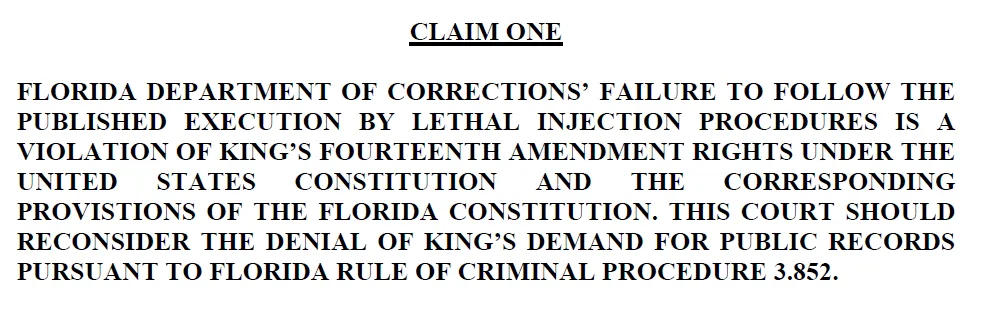
Attorneys representing individuals facing execution have raised repeated alarms regarding deviations from the state’s own lethal injection protocol. These warnings have persisted for more than one hundred days, drawing attention to discrepancies in how execution drugs are prepared and administered.
Documentation from prior executions suggests troubling inconsistencies.
During one execution, records indicate that the state prepared only about half of the required dose of the paralytic drug used in the protocol. In another case, officials reportedly prepared just over half of the drug intended to induce cardiac arrest.
These irregularities raise significant constitutional concerns, particularly under legal standards prohibiting cruel and unusual punishment.
Recent executions have also taken far longer than expected. One execution carried out last November reportedly lasted around twenty minutes, while another execution conducted just a week ago extended to approximately twenty-four minutes—nearly double the timeframe typically anticipated in lethal injection procedures.
For critics of the death penalty, these incidents reinforce fears that flawed procedures may be causing unnecessary suffering during executions.
The Irreversibility of Capital Punishment
Execution is unique among criminal penalties because it cannot be undone.
If errors emerge after an execution has taken place, the legal system has no mechanism to correct the outcome. This finality has long been central to the debate over capital punishment in the United States.
Courts have repeatedly emphasized that constitutional violations must be addressed when they occur. Yet once an execution has been carried out, those violations become permanently beyond remedy.
This reality has led many legal scholars, judges, and policymakers to question whether a system capable of human error can responsibly administer an irreversible punishment.
The Human Impact Beyond the Courtroom
Executions affect far more people than those whose names appear in court records.
Families of victims often experience renewed trauma when execution dates approach. Reliving the circumstances of a loved one’s death through media coverage and legal proceedings can reopen emotional wounds that never fully heal.
Correctional staff tasked with carrying out executions also bear a heavy psychological burden. Numerous studies have documented the emotional toll placed on prison personnel involved in the process.
Communities surrounding correctional facilities often become focal points for vigils, protests, and public gatherings as execution dates draw near. These events reflect a society wrestling with complex moral questions about punishment, accountability, and justice.
A Moment of Reflection for the Justice System
Florida’s current execution schedule has intensified national attention on capital punishment and the standards required to impose it.
Cases involving neurological injuries, evolving legal claims, and procedural questions about execution protocols illustrate the complexity of administering the death penalty within a constitutional framework.
As courts continue reviewing appeals and legal arguments, advocates across the state are urging residents to engage with the issue—whether through public dialogue, attending vigils, or participating in community discussions about the future of capital punishment.
The broader question facing the country is not only how justice should be delivered, but also what justice ultimately means in a society committed to both accountability and human dignity.
Why the National Conversation Is Growing
Across the United States, attitudes toward the death penalty have shifted significantly over the past two decades. A growing number of states have either abolished capital punishment or imposed moratoriums while reevaluating its fairness and effectiveness.
Concerns about wrongful convictions, racial disparities, inadequate legal representation, and flawed forensic evidence have fueled these changes. Advances in DNA testing have exonerated individuals who once faced execution, reinforcing the reality that mistakes can and do occur within the criminal justice system.
Florida’s current series of scheduled executions places these national debates into sharp focus.
For communities, lawmakers, and courts alike, the coming weeks represent more than a series of legal proceedings. They are a moment of reckoning about how the justice system balances accountability, fairness, and the irreversible power of the state to take a life.
A Defining Period in the Debate Over Capital Punishment
The cases of Chadwick Willacy, Michael King, and James Duckett are unfolding against a backdrop of heightened scrutiny and evolving public opinion.
Each case carries its own legal complexities and human stories. Each raises questions about evidence, due process, and the constitutional standards that must guide the most severe punishment available under American law.
As Florida moves forward with its execution schedule, the broader national conversation about capital punishment continues to grow—one that asks whether the death penalty truly serves the goals of justice, or whether it represents a system increasingly at odds with modern understandings of fairness, human rights, and accountability.
The coming weeks will not only shape the futures of the individuals whose cases are currently before the courts. They will also influence how the nation continues to examine the role of capital punishment within a justice system striving to uphold both the rule of law and the fundamental values on which it was built.