
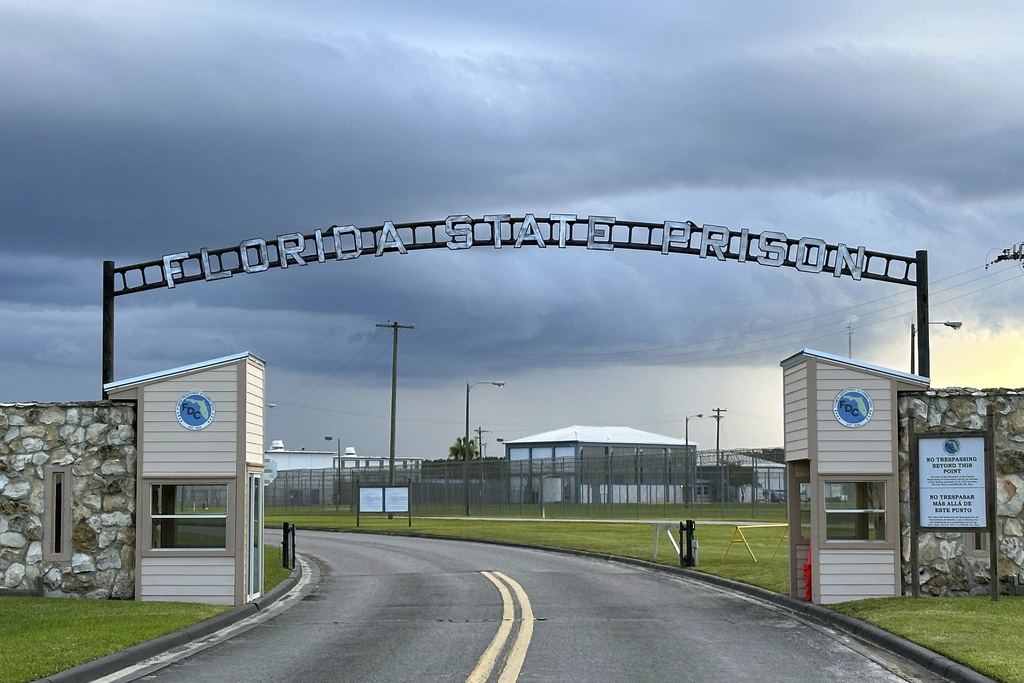
Two execution dates are now fixed on Florida’s calendar, and with them comes a renewed urgency that extends far beyond the individuals at the center of each case. Chadwick “Khalil” Willacy is scheduled to be executed on Tuesday, April 21 at 6PM. Just days later, on Thursday, April 30 at 6PM, the State plans to execute James “Erny” Hitchcock. These are not isolated events. They are part of a broader and deeply consequential pattern—one that demands immediate public attention, informed engagement, and sustained civic action.
| Chadwick “Khalil” Willacy: Execution Scheduled for Tuesday, April 21 @ 6pmSign Khalil’s Petition Send a Letter to the Governor Make Plans to Attend a Vigil Learn More About Khalil’s Case |
| James “Erny” Hitchcock: Execution Scheduled for Thursday, April 30 @ 6pmSign Erny’s Petition Send a Letter to the Governor Make Plans to Attend a Vigil Learn More About Erny’s Case |
At Sustainable Action Now, this moment is not approached as a distant legal issue. It is a call to engage directly with the mechanisms of power, accountability, and human rights. The ability of any government to carry out the ultimate punishment must be accompanied by absolute transparency, rigorous oversight, and an unwavering commitment to justice. What is unfolding in Florida raises serious questions about whether those standards are being met.
For those ready to take action, the path forward is clear and immediate. Supporters can sign Khalil Willacy’s petition, contact the Governor directly, attend organized vigils, and engage with detailed case materials through <a href=”https://sustainableactionnow.org/death-penalty/”>Sustainable Action Now</a>. The same opportunities exist for James Hitchcock’s case, where petitions, direct outreach, and public presence remain essential tools in ensuring these cases receive the scrutiny they demand. These are not symbolic gestures. They are tangible actions that shape public discourse and influence decision-making at the highest levels.
At the core of both cases lies a shared legal struggle that cuts to the heart of the issue: access to information. Both Willacy and Hitchcock have filed legal challenges seeking records related to Florida’s lethal injection protocol. This is not a procedural technicality—it is a fundamental question of whether the State is operating within its own legal and ethical boundaries when carrying out executions.
To understand the gravity of this issue, it is necessary to examine recent history. In 2025 alone, Florida carried out 19 executions. Among them was Frank Walls, whose case brought critical concerns into sharper focus. Prior to his execution, Walls filed a federal civil rights lawsuit arguing that his medical condition placed him at a heightened risk of experiencing severe pain during the execution process. Through public records requests, his legal team obtained documentation suggesting troubling inconsistencies in how executions were being conducted.
These records indicated that, in multiple cases leading up to Walls’ execution, the State used expired drugs, administered partial dosages, and introduced substances that were not authorized under its own established protocol. These are not minor deviations. They represent potential breaches of procedure that could directly impact whether an execution is carried out in a manner consistent with constitutional standards.
The outcomes of several executions during this period further intensified concern. Bryan Jennings’ execution extended to approximately 20 minutes, raising questions about the efficiency and reliability of the protocol. Tommy Gudinas exhibited visible physical distress, including prolonged convulsions, while on the execution table. In 2026, the execution of Billy Kearse lasted 24 minutes, with a prolonged period during which he remained motionless before being pronounced dead. Each of these cases contributes to a growing body of evidence that warrants deeper examination.
Yet, despite these documented concerns, both the Florida Supreme Court and the United States Supreme Court have repeatedly determined that the available records do not definitively prove wrongdoing. The courts have effectively instructed defendants to return with stronger evidence. This creates a profound structural problem. The State of Florida has since restricted access to execution-related records through public records requests, limiting the ability of individuals to obtain the very evidence required to meet the courts’ standard.
This dynamic has been described as a “Catch-22,” a term used by Justice Sonia Sotomayor to highlight the inherent contradiction. Individuals must provide proof of misconduct, yet the State controls access to the information necessary to obtain that proof. It is a closed loop that undermines the foundational principles of due process and transparency.
Chadwick “Khalil” Willacy’s case brings this issue into even sharper relief. Anticipating the challenges faced by previous defendants, Willacy and his legal team sought to proactively obtain records related to recent executions before a death warrant was issued. The intention was clear: to gather the necessary information in advance, thereby avoiding the procedural deadlock that has defined similar cases.
The outcome, however, was not what his legal team expected. Rather than receiving a response to the records request, Willacy was issued a death warrant just six days later. This sequence of events raises a critical question that now extends beyond the specifics of his case: was this timing coincidental, or does it reflect a broader pattern of response when transparency is pursued? The answer carries significant implications, not only for Willacy, but for the integrity of the system itself.
James “Erny” Hitchcock’s case introduces an additional dimension to this evolving narrative. Now 70 years old and reliant on a wheelchair, Hitchcock has spent decades on death row. Like Willacy, he is challenging the State’s refusal to provide access to execution protocol records, arguing that this lack of transparency prevents him from mounting a meaningful legal defense against the method of execution.
But Hitchcock’s appeal goes further. In a recent filing, he asserts that he is innocent of the crime for which he was sentenced to death. His claim is supported by testimony from two living witnesses who are prepared to state that another individual—his brother, who was also the victim’s stepfather—repeatedly confessed to the murder. This individual has a documented history of violence against women, including acts consistent with the circumstances of the crime in question. These assertions, now formally presented in court, add a profound layer of complexity and urgency to Hitchcock’s case.
Taken together, these two cases illuminate a system under strain. Questions of transparency, procedural integrity, and the possibility of wrongful conviction are not theoretical—they are active, unfolding issues with irreversible consequences. The decisions made in the coming weeks will not only determine the fate of two individuals, but will also signal how these broader concerns are addressed moving forward.
At Sustainable Action Now, the response to this moment is grounded in action, awareness, and accountability. The growing community surrounding this work reflects a shared understanding that change is not driven by isolated voices, but by sustained, collective engagement. Each petition signed, each letter sent, and each vigil attended contributes to a larger effort to ensure that these cases are examined with the seriousness they demand.
This is a pivotal moment. The timeline is short, but the implications are lasting. As these dates approach, the question is not whether attention is warranted—it is whether enough attention will be brought to bear in time to make a difference.
The path forward is clear. Engage with the issue. Take action through <a href=”https://sustainableactionnow.org/death-penalty/”>Sustainable Action Now</a>. Ensure that these cases are not reduced to dates on a calendar, but recognized for what they represent: a critical test of transparency, justice, and the values that define a society.
What happens next will matter.

