
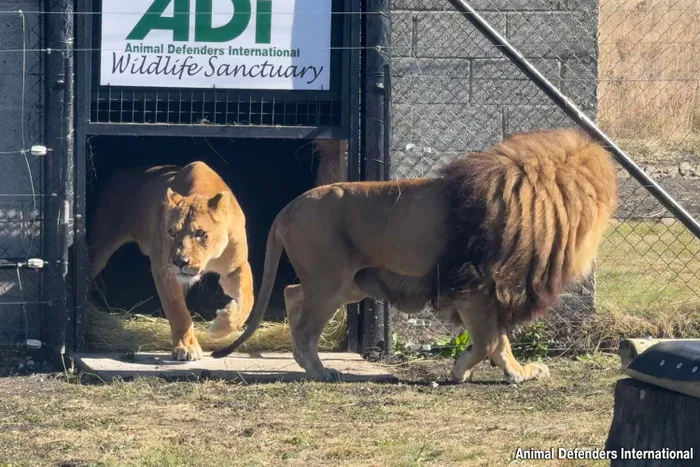
There is a profound difference between survival and living. For many of the lions and tigers now roaming freely across the vast landscapes of South Africa’s Animal Defenders International Wildlife Sanctuary, that distinction defines their entire story. Once confined to circus cages, exploited in illegal trade networks, or restricted within inadequate zoo environments, these animals have undergone a transformation that extends far beyond relocation. It is a shift from confinement to autonomy, from routine control to instinctive expression, and from a past defined by exploitation to a present shaped by recovery.
This transformation is not abstract. It is visible in the smallest moments—moments that, in another context, might seem ordinary. At the sanctuary, those moments recently took on a celebratory dimension as rescued lions and tigers engaged in an Easter-themed enrichment experience designed not for spectacle, but for stimulation. Across expansive, multi-acre habitats, brightly decorated boxes filled with hay and catnip were strategically placed, inviting exploration, interaction, and play. What followed was not a performance, but a spontaneous display of instinct: animals investigating, pawing, tearing, and fully engaging with their environment in ways that reflect both physical health and psychological renewal.
For animals that once lived in conditions defined by restriction, these behaviors carry significant meaning. Enrichment is not an accessory to care; it is a critical component of rehabilitation. It encourages movement, sharpens cognitive engagement, and supports the re-emergence of natural behaviors that may have been suppressed through years of confinement. In this context, even a simple object becomes a catalyst for expression, offering an opportunity for animals to interact with their surroundings on their own terms.
The sanctuary itself represents the culmination of years of coordinated effort, advocacy, and large-scale rescue operations. Animal Defenders International, the organization behind the facility, has built its reputation on confronting some of the most entrenched forms of animal exploitation worldwide. Their work extends across continents, targeting industries and practices that have long operated beyond the reach of effective regulation. Through a combination of investigative work, legal advocacy, and direct intervention, they have played a central role in advancing protections for animals used in entertainment and other sectors.
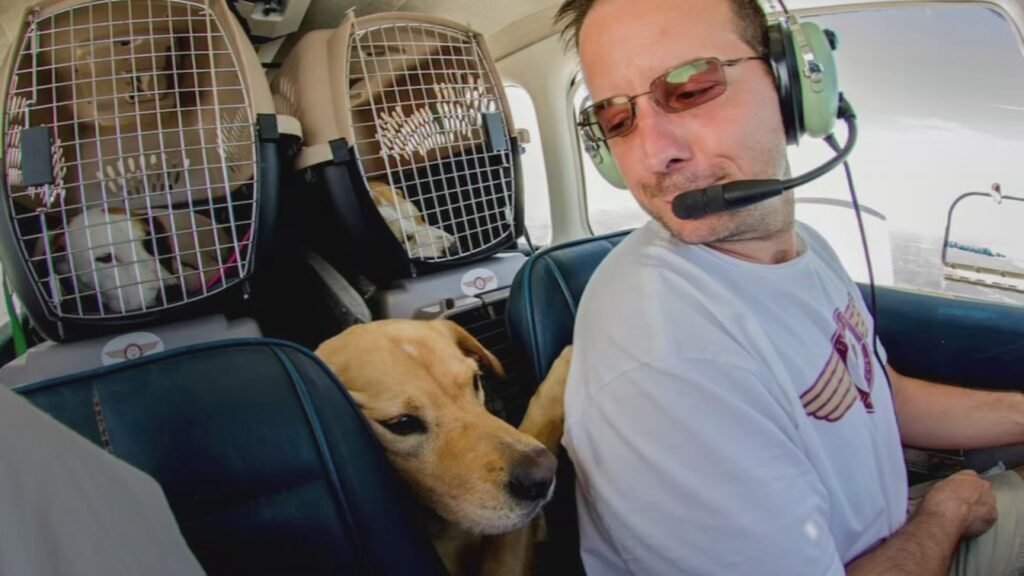
One of the defining aspects of this work is its scale. Rescue operations often involve not just individual animals, but entire populations—lions, tigers, bears, and primates—removed from environments that no longer meet even the most basic standards of care. These operations require logistical precision, from securing legal authority to coordinating transportation across international borders. In some cases, this has included record-setting airlifts, relocating dozens of large predators in a single operation to ensure their safety and long-term well-being.
The sanctuary in South Africa serves as the endpoint for many of these journeys, but it is not a final destination in the conventional sense. It is a place designed to restore conditions that approximate the natural world, within the constraints of animals that can no longer be returned to the wild. The reasons for this are complex. Years of captivity, exposure to human-controlled environments, and the loss of survival skills make reintroduction impractical and, in many cases, unsafe. The objective, therefore, is not to recreate the wild, but to provide an environment that supports the fullest possible expression of natural behavior.
Spanning hundreds of acres, the sanctuary offers space, variation, and autonomy—elements that are essential for large predators. Unlike traditional enclosures, these habitats are structured to encourage exploration and movement, allowing animals to establish their own routines and interactions. The result is a dynamic environment where behavior is not dictated by confinement, but shaped by instinct.
The Easter enrichment activity is emblematic of a broader philosophy that guides the sanctuary’s approach. Care is not limited to meeting physical needs; it extends to creating experiences that engage and stimulate. For animals that have endured prolonged periods of monotony, the introduction of novelty—whether through objects, scents, or environmental changes—plays a vital role in maintaining mental and emotional health.
This approach reflects an understanding that recovery is not a single event, but an ongoing process. It requires continuous adaptation, observation, and refinement, ensuring that each animal’s needs are met as they evolve. The visible outcomes—playful behavior, increased activity, and social interaction—are indicators of progress, signaling that the environment is effectively supporting rehabilitation.
The broader implications of this work extend beyond the sanctuary itself. Each rescue, each relocation, and each successful rehabilitation contributes to a larger shift in how animals are treated and valued. It challenges the systems that enabled exploitation and demonstrates that alternative models—grounded in care, respect, and sustainability—are both viable and effective.
This perspective is reinforced across ongoing initiatives highlighted within Sustainable Action Now’s rescue network coverage, where the focus remains on scaling impact and strengthening the infrastructure needed to support complex rescue operations. The goal is not only to respond to individual cases, but to build a global framework capable of addressing systemic issues in animal welfare.
Public engagement plays a critical role in sustaining this work. Opportunities to support sanctuaries, whether through donations, symbolic adoptions, or educational visits, create a direct connection between individuals and the outcomes they help enable. These contributions are not peripheral; they are integral to maintaining the resources required for ongoing care, future rescues, and the continued expansion of sanctuary environments.
What makes the story of these lions and tigers particularly compelling is not only the scale of their rescue, but the clarity of their transformation. The contrast between their past and present is unmistakable. Where there was once confinement, there is now space. Where there was routine, there is now choice. Where there was silence, there is now movement, interaction, and expression.
The image of a lion or tiger engaging with its environment—rolling, exploring, or dismantling an enrichment object—captures more than a moment of activity. It represents a reclaiming of identity, a return to behaviors that define the species. It is a visible affirmation that, even after years of hardship, the capacity for recovery remains.
As global awareness of animal welfare continues to grow, the importance of sanctuaries like this becomes increasingly evident. They are not only places of refuge, but centers of transformation, demonstrating what is possible when systems are redesigned with intention and care.
In the end, the significance of these Easter moments extends far beyond the event itself. They are markers of progress, reminders of resilience, and evidence of what can be achieved when intervention is matched with commitment. For the lions and tigers now thriving within these landscapes, the past is no longer the defining narrative. What defines them now is movement, space, and the freedom to live in a way that aligns, as closely as possible, with the nature they were always meant to express.