
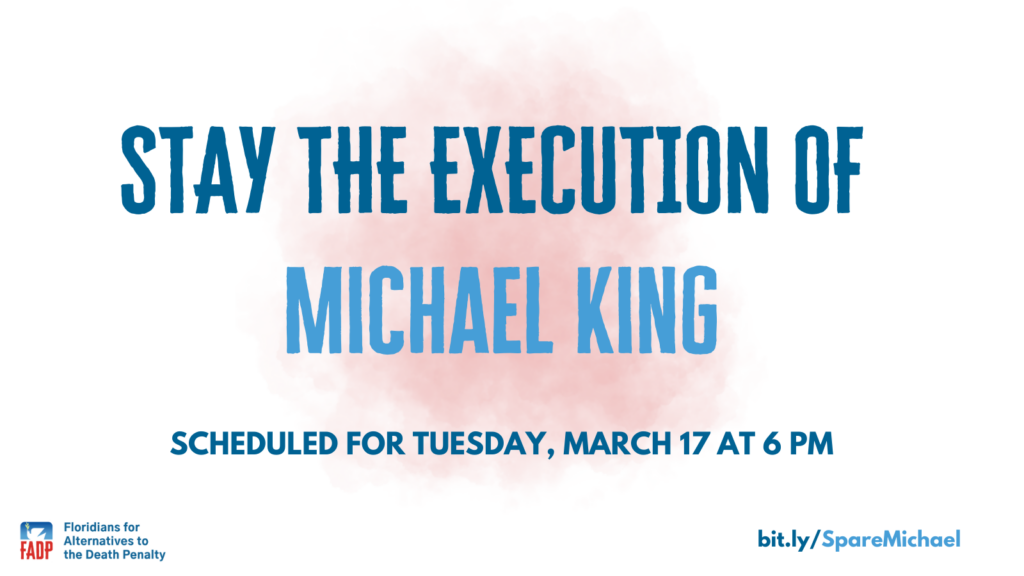
Earlier this week, Florida Gov. Ron DeSantis signed a death warrant for Michael Lee King, who was sentenced to death for the 2008 abduction and murder of Denise Amber Lee—a horrific crime that ended a young woman’s life and devastated her loved ones. King’s execution is scheduled for March 17, 2026, at Florida State Prison. Sign The Petition Now.
For Sustainable Action Now, this is not a story about excusing violence or minimizing loss. It’s a story about what “justice” is supposed to accomplish—and whether state executions deliver safety, healing, or accountability, or whether they compound trauma and expand government power in ways that ultimately undermine community wellbeing.
At the same time, the political ground under the death penalty is shifting in unexpected ways. A growing coalition of conservatives, libertarians, and Republican leaders is increasingly questioning capital punishment—not from a soft-on-crime posture, but from core right-of-center concerns: government overreach, fiscal waste, and irreversible error.
This moment sets up a wider national conflict: as parts of the Trump political ecosystem push to accelerate executions and narrow barriers to carrying them out, the conservative anti-death-penalty movement is sharpening its argument that the state should not hold (or use) the ultimate power.
And that clash is now playing out in Florida.
What Happened in Florida and Why It Matters Now
The case at the center of this renewed public attention is profoundly painful. Denise Amber Lee’s murder remains one of Florida’s most heartbreaking crimes of the last generation, and any serious conversation must begin by acknowledging the permanent harm done to her and her family.
But the signing of a death warrant does more than schedule a date. It reactivates an entire machinery—legal, political, institutional, psychological—that touches far more people than the condemned person alone. Executions engage corrections staff, attorneys, judges, law enforcement, witnesses, media, and the families of both victims and defendants. That’s one reason why many advocates argue the death penalty doesn’t “close” trauma—it often reopens it, sometimes repeatedly, for years.
Florida’s death warrant also lands in a national environment where executions and execution methods have become newly contentious—legally, medically, and morally—and where public support has continued to erode even as some elected officials push harder in the opposite direction. Sign The Petition Now.
The Sustainable Action Lens: Safety, Healing, and the Long-Term Health of Communities
At SAN, sustainability isn’t limited to emissions and ecosystems. It’s also about whether our systems reduce harm over time—or institutionalize it.
A sustainable justice system should aim to:
- Protect the public effectively
- Honor victims without exploiting their suffering
- Reduce violence, rather than normalize it
- Use public funds responsibly
- Prevent irreversible failures in life-and-death decisions
The death penalty, critics argue, struggles on every one of these measures.
Even among people who believe severe punishment is warranted, there’s a serious question: does an execution actually make communities safer, or does it function as a ritual of retribution that diverts attention (and resources) from what reduces harm in the real world—prevention, rapid response, effective investigation, victim services, and evidence-based corrections?
The Quiet Conservative Revolt: Four Pillars Driving Opposition to the Death Penalty
What’s changing the conversation—especially in red states—is that opposition is no longer confined to progressive circles. Conservatives Concerned About the Death Penalty (often abbreviated as CCATDP) has helped organize a distinctly right-of-center critique that is increasingly influential in state-level debates.
Here are the four arguments that are moving the needle:
1) Distrust of Government: “If government can’t do the basics, why trust it with life and death?”
This is the philosophical core for many conservatives. If people distrust bureaucracy, incompetence, politicization, and institutional bias in other areas, granting the state the ultimate, irreversible power becomes a contradiction in principle.
2) Fiscal Responsibility: Capital cases cost more than life without parole
Capital punishment is not the “cheap” option. The legal complexity required (appeals, specialized counsel, heightened procedural requirements) typically drives far greater costs than life sentences. Many conservatives argue: if the outcome is not meaningfully different for public safety, the price tag is unjustifiable.
3) Pro-life consistency: A “consistent life ethic”
A growing segment of right-of-center advocacy frames opposition as consistent with valuing human life—even when that person has committed a terrible crime. This doesn’t mean ignoring victims; it means arguing the state should not answer killing with killing.
4) Irreversible Error: Innocence is not theoretical
Since 1973, at least 200 people have been exonerated after being sentenced to death—an extraordinary statistic for anyone concerned about irreversible government action.
This point doesn’t require claiming any particular individual is innocent. It’s a systems argument: if the process is fallible—and it is—then the punishment cannot be justified because it cannot be undone.
Public Opinion Is Shifting—Even as Political Pressure Intensifies
While the death penalty remains politically popular in some quarters, overall U.S. support has dropped to a five-decade low in recent national polling. In October 2025, Gallup found 52% support—among the lowest levels since the early 1970s.
That decline matters because it suggests a growing gap between what some officials pursue and what the country is increasingly willing to endorse—especially as younger voters become less convinced that executions deter crime or represent an effective, moral response to violence.
This is the broader arena Florida is stepping into: a national debate where the death penalty is simultaneously being pushed harder by some political leaders and questioned more deeply by an expanding coalition that includes conservatives. Sign The Petition Now.
What an Execution Can’t Do—and What Communities Actually Need
Supporters of the death penalty often talk about closure and justice. But closure is not a policy outcome; it’s a human process. Many families find peace through remembrance, community, and support. Others experience renewed suffering through the prolonged churn of capital litigation and execution scheduling.
Meanwhile, the public safety case is complicated. Even many Republicans now question whether the death penalty functions as an effective deterrent compared to life without parole and robust prevention strategies. And the “deterrence” debate often obscures what victims’ families consistently need regardless of ideology:
- immediate and long-term trauma-informed services
- stable funding for victim advocacy
- accountable, competent investigations and prosecutions
- policies that reduce violence upstream
A sustainable justice approach prioritizes interventions that measurably reduce harm—rather than symbolic actions that risk widening it.
A Florida Flashpoint in a National Reassessment
The DeSantis death warrant for Michael Lee King is likely to intensify public debate in Florida and beyond—not only because of the gravity of the underlying crime, but because it arrives at a moment when the death penalty is being re-litigated in the public conscience.
This case also highlights a reality that both supporters and opponents often overlook: capital punishment is not a single decision. It is an entire governmental apparatus—expensive, prolonged, traumatic, and irrevocable.
And in a period defined by systemic strain—courts, corrections, budgets, trust in institutions—many Americans, including conservatives, are asking whether expanding that apparatus is truly the best we can do in the name of justice.
How SAN Readers Can Engage Constructively
Sustainable Action Now exists to promote action that reduces harm and strengthens communities over time. If this issue moves you—whether your priority is public safety, victims’ rights, government restraint, or the moral direction of policy—engagement matters when it’s grounded in facts, dignity, and a commitment to outcomes that actually improve lives.
To explore SAN’s broader coverage and action-focused posts, visit <a href=”https://sustainableactionnow.org/category/climate/”>SAN’s climate and systems-impact reporting</a> and <a href=”https://sustainableactionnow.org/category/recipes/”>SAN’s recipes</a>—because sustainability is ultimately about how we build daily life: what we normalize, what we fund, and what we refuse to accept as “inevitable.”
If you’re seeking to learn more about conservative-led death penalty reform arguments, you can also review the work of <a href=”https://conservativesconcerned.org/”>Conservatives Concerned About the Death Penalty</a>.
The Defining Question
Denise Amber Lee deserved to live. Her loved ones deserved a future untouched by the worst kind of loss. Nothing can restore what was taken.
But the question Florida now confronts—amid an evolving national landscape—is whether an execution in 2026 delivers justice that heals, or whether it extends violence through the power of the state.
That is the courtroom—and moral—clash at the center of America’s death penalty debate right now: not whether crime should be condemned, but whether state-sanctioned killing is a sustainable, defensible, and humane instrument of justice in a society that claims to value life. Sign The Petition Now.