
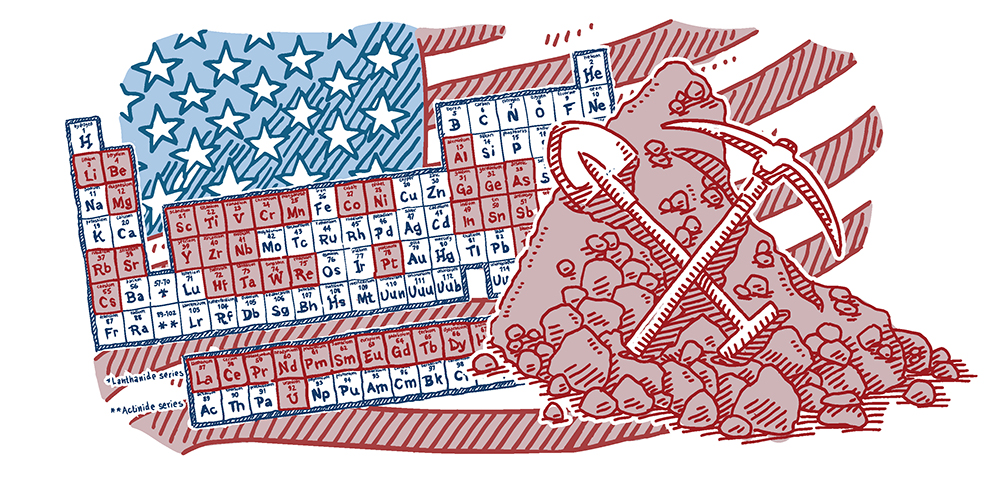
On February 4, 2026, the U.S. House of Representatives narrowly approved H.R. 4090, the Critical Mineral Dominance Act, a sweeping piece of legislation aimed at dramatically expanding domestic mining of so-called “critical minerals” and reducing America’s dependence on foreign suppliers—particularly China.
The bill passed by a vote of 224–195 and now moves to the U.S. Senate, where it is expected to ignite a high-stakes debate over how the United States should balance national security, climate goals, public-land protection, and environmental justice.
At Sustainable Action Now, we track legislation like this closely because decisions made under the banner of energy independence and supply-chain security can either accelerate a responsible clean-energy transition—or deepen long-standing patterns of environmental harm, extractive industry favoritism, and weakened public oversight. This proposal now sits squarely at the intersection of climate policy, industrial strategy, and the future of environmental regulation.
As part of our ongoing coverage of climate and environmental policy, this report examines what the Critical Mineral Dominance Act actually does, why it is being advanced so aggressively, and why many environmental and conservation advocates are sounding the alarm.
What the Critical Mineral Dominance Act is designed to do
H.R. 4090 is built around a single overarching goal: rapidly scale up domestic production of critical minerals in order to reduce U.S. dependence on foreign supply chains—especially those connected to China.
“Critical minerals” include materials such as lithium, cobalt, nickel, rare earth elements, and other inputs widely used in advanced manufacturing, defense systems, electronics, and renewable-energy technologies.
Supporters of the legislation argue that America’s current reliance on imported minerals represents both an economic vulnerability and a national security risk.
The bill now awaiting Senate consideration would significantly reshape how mining projects on U.S. public lands are reviewed, approved, and regulated.
Codifying past executive orders into permanent law
One of the most consequential elements of the Critical Mineral Dominance Act is its effort to permanently embed several Trump-era executive orders into federal statute.
These executive orders were originally issued under the banner of “unleashing American energy” and boosting domestic mineral production. Under H.R. 4090, those directives would no longer be temporary policy preferences of a prior administration—they would become binding law.
This shift matters. Codification limits the ability of future administrations to reverse or modify these approaches without passing new legislation, effectively locking in a deregulatory mining framework for years to come.
Fast-tracking mining projects on public lands
The bill directs the U.S. Department of the Interior to identify so-called “priority” mining projects located on federal lands and place them on an expedited approval track.
Under the legislation, the Department would be required to identify these priority projects in as little as 10 days.
For environmental organizations, tribal governments, and community advocates, this compressed timeline raises serious concerns. Large-scale mining projects routinely involve complex ecological impacts, water contamination risks, wildlife habitat disruption, and long-term land degradation. Compressing the early stages of project review dramatically reduces the opportunity for meaningful scientific analysis and public input.
Rolling back “undue burdens” on mining
H.R. 4090 also directs the Department of the Interior to review existing agency actions—rules, guidance, and regulatory decisions—and identify which ones allegedly impose “undue burdens” on mining projects.
Once identified, the agency would be instructed to suspend, revise, or rescind those actions.
The bill does not clearly define what qualifies as an “undue burden,” a phrase that critics argue creates an open-ended mandate for regulatory rollback. Environmental review requirements, public comment procedures, mitigation standards, and land-use protections could all become targets under this framework.
For conservation and environmental justice advocates, this provision represents one of the most troubling aspects of the legislation.
Expanding geological mapping to locate new deposits
Another key component of the bill mandates expanded geological mapping efforts to identify previously unknown hard-rock mineral deposits across the United States.
While mapping itself is not inherently harmful, opponents argue that the intent of the provision is clear: to open new areas—many of them on or near public lands and sensitive ecosystems—to future mining development.
Expanded mapping is also expected to drive private-sector investment into regions that have historically resisted extractive industries because of environmental or cultural concerns.
New reporting on mineral imports and economic exposure
The legislation would require annual federal reports detailing the dollar value and economic impact of U.S. reliance on imported minerals.
Supporters say this provision will help policymakers better understand supply-chain vulnerabilities and justify future domestic investments.
Critics counter that the reporting framework focuses heavily on economic exposure while failing to require similar assessments of environmental cost, public-health impact, or long-term cleanup liabilities associated with domestic mining expansion.
Why supporters are pushing the bill
Supporters of the Critical Mineral Dominance Act frame the bill as essential to national security and industrial competitiveness.
They point to China’s dominant role in global mineral supply chains, noting that China currently controls approximately 60 percent of global production and roughly 90 percent of mineral processing capacity.
From this perspective, expanding U.S. mining is portrayed as an urgent strategic necessity. Proponents argue that without rapid domestic development, the United States risks falling further behind in advanced manufacturing, military readiness, and clean-energy deployment.
The White House has formally endorsed the bill through a Statement of Administration Policy supporting its passage, adding political momentum as the legislation moves into the Senate.
Why environmental and conservation groups oppose the bill
Opposition to H.R. 4090 has been led by many House Democrats, national conservation organizations, and public-lands advocates.
Critics argue that the bill hands extraordinary power to the mining industry while weakening the regulatory safeguards that protect public lands, water resources, and surrounding communities.
Groups such as the National Parks Conservation Association have raised direct concerns that fast-tracking projects and rolling back regulatory protections could expose national parks, surrounding ecosystems, and culturally significant landscapes to increased industrial pressure.
Equally important, opponents argue that the bill fails to prioritize the minerals most urgently needed for a genuine clean-energy transition. Instead of focusing narrowly on materials required for renewable power, battery storage, and grid modernization, the legislation broadly promotes mineral extraction for defense and industrial use without meaningful environmental guardrails.
For climate advocates, this raises a fundamental concern: the bill risks becoming an extractive-industry expansion package disguised as a climate-and-security initiative.
The climate contradiction at the heart of the bill
There is no serious dispute that clean-energy infrastructure—from electric vehicles to renewable power storage—requires mineral inputs. However, the path toward climate solutions cannot simply replicate the same extractive practices that have historically damaged ecosystems and frontline communities.
The Critical Mineral Dominance Act does not meaningfully integrate environmental justice protections, tribal consultation requirements, or long-term reclamation and cleanup funding standards into its expedited framework.
Instead, the legislation prioritizes speed and volume of extraction.
This approach presents a central contradiction in current U.S. climate policy: how to accelerate the clean-energy transition without creating a new generation of environmental sacrifice zones.
Mining, particularly hard-rock mining, carries well-documented risks of groundwater contamination, acid mine drainage, heavy-metal pollution, and irreversible habitat destruction. These impacts do not disappear simply because the minerals are used in technologies labeled “green.”
What happens next
With House passage secured, the Critical Mineral Dominance Act now moves to the Senate, where committees and leadership will determine whether the bill advances in its current form or is amended.
For environmental advocates and community leaders, the Senate debate represents a critical opportunity to demand stronger protections, transparency, and public participation.
At Sustainable Action Now, our climate reporting continues to follow how federal policy shapes the future of land use, energy infrastructure, and environmental protection. The outcome of H.R. 4090 will signal whether lawmakers are willing to pursue climate-aligned industrial policy without sacrificing public lands, biodiversity, and community health.
The United States does need a resilient and ethical mineral supply chain. But resilience cannot come from regulatory shortcuts that shift environmental risk onto communities and ecosystems already under strain.
As Congress weighs the Critical Mineral Dominance Act, the question is not whether America should reduce its reliance on foreign minerals. The real question is whether it can do so without undermining the very environmental and climate values it claims to defend.