There are moments in global animal welfare that redefine what progress truly looks like. Not through policy alone, not through headlines, but through the transformation of a single life.
Samba’s story is one of those moments.
After years of exploitation, confinement, and forced performance, her journey has taken a decisive and powerful turn—one that reflects both the challenges and the possibilities within today’s global rescue network. At Sustainable Action Now, this is exactly the kind of story that matters: not just because of where it ends, but because of what it reveals about how far we still have to go—and how much can change when systems finally work.
A Life Defined by Exploitation
For years, Samba—alongside another tiger named Kenya—was subjected to a life that no wild animal should ever experience.
They were forced to perform unnatural tricks in a circus environment, stripped of autonomy, and conditioned to respond to human demands rather than their natural instincts. This kind of exploitation is not just physical—it is psychological. Big cats, particularly tigers, are highly intelligent, territorial animals that require space, stimulation, and control over their environment.
In circus settings, those needs are systematically denied.
Even after Slovakia implemented a ban on the use of wild animals in circuses, Samba’s ordeal did not immediately end. Instead, she remained confined in a cramped trailer for an additional year and a half—a stark reminder that legislation alone does not guarantee immediate relief.
This gap between policy and practice is one of the most persistent challenges in global animal welfare.
The Turning Point: January 2025
Everything changed in January 2025.
Through coordinated rescue efforts, Samba was transferred to FELIDA Big Cat Sanctuary—a specialized facility designed to provide lifelong care for rescued big cats who have endured exploitation, neglect, or trauma.
This transition was not just a relocation. It was a complete redefinition of her existence.
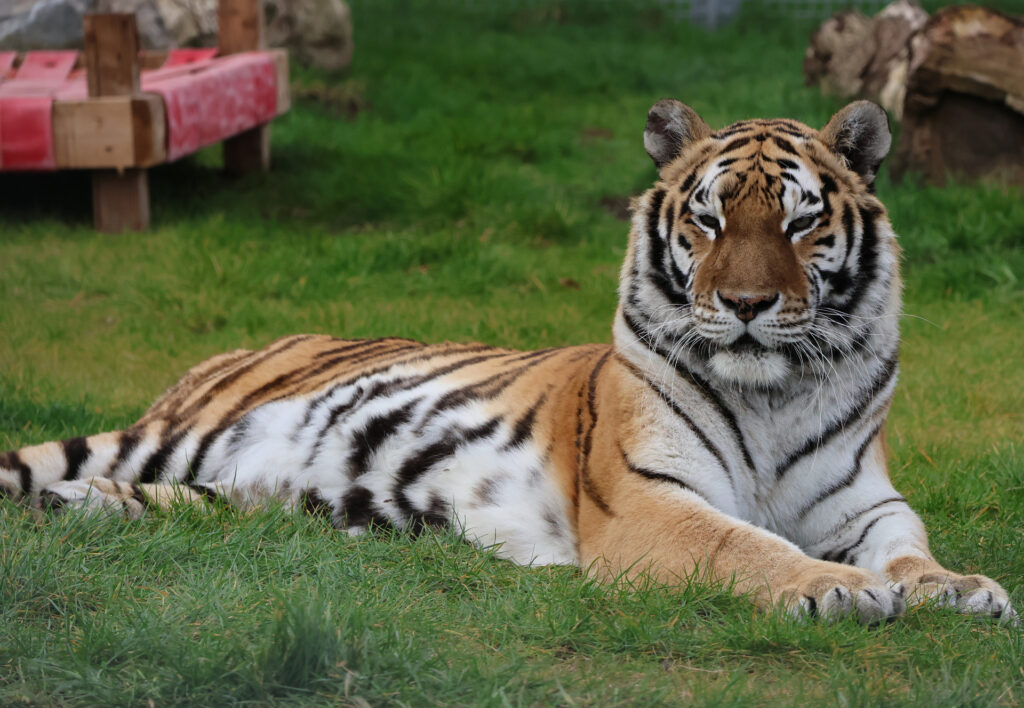
At FELIDA, Samba entered an environment built around her needs rather than human entertainment. Space replaced confinement. Care replaced control. And for the first time, she was given the opportunity to simply be a tiger.
Inside FELIDA: A Model for Ethical Big Cat Care
FELIDA Big Cat Sanctuary represents a new standard in how rescued wild animals are treated.
Unlike traditional captivity models, the sanctuary prioritizes rehabilitation, enrichment, and long-term well-being. Enclosures are designed to simulate natural habitats, allowing animals to explore, rest, and engage with their surroundings in ways that align with their instincts.
For Samba, this means access to space—real space. Not a cage, not a trailer, but an environment where movement is unrestricted and choice is restored.
It also means structured enrichment.
Enrichment is not optional in modern sanctuaries—it is essential. It includes activities and environmental features that stimulate natural behaviors, from scent tracking and exploration to play and rest cycles. For an animal that has spent years performing repetitive, unnatural tasks, this kind of stimulation is transformative.
It rebuilds both physical health and psychological stability.
From Performance to Presence: A New Daily Reality
Today, Samba’s life looks fundamentally different.
She is no longer a performer. There are no routines, no forced interactions, no expectations placed on her behavior for human benefit. Instead, her days are defined by discovery.
She explores her environment. She engages with enrichment activities. She rests when she chooses. She moves freely within a space designed for her well-being.
This shift—from performance to presence—is one of the most important indicators of successful rehabilitation.
It reflects a return to autonomy, even within the structured environment of a sanctuary.
The Broader Implications: What Samba’s Story Reveals
While Samba’s transformation is deeply personal, it also highlights systemic realities within the global rescue network.
First, it underscores the limitations of legislation without enforcement. Slovakia’s ban on wild animals in circuses was a critical step, but the delay in removing Samba from confinement illustrates how implementation gaps can prolong suffering.
Second, it demonstrates the importance of specialized sanctuaries. Not all facilities are equipped to handle the complex needs of rescued big cats. Sanctuaries like FELIDA provide the expertise, infrastructure, and long-term commitment required for true rehabilitation.
Third, it reinforces the role of coordinated rescue efforts. Transferring an animal like Samba is not a simple process—it involves logistics, legal frameworks, veterinary care, and cross-organizational collaboration.
These systems must function together to create meaningful outcomes.
The Evolution of Animal Welfare Standards
Samba’s story also reflects a broader shift in how society views the use of wild animals for entertainment.
Circuses that rely on animal performance are increasingly being phased out, replaced by models that do not involve exploitation. Public awareness has grown, and with it, expectations.
What was once normalized is now being challenged.
This shift is not complete, but it is accelerating.
And each successful rescue adds momentum.
Why Rescue Networks Matter More Than Ever
At Sustainable Action Now, the focus on rescue networks is intentional.
These networks represent the operational backbone of animal welfare. They are where policy meets practice, where advocacy becomes action, and where individual lives are changed.
Without them, legislation remains theoretical.
With them, change becomes tangible.
Samba’s journey from a circus trailer to a sanctuary habitat is a direct result of these systems functioning effectively.
A Future Built on Accountability and Care
Looking ahead, the goal is not just to rescue individual animals—it is to eliminate the conditions that make rescue necessary in the first place.
This means stronger enforcement of existing laws. It means continued pressure to end exploitative practices. And it means sustained support for sanctuaries that provide lifelong care.
It also means recognizing that every rescue is both an end and a beginning.
An end to suffering.
And a beginning of responsibility.
The Power of One Story
Samba’s story is not isolated, but it is powerful.
It captures the full arc of animal welfare—from exploitation to rescue to rehabilitation. It highlights the gaps that still exist and the systems that are working to close them.
Most importantly, it shows what is possible.
Because behind every policy, every organization, and every network, there are individual lives at stake.
And when those lives change, the impact is undeniable.
At Sustainable Action Now, we will continue to bring these stories forward—not just to inform, but to drive awareness, accountability, and action.
Because progress is not measured by intention.
It is measured by outcomes.
And for Samba, that outcome is finally what it should have been all along: freedom, care, and the space to simply live.