
On the streets, weakness can be fatal.
For stray dogs, survival depends on appearing strong, alert, and unbreakable—even when they are carrying injuries that would bring most humans to their knees. That was the case with Mario, a homeless dog who tried to project resilience while silently enduring a devastating, long-untreated injury.
It was only after he was brought to safety that the full truth was revealed.
At Sustainable Action Now, through our Rescue Network platform, we are highlighting Mario’s story as both a powerful rescue narrative and a sobering reminder of what countless animals endure without intervention. His journey from concealed suffering to medical recovery underscores why street animal rescue remains one of the most urgent and underfunded aspects of animal welfare.
The Illusion of Strength: Why Stray Dogs Hide Pain
Animals living on the streets operate under constant threat. Competition for food, territorial conflicts, exposure to vehicles, and human hostility shape daily survival. In that environment, vulnerability can invite aggression.
Dogs instinctively mask pain. It is a biological defense mechanism rooted in evolutionary survival. Limping, slowing down, or vocalizing distress can signal weakness to other animals or humans who might exploit it.
When rescuers first encountered Mario, there were no obvious signs of catastrophic injury. He carried himself as if he were simply another wary stray navigating urban terrain.
But once he arrived at CARES and was able to relax in a controlled environment, the signs became undeniable. His posture shifted. His movements stiffened. His discomfort surfaced.
What an X-ray revealed confirmed what his body had been hiding: Mario had been living with a severe injury that had never healed properly.
For how long? No one can say with certainty. Long enough to reshape bone. Long enough to cause chronic pain. Long enough to demonstrate extraordinary endurance.
The Role of Diagnostic Care in Street Rescues
Without diagnostic imaging, many internal injuries go undetected. Street dogs often suffer fractures from vehicle collisions, blunt trauma from abuse, or untreated wounds that calcify and deform.
In Mario’s case, the X-ray was transformative. It turned speculation into evidence. It allowed veterinarians to develop a treatment plan rooted in clinical assessment rather than assumption.
Rescue work is not just about removing an animal from danger. It is about comprehensive medical evaluation. That includes bloodwork, imaging, pain management, surgical intervention when necessary, and long-term rehabilitation.
Each step carries financial cost. Each step requires professional expertise.
And each step gives an animal like Mario the chance to live without agony.
From Street Survival to Structured Healing
Once his injury was diagnosed, Mario’s recovery began in earnest. Pain management became immediate priority. Stabilization followed. Veterinary teams assessed whether surgical correction or long-term therapeutic management would offer the best outcome.
Healing for animals who have lived in chronic pain is not instantaneous. Muscles adapt to compensation. Joints stiffen. Behavioral trust erodes. Trauma reshapes instinct.
But in a safe environment, something remarkable happens. The body relaxes. The nervous system recalibrates. The defensive posture fades.
Mario’s transformation was not only physical—it was psychological.
And he was not alone.
The Super Mario Bros: Recovery in Pairs
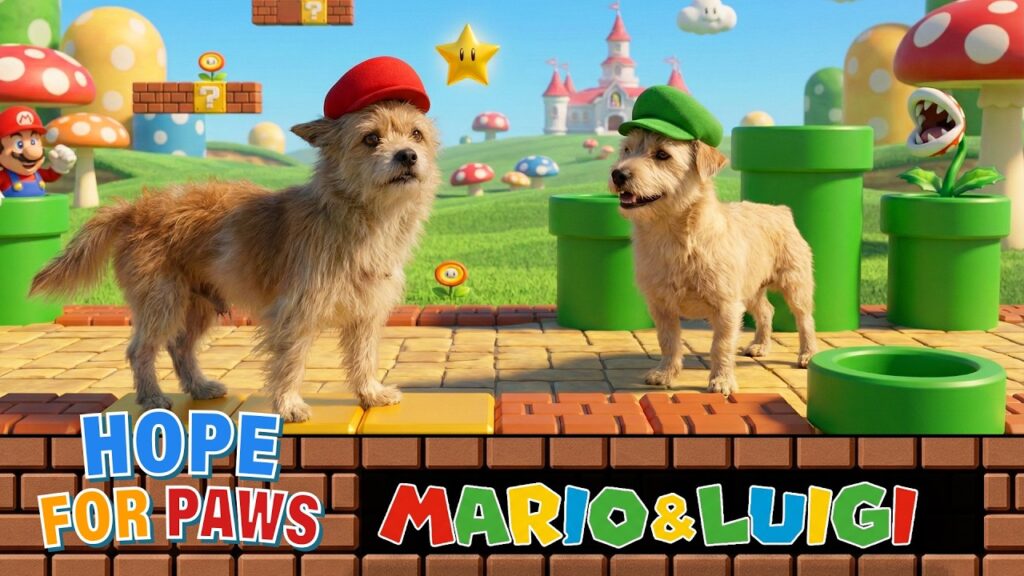
Mario and Luigi—now affectionately known as the “Super Mario Bros”—are currently in a foster home through collaboration with L.A. Animal Rescue. Foster environments are critical transitional spaces between emergency medical stabilization and permanent adoption.
In foster care, rescued animals experience domestic routines. They learn consistency. They rediscover play. They begin to trust.
For dogs recovering from trauma, companionship can accelerate emotional healing. Whether bonded by shared experience or proximity in rescue, pairs like Mario and Luigi often rebuild confidence together.
Foster networks serve as the connective tissue of rescue ecosystems. Without them, shelter overcrowding would limit intake capacity. With them, individualized recovery becomes possible.
The Financial Reality of Medical Rescue
Stories like Mario’s often circulate as heartwarming social media updates. What is less visible is the infrastructure required to make them possible.
Street rescue organizations depend on:
Veterinary partnerships
Emergency transport logistics
Diagnostic equipment
Surgical teams
Medication supplies
Rehabilitation support
Foster placement networks
Each rescue involves coordination, cost, and long-term commitment. The visible moment of extraction from the street is only the beginning.
Organizations such as Hope for Paws rely on direct public support to fund advanced medical care for cases like Mario’s. Without donor contributions, X-rays do not happen. Surgeries are delayed. Pain persists.
When people contribute, they are not funding sentiment—they are funding measurable intervention.
Why Street Dog Rescue Is a Global Issue
Mario’s story is emblematic of a larger crisis. Globally, hundreds of millions of dogs live without stable shelter. Urban expansion, economic instability, and inadequate spay-neuter programs contribute to growing stray populations.
Street dogs face:
Vehicle trauma
Intentional abuse
Untreated disease
Parasitic infections
Malnutrition
Extreme weather exposure
Many endure injuries for months or years before rescue—or die without intervention.
The Rescue Network exists to amplify stories that demonstrate what happens when intervention succeeds.
Adoption as the Final Chapter
The ultimate goal of rescue is not temporary safety—it is permanence.
Mario and Luigi are now seeking loving, stable homes through L.A. Animal Rescue. Adoption represents the final transformation: from survival mode to belonging.
For adopters, welcoming a rescued dog carries profound responsibility and reward. It means providing:
Consistent veterinary care
Emotional security
Physical activity
Structure and training
Lifelong commitment
For dogs like Mario, it means no longer having to pretend to be tough.
It means pain-free movement. It means sleep without fear. It means affection without calculation.
The Psychological Toll of Hidden Pain
There is a deeper layer to Mario’s story that extends beyond physical injury. Chronic pain in animals often manifests as behavioral suppression. Dogs in persistent discomfort may withdraw socially, display irritability, or appear aloof.
Once pain is treated, personality frequently re-emerges.
Rescue teams often describe a “second awakening” phase—when dogs who initially seemed reserved suddenly exhibit playfulness, curiosity, and affection.
The removal of pain does more than heal tissue. It restores identity.
Sustainable Compassion in Action
At Sustainable Action Now, our Rescue Network coverage focuses on systemic compassion. Rescue is not episodic charity. It is structured, sustainable intervention supported by networks of volunteers, veterinarians, foster families, and donors.
Every successful case creates ripple effects:
Veterinary capacity expands.
Public awareness increases.
Adoption interest grows.
Policy conversations around animal welfare gain traction.
Mario’s story strengthens that ecosystem.
Why These Stories Matter
In a world saturated with environmental crisis headlines, it is easy to become desensitized. Yet individual rescues ground the conversation in tangible impact.
Mario was one dog among countless others.
But for him, the intervention was total.
From invisible suffering to clinical diagnosis.
From untreated injury to structured care.
From street survival to foster comfort.
From pain to possibility.
That arc is not inevitable. It is funded, coordinated, and chosen.
The Call to Action
If you believe animals should not endure untreated injuries on city streets, support the organizations making recovery possible. Contributions to groups like Hope for Paws directly fund diagnostic imaging, surgery, medication, and rehabilitation.
If you are ready to adopt, consider reaching out to L.A. Animal Rescue about Mario and Luigi.
Rescue is not abstract. It is immediate. It is measurable. It is transformative.
Mario no longer has to pretend to be tough.
Now he just gets to be a dog.
And that is what rescue is supposed to achieve.