

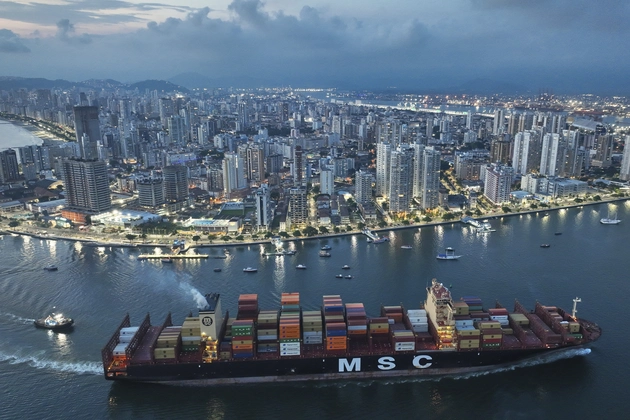
A consequential clash is unfolding at the heart of international climate governance, where the United States has launched a coordinated effort to derail one of the most closely watched emissions policies under consideration: a proposed global carbon tax on shipping. At the center of the dispute is the International Maritime Organization (IMO), the United Nations body responsible for regulating global shipping, where member states are now confronting a defining question for the future of climate accountability in international trade.
The U.S. delegation’s campaign—marked by direct diplomatic outreach and visible messaging efforts at the IMO’s latest gathering—signals a renewed resistance to market-based climate mechanisms that impose direct costs on carbon-intensive industries. By framing the proposed levy as an inflationary risk with downstream consequences for global supply chains, American officials are attempting to reshape the narrative around decarbonization, positioning economic stability and consumer cost protection as primary concerns. The strategy reflects a broader geopolitical tension: whether the urgency of climate mitigation should override short-term economic pressures in one of the world’s most essential and emissions-heavy industries.
Global shipping, often overlooked in mainstream climate discourse, represents a substantial and complex contributor to greenhouse gas emissions. Responsible for roughly 3% of total global emissions, the maritime sector operates largely outside national jurisdiction, making it one of the most difficult industries to regulate effectively. The IMO’s proposed carbon tax is not merely a symbolic gesture—it is designed as a structural intervention aimed at accelerating the transition to low- and zero-emission fuels, including green hydrogen, ammonia, and other emerging alternatives. By placing a price on carbon emissions from ships, the policy seeks to create a financial incentive for innovation and to level the playing field between legacy fossil fuel systems and cleaner technologies.
What makes the current moment particularly significant is the convergence of political, economic, and environmental stakes. Proponents of the carbon tax argue that without a unified, enforceable global mechanism, the maritime sector will continue to lag behind other industries in decarbonization efforts. Unlike aviation or land-based transportation, shipping has historically benefited from fragmented oversight and minimal climate accountability, allowing emissions to rise alongside expanding global trade volumes. The proposed tax is intended to correct that imbalance, creating a predictable and scalable framework for emissions reduction that aligns with broader international climate targets.
Opposition led by the United States introduces a powerful counterforce that could stall or dilute the policy before it reaches implementation. By emphasizing the potential for increased shipping costs to cascade through supply chains—raising prices on everything from consumer goods to essential commodities—the U.S. position taps into widespread economic anxieties. Inflation, already a dominant concern in global markets, becomes a central argument against aggressive climate action in this context. However, critics of this stance contend that the long-term costs of inaction—ranging from climate-driven disruptions to infrastructure damage and resource scarcity—far exceed the short-term financial impacts of a carbon pricing mechanism.
The diplomatic maneuvering now underway at the IMO reveals a deeper structural challenge within global climate governance: the absence of consensus on how to distribute the costs and responsibilities of decarbonization. Developing nations, many of which rely heavily on maritime trade for economic growth, have expressed both support and concern regarding the proposed tax. On one hand, a global framework ensures that all countries operate under the same rules, preventing competitive disadvantages. On the other, there is apprehension about how increased shipping costs might disproportionately affect economies with limited capacity to absorb or offset those expenses.
This tension underscores the importance of how any carbon tax revenue would be allocated. Advocates have pushed for mechanisms that reinvest funds into climate adaptation and mitigation efforts, particularly in vulnerable regions most affected by climate change. Such provisions could transform the policy from a purely regulatory tool into a vehicle for climate equity, addressing historical imbalances while accelerating the transition to sustainable infrastructure worldwide. Whether these considerations can be integrated into a final agreement remains one of the most critical variables in the ongoing negotiations.
Beyond the immediate policy debate, the U.S. campaign to block the shipping carbon tax carries broader implications for international climate leadership. At a time when coordinated global action is widely recognized as essential to meeting emissions reduction targets, resistance from a major economic power introduces uncertainty into the trajectory of multilateral climate initiatives. The outcome of this dispute will likely influence not only maritime policy but also the credibility and effectiveness of international institutions tasked with managing the climate crisis.
For the shipping industry itself, the stakes could not be higher. The transition to low-emission operations requires significant capital investment, technological innovation, and long-term planning. A clear and consistent regulatory framework is widely seen as essential for unlocking that transition, providing the certainty needed for companies to commit to new fuels, vessel designs, and infrastructure. Delays or inconsistencies in policy implementation risk prolonging reliance on fossil fuels and slowing the pace of change at a moment when acceleration is urgently needed.
As negotiations continue, the debate over the IMO carbon tax encapsulates a fundamental question that extends far beyond shipping: how to balance economic realities with environmental imperatives in a rapidly changing world. The United States’ intervention has ensured that this question will be contested at the highest levels, with outcomes that will resonate across industries, borders, and generations.
What emerges from this moment will not simply determine the future of maritime emissions policy—it will help define the global approach to climate accountability in the decades ahead.