
Across the world, thousands of wild animals spend their lives in environments that fall far short of their natural needs. From roadside attractions to abandoned zoos and private facilities, many animals born into captivity endure years of confinement without adequate space, enrichment, or veterinary care.
Yet within the global movement for animal protection, stories of rescue and rehabilitation offer powerful reminders that a different future is possible.
One such story belongs to Sandro, a tiger whose life journey reflects both the hardships many captive animals endure and the extraordinary dedication of rescue networks working to give them a second chance.
Today, Sandro marks a remarkable milestone: four years since his rescue and relocation to LIONSROCK Big Cat Sanctuary. Known as one of the “Argentinean Train Tigers,” Sandro’s story has become a symbol of resilience, compassion, and the growing international effort to protect animals from exploitation.
From Confinement to Sanctuary
Sandro’s life began in captivity.
Born in 2004, he spent much of his early life living under conditions that animal welfare experts widely criticize as unsuitable for large predators.
Alongside another tiger named Mafalda, Sandro was confined in a train carriage—an environment drastically removed from the vast territories that tigers naturally inhabit in the wild.
For fifteen years, the two adult tigers lived in this unusual enclosure along with their sons, Messi and Gustavo.
While the animals survived in these conditions, the space, stimulation, and natural environment required for healthy tiger behavior were largely absent.
Tigers are solitary animals that typically roam territories spanning dozens of square miles in the wild. They rely on complex landscapes to hunt, explore, and establish territory.
Confinement in small or artificial spaces often leads to physical and psychological stress for big cats.
For Sandro and his family, life inside the train carriage represented a stark contrast to the natural world their species evolved to inhabit.
The Rescue Mission
In March 2022, an international animal rescue effort finally changed the trajectory of their lives.
A coordinated team of animal welfare professionals worked to safely relocate Sandro, Mafalda, and their sons from Argentina to LIONSROCK Big Cat Sanctuary.
Animal rescues of this scale are highly complex operations.
Transporting large predators across continents requires careful planning, veterinary oversight, specialized transport equipment, and cooperation from multiple authorities.
Each animal must undergo health assessments, travel preparation, and gradual acclimatization to new surroundings.
For animals that have spent years in limited environments, relocation can be both physically and emotionally challenging.
But when successful, the results are transformative.
LIONSROCK: A Sanctuary for Big Cats
LIONSROCK Big Cat Sanctuary was established as a safe haven for lions, tigers, and other big cats rescued from circuses, private ownership, and inadequate facilities around the world.
Unlike zoos that breed animals or use them for public entertainment, sanctuaries prioritize the well-being of rescued animals for the remainder of their lives.
At LIONSROCK, rescued big cats receive:
- Spacious natural enclosures
- Veterinary care tailored to their needs
- Diets designed to support long-term health
- Environmental enrichment to stimulate natural behaviors
- Protection from breeding, exploitation, or commercial use
For animals like Sandro, sanctuary life offers something they may never have experienced before: stability, space, and safety.
The Loss of Family Members
While Sandro’s rescue represented a hopeful new chapter, his story has also been marked by profound loss.
Mafalda, his longtime companion, passed away in 2024.
Their son Messi also died that same year.
In 2025, the family faced another tragedy when Gustavo passed away as well.
These losses highlight a difficult reality for animals rescued later in life.
Many arrive at sanctuaries after years of stress, inadequate medical care, or living conditions that may have already affected their long-term health.
Sanctuaries work tirelessly to provide medical treatment and supportive care, but the effects of earlier hardship can sometimes shorten an animal’s lifespan.
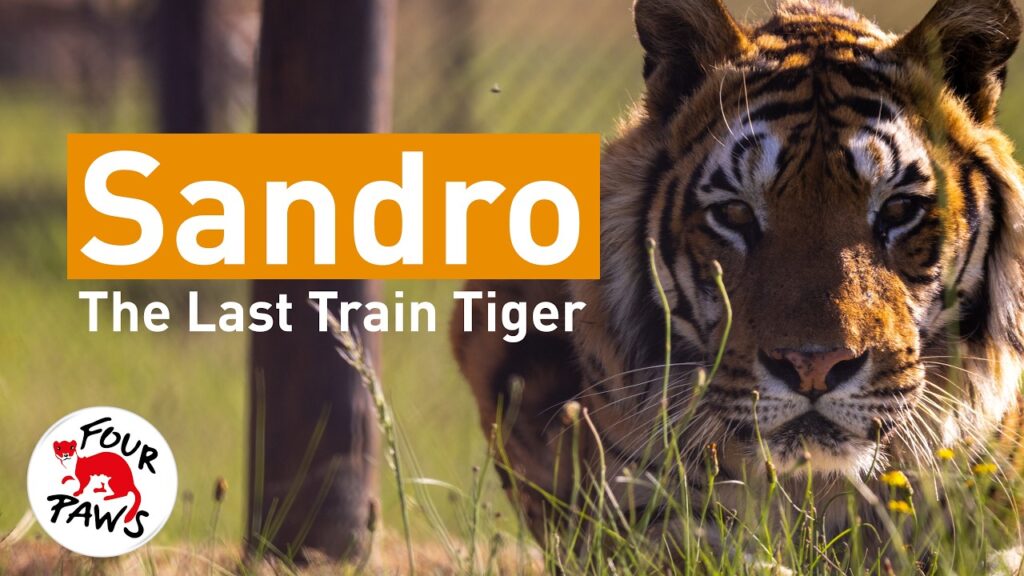
Today, Sandro remains the last of the Argentinean Train Tigers.
Yet his continued life at LIONSROCK carries forward the legacy of the family that was rescued alongside him.
A Senior Tiger with a Resilient Spirit
At 22 years old, Sandro is considered a senior tiger.
In the wild, many tigers live between 10 and 15 years, though those in protected environments may live longer.
Age has brought its own set of health challenges.
Sandro experiences impaired vision, which can affect his ability to navigate his surroundings. He also lives with arthritis in his elbows, a condition that can develop in older animals and may be exacerbated by earlier life conditions.
Dental issues have also required veterinary attention, leading to two procedures designed to maintain his comfort and health.
Another lasting effect of his earlier life is the fact that Sandro was declawed as a young animal—a practice that can have long-term consequences for large cats.
Declawing alters the structure of a cat’s paws and can lead to changes in gait and posture. For Sandro, this has contributed to some misalignment in the way he moves.
Despite these challenges, he continues to live peacefully within the sanctuary environment.
The dedicated veterinary team and caretakers at LIONSROCK provide ongoing support to ensure he remains comfortable and enriched as he ages.
Life in Sanctuary
For Sandro, sanctuary life represents a profound change from the early years of his life.
Instead of living within the confines of a train carriage, he now has access to outdoor enclosures designed to mimic natural habitats.
These environments allow rescued big cats to engage in behaviors that reflect their instincts.
They can explore, rest in shaded areas, climb natural structures, and observe the world around them.
Even simple experiences—feeling grass under their paws or basking in sunlight—can be deeply meaningful for animals who spent years in restrictive conditions.
Sanctuary caretakers also provide enrichment activities designed to stimulate curiosity and mental engagement.
These might include scent trails, hidden food items, or objects that encourage exploration.
For animals like Sandro, such experiences help maintain both physical and mental well-being.
The Role of Global Rescue Networks
Sandro’s story is part of a much larger effort taking place around the world.
Animal rescue networks have become increasingly important as awareness grows about the conditions many captive animals face.
These organizations work across borders to identify animals in need, negotiate rescues, coordinate transport logistics, and provide long-term sanctuary care.
The process requires cooperation between veterinarians, wildlife experts, transport specialists, and government authorities.
It also relies heavily on public support.
Donations and advocacy help fund rescue missions, maintain sanctuary facilities, and ensure that animals receive care for the rest of their lives.
Every successful rescue represents countless hours of dedication from teams committed to improving the lives of animals who cannot return to the wild.
Why Sanctuary Matters
For big cats raised in captivity, returning to the wild is rarely possible.
They often lack the survival skills needed to hunt independently or avoid human settlements.
Sanctuaries therefore play a crucial role in ensuring these animals live out their lives in dignity and safety.
Unlike commercial facilities, reputable sanctuaries do not breed animals or use them for entertainment.
Their mission focuses solely on rehabilitation, protection, and long-term care.
For animals like Sandro, sanctuary life represents the closest possible approximation to freedom after years of confinement.
Honoring Sandro’s Rescueversary
Four years after his rescue, Sandro’s story continues to inspire animal welfare advocates around the world.
His life is a testament to both resilience and compassion.
It reminds us that even animals who have endured difficult beginnings can find peace and comfort when given the opportunity.
Celebrating Sandro’s rescue anniversary is not only about honoring one tiger—it is about recognizing the broader movement working to protect animals from exploitation.
Each rescue story reinforces the importance of global cooperation and public awareness.
It also reminds us that change is possible when people choose compassion over indifference.
Supporting the Future of Animal Rescue
Sanctuaries and rescue networks rely on public engagement to continue their work.
By supporting animal welfare organizations, spreading awareness about captive wildlife issues, and advocating for stronger protections for animals, individuals can play a meaningful role in shaping a more humane future.
For Sandro, the quiet days he now spends resting under open skies represent a life that once seemed impossible.
Four years after his rescue, he stands as a powerful reminder that compassion, persistence, and global cooperation can transform even the most difficult stories into ones of hope.