
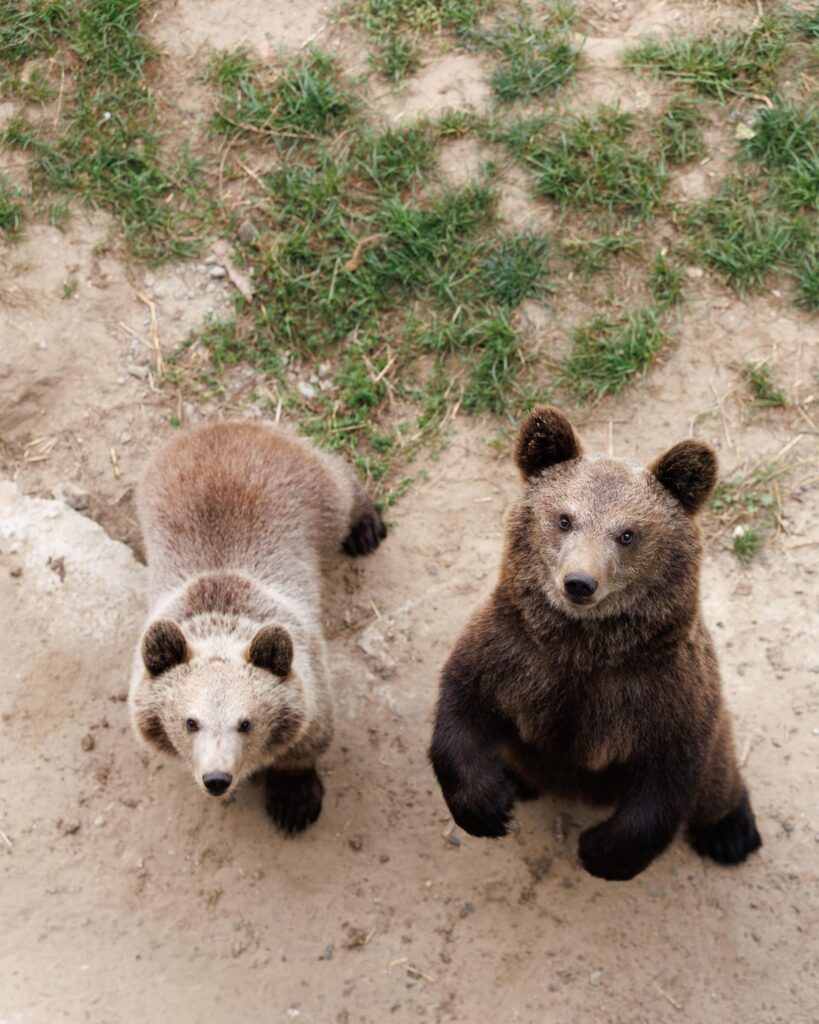
One year ago, two vulnerable brown bear cubs—Runa and Kodi—entered a world that had already turned against them. Discovered alone in the Ukrainian wilderness, just weeks into their lives and weighing only a fragile 5 and 7 kilograms, their survival odds were effectively nonexistent. Without maternal protection, without shelter, and without access to the instinctual learning that defines a bear’s early development, they were facing a trajectory that too often ends in silence. What followed instead was a decisive intervention that now stands as a defining example of why global wildlife rescue networks are not just important—they are essential.
Their story begins in crisis but evolves into something far more powerful: a living, breathing case study in what coordinated rescue, long-term sanctuary care, and sustained human commitment can achieve. Through an emergency operation led by FOUR PAWS, Runa and Kodi were transported to safety at BEAR SANCTUARY Domazhyr, a protected refuge that has become one of the most critical facilities for rescued bears in Eastern Europe. The sanctuary itself is more than a physical space—it is a specialized ecosystem designed to restore dignity, security, and natural behaviors to animals that have been deprived of both.
This anniversary is not simply a milestone marking the passage of time. It is a reflection of transformation at the most fundamental level. When Runa and Kodi arrived, they were physically depleted and psychologically vulnerable, carrying the imprint of early-life trauma that often leaves lasting consequences. In the absence of structured rehabilitation infrastructure in Ukraine capable of preparing orphaned brown bears for rewilding, the path forward required a different approach—one rooted in long-term sanctuary care rather than eventual release. This distinction matters, because it highlights a critical gap in global conservation systems: not all animals can be returned to the wild, but all deserve a life that honors their nature.
Over the past year, Runa and Kodi have undergone a remarkable progression that underscores the effectiveness of species-specific care. Their development has been guided not by domestication, but by carefully calibrated enrichment strategies designed to stimulate natural behaviors. From foraging exercises to terrain exploration, every element of their daily environment has been structured to rebuild instinct, confidence, and independence within the safe boundaries of sanctuary life. The result is visible in every aspect of their growth. They are no longer the fragile cubs that arrived in crisis; they are strong, curious, and socially engaged bears exhibiting the behavioral hallmarks of their species.
This transformation is not accidental. It is the direct outcome of a rescue network that understands the complexity of wildlife welfare at scale. Sanctuaries like Domazhyr operate at the intersection of emergency response, veterinary science, behavioral ecology, and long-term care planning. They are not temporary solutions; they are permanent commitments that require sustained resources, expertise, and public engagement. The success of Runa and Kodi is inseparable from this infrastructure, which remains under constant pressure due to increasing demand driven by habitat loss, conflict zones, and illegal wildlife exploitation.
Their story also exposes a deeper structural reality within conservation: the absence of rehabilitation pathways in certain regions creates a bottleneck that forces organizations to make difficult decisions. In an ideal scenario, orphaned cubs would be prepared for reintroduction into protected wild habitats. But when that option is unavailable, sanctuaries become the final—and only—line of defense. This reality elevates the importance of expanding global rescue networks, not just in capacity but in geographic reach. Without investment in rehabilitation facilities and rewilding programs, more animals will follow the same path as Runa and Kodi—rescued, saved, but permanently displaced from the ecosystems they were born into.
Yet within that constraint lies an opportunity to redefine what success looks like in wildlife conservation. Survival alone is not the metric. Quality of life, behavioral expression, and long-term wellbeing are equally critical benchmarks. By those standards, Runa and Kodi represent a success that goes far beyond rescue. They embody a model of care that prioritizes dignity over expediency, ensuring that even in captivity, animals can live in environments that respect their biological and psychological needs.
The celebration of their one-year anniversary within the sanctuary was not merely symbolic. It was a reaffirmation of the bond between caretakers and the animals they protect, expressed through enrichment activities and carefully prepared nutrition designed to engage both body and mind. These moments, while seemingly simple, are essential components of welfare. They reinforce trust, stimulate cognitive development, and provide the sensory experiences that define a life worth living for a species that would otherwise roam vast forest territories.
For Sustainable Action Now’s rescue network initiative, the story of Runa and Kodi serves as both inspiration and directive. It demonstrates what is possible when rapid response is matched with long-term vision, and it underscores the urgent need to scale these efforts globally. Wildlife rescue is no longer a peripheral concern within the climate and environmental movement—it is a central pillar. As ecosystems destabilize and human activity continues to encroach on natural habitats, the frequency of cases like this will only increase. The question is not whether intervention will be needed, but whether the infrastructure will exist to support it.
This is where the role of public awareness and engagement becomes critical. Supporting rescue networks, advocating for expanded rehabilitation facilities, and aligning policy with the realities of wildlife displacement are all part of a broader strategy that must be pursued with urgency and precision. The survival of individual animals like Runa and Kodi may capture attention, but it is the systemic response that will determine whether such outcomes become the exception or the standard.
One year later, their story stands as a testament to resilience, but also as a reminder of responsibility. They were given a second chance not by circumstance, but by deliberate action. As they continue to grow within the sanctuary that now defines their world, they carry with them a message that extends far beyond their enclosure: when rescue networks are empowered, lives are not only saved—they are rebuilt.
And in that rebuilding lies the future of ethical, effective, and truly sustainable wildlife conservation.