

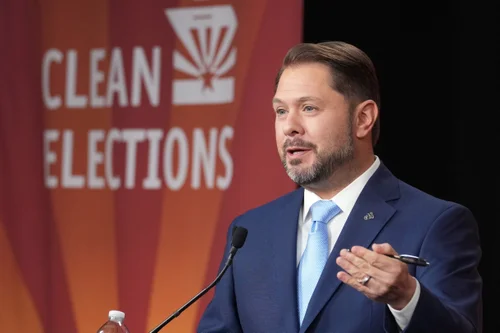
A major realignment may now be unfolding inside the Democratic Party’s approach to energy policy, and its implications could reshape not only the 2026 midterm elections, but the broader national debate surrounding climate change, economic anxiety, energy affordability, industrial competitiveness, and the future of America’s electrical grid. At the center of that shift is Arizona Senator Ruben Gallego, whose emerging energy blueprint is rapidly drawing attention across Washington for one simple reason: it represents one of the clearest signs yet that a growing faction within the Democratic Party believes voters are no longer responding primarily to climate messaging alone.
Instead, they are responding to utility bills.
They are responding to housing costs, gasoline prices, inflation pressures, manufacturing concerns, and mounting fears surrounding whether America’s energy systems are reliable enough to support the demands of a rapidly changing economy increasingly dominated by artificial intelligence infrastructure, electrification, data centers, domestic manufacturing expansion, and population growth across high-demand states like Arizona.
Gallego’s strategy reflects a growing recognition that the politics of energy are entering a new phase.
For years, much of the national climate debate centered heavily on emissions targets, carbon reduction frameworks, renewable deployment goals, and environmental urgency. While those priorities remain central to many Democratic lawmakers and climate advocates, Gallego is now pushing a different political argument — one rooted less in ideological framing and more in economic pragmatism. His proposal calls for Democrats to embrace what he describes as an “all-of-the-above” energy strategy focused first on affordability, reliability, permitting reform, infrastructure expansion, and maintaining enough energy supply to support both economic growth and working-class stability.
The message is deliberate.
Rather than framing energy discussions primarily through the lens of climate sacrifice or regulatory restrictions, Gallego’s approach attempts to reposition Democrats as the party capable of delivering lower costs, stronger grids, faster infrastructure development, and practical energy abundance during a period of enormous economic and technological transition.
That recalibration comes at a politically sensitive moment.
Across the country, energy affordability has become deeply intertwined with broader voter frustrations surrounding cost of living pressures. Utility bills have risen in many regions alongside housing costs, insurance rates, transportation expenses, and food inflation. At the same time, electricity demand projections are climbing rapidly as artificial intelligence systems, cloud computing infrastructure, electrified transportation, semiconductor manufacturing, and domestic industrial policy initiatives place unprecedented pressure on American grids.
The result is a political environment where voters increasingly care less about ideological energy purity and more about whether the lights stay on at a reasonable cost.
Gallego appears to understand that shift.
His policy framework reportedly emphasizes several key pillars: accelerating permitting reform to speed energy infrastructure projects, maintaining a role for natural gas to stabilize grid operations, expanding transmission systems, increasing domestic energy production capacity, and modernizing electrical infrastructure without alienating moderate and working-class voters who may feel disconnected from more aggressive climate rhetoric.
In many ways, the strategy reflects broader anxieties now emerging inside Democratic circles following years of difficult political messaging around inflation and energy costs. While climate action continues enjoying broad conceptual support nationally, voter priorities often shift rapidly when affordability pressures intensify. Rising electricity prices, grid instability fears, and concerns about economic competitiveness have complicated efforts to sell aggressive decarbonization policies in regions heavily dependent on industrial growth or energy-intensive development.
Arizona itself represents a powerful example of those tensions.
The state sits directly at the intersection of nearly every major issue reshaping modern energy politics. Explosive population growth, extreme heat, water scarcity, housing expansion, semiconductor manufacturing investment, solar deployment, electric vehicle infrastructure, and rising electricity demand are all converging simultaneously. As temperatures climb across the Southwest, reliable air conditioning becomes not merely a convenience but a public health necessity. Grid reliability in Arizona is inseparable from economic stability and human survival.
That reality changes how energy policy is discussed politically.
In states experiencing sustained heat extremes and rapid growth, voters often prioritize affordability and reliability just as heavily as emissions reduction goals. Energy becomes tangible, immediate, and personal. It determines whether businesses can operate, whether homes remain habitable during dangerous heat waves, and whether communities can absorb future economic development without destabilizing existing infrastructure.
Gallego’s political positioning reflects that environment.
His proposal does not reject climate concerns outright. Instead, it attempts to reorder priorities in a way designed to broaden Democratic appeal among independents, moderate suburban voters, union workers, industrial labor groups, and economically anxious households. The strategy recognizes that many Americans increasingly view energy through the lens of economic security rather than solely environmental responsibility.
That shift also reflects broader transformations happening globally.
The rapid emergence of artificial intelligence infrastructure is dramatically altering long-term electricity demand projections across the United States and worldwide. Data centers powering AI systems consume enormous quantities of electricity, and utility planners increasingly warn that demand growth may accelerate far faster than previously anticipated. Simultaneously, governments are encouraging electrification across transportation, manufacturing, heating systems, and industrial sectors to support decarbonization goals.
Those parallel transitions create enormous strain on existing grids.
For policymakers, the challenge is no longer simply reducing emissions. The challenge is managing a historic increase in electricity demand while keeping power affordable, maintaining reliability, expanding infrastructure, and avoiding political backlash from consumers already burdened by rising costs.
This is where Gallego’s messaging becomes especially significant.
By emphasizing energy abundance rather than scarcity, and infrastructure acceleration rather than restriction-focused rhetoric, he is tapping into an emerging centrist argument that Democrats risk losing politically if climate policy becomes associated primarily with higher costs, permitting delays, or reduced reliability. His approach suggests that future electoral success may depend less on emphasizing sacrifice and more on convincing voters that clean energy transitions can coexist with economic growth, industrial expansion, and affordable living standards.
The proposal also underscores a growing divide within Democratic energy politics itself.
Progressive climate advocates continue pushing for faster fossil fuel phaseouts, stricter emissions standards, and more aggressive renewable mandates. Meanwhile, moderates increasingly warn that voters outside major urban centers often interpret parts of the climate agenda as economically disruptive or disconnected from everyday financial realities. Gallego appears to be positioning himself firmly within the latter camp — arguing that Democrats must speak more directly to affordability concerns if they hope to rebuild broader working-class coalitions nationally.
That calculation may prove especially influential heading into the 2026 midterm cycle.
Historically, economic anxiety tends to outweigh abstract policy discussions during periods of uncertainty. Utility bills, gasoline costs, inflation, and energy reliability often resonate more immediately with voters than long-range climate modeling or emissions targets. Gallego’s blueprint effectively attempts to merge climate-era infrastructure modernization with politically durable economic messaging capable of surviving those pressures.
His emphasis on permitting reform is particularly notable because it reflects one of the most rapidly evolving conversations in American energy policy. Across ideological lines, frustration has grown over how difficult it has become to build major infrastructure projects in the United States — including renewable energy systems, transmission lines, pipelines, semiconductor facilities, grid upgrades, and industrial manufacturing sites.
Many analysts now argue that America’s greatest energy challenge is not technological innovation, but deployment speed.
Projects frequently face years of regulatory reviews, lawsuits, environmental assessments, and bureaucratic delays before construction even begins. Gallego’s framework appears designed to address that bottleneck directly, positioning permitting reform as both an economic and energy security issue rather than purely a deregulatory one.
At the same time, his willingness to maintain natural gas as part of the national energy mix reflects growing concern about grid stability during the transition toward cleaner energy systems. While renewable generation continues expanding rapidly, many utilities and grid operators remain cautious about eliminating dispatchable fossil fuel capacity too quickly without sufficient storage, transmission, or backup infrastructure fully operational.
This debate has become especially urgent following repeated grid emergencies, extreme weather events, and electricity price spikes witnessed across multiple regions in recent years.
Gallego’s approach suggests Democrats may increasingly attempt to occupy a political middle ground where decarbonization goals remain intact, but energy realism and affordability concerns are elevated alongside environmental priorities. Whether that balance proves politically successful remains uncertain, but the strategy clearly reflects recognition that the energy conversation itself is changing.
Increasingly, the national debate is no longer framed simply as climate versus fossil fuels.
It is becoming a debate about how nations power AI systems, manufacturing growth, electrified transportation, extreme-weather adaptation, population expansion, and modern digital economies without triggering affordability crises or destabilizing public support for long-term climate action itself.
In that sense, Gallego’s proposal may ultimately represent more than a campaign positioning document.
It may signal the early stages of a broader Democratic recalibration around the political realities of the energy transition era — an acknowledgment that climate policy, economic competitiveness, technological infrastructure, and consumer affordability can no longer be treated as separate conversations.
They are now deeply interconnected.
And as the 2026 elections approach, the politicians capable of navigating those intersections most effectively may ultimately shape not just electoral outcomes, but the future direction of American energy policy itself.
For more environmental policy analysis, sustainability reporting, and energy transition coverage, visit the SAN Climate section.