

William Silvia is gone. Three more warrants are signed. A conservative Republican wants to end the death penalty in Pennsylvania. And fifty years after Gregg v. Georgia, the conversation is finally changing.
Florida Keeps Executing.
The Rest of the Country Is Asking Why.
William Silvia is gone. Three more warrants are signed. A conservative Republican wants to end the death penalty in Pennsylvania. And fifty years after Gregg v. Georgia, the conversation is finally changing.
On Monday evening, August 18, 2026, the State of Florida executed William Frances Silvia, Jr. He was the fourteenth person Florida has executed in 2026 alone. In all of 2025, the entire United States carried out nineteen executions. Florida’s pace has now surpassed the combined total of every other state in the country for this year, and Governor DeSantis has signed three more warrants. The calendar through early September is full. The questions that each of these deaths forces the state and its citizens to confront are not getting easier to avoid.
William Silvia: Mental Illness, a Waiver, and a Constitutional Right That Came Too Late
Patricia Silvia died as a result of an act of intimate partner violence that also left her mother, Betty Woodard, grievously wounded. The harm William Silvia caused to Patricia, to Betty, and to Patricia’s children is real, documented, and not in dispute. It shaped lives in ways that no legal outcome can fully address, and any honest accounting of this case begins with that acknowledgment. But an honest accounting cannot end there. It must also engage with the documented reality of William Silvia’s mental illness, the constitutional question raised by the circumstances of his death sentence, and what it means that Florida executed him anyway.
William Silvia grew up in a home marked by domestic violence. He experienced physical and emotional abuse as a child. As an adult, he carried a documented history of delusional thinking, paranoia, and severe alcohol dependence, compounded by multiple head injuries whose neurological consequences were never fully assessed by the criminal legal system before it sentenced him to die. In the months before Patricia’s death, he lost his job, lost his housing, and experienced a psychological deterioration that multiple experts at his trial acknowledged was genuine. Both the state and defense experts agreed at trial that his chronic psychological disorder constituted mitigating evidence. His jury agreed enough that it did not reach a unanimous verdict, voting seven to five in favor of death under Florida law as it existed at the time.
When William Silvia arrived on death row, he gave up. His first postconviction attorneys told the court he wanted to abandon his appeals. The court held a brief hearing, asked a few basic questions, provided no meaningful evaluation of whether a man with documented severe mental illness could make a rational, voluntary decision of that magnitude, and rubber-stamped the waiver. Research on people who have volunteered for execution by waiving their appeals finds that nearly ninety percent had documented mental illness or severe substance use disorders. The system that accepted William Silvia’s waiver did not pause to establish whether it met any meaningful standard of informed, voluntary decision-making for a man in his condition.
Then the law changed. In 2016, the United States Supreme Court issued its decision in Hurst v. Florida, ruling that Florida’s practice of allowing a judge to impose a death sentence based on a non-unanimous jury recommendation was unconstitutional. More than 150 people on Florida’s death row received new sentencing proceedings as a result. William Silvia should have been among them. His new lawyers argued that he could not be bound by a waiver made before the constitutional right it surrendered existed, and that the waiver itself had been made in a state of mental illness that undermined its validity as an informed and voluntary act. A circuit court judge agreed and vacated his death sentence. For a brief period, William Silvia had hope.
The State appealed. The Florida Supreme Court reversed the circuit court, allowing the waiver to stand despite the constitutional transformation that had occurred since it was made. Justice Fred Lewis, in a sharp dissent, warned that the court was pushing Florida’s death penalty into an unconstitutional abyss. Florida executed William Silvia on the evening of August 18, 2026, and Patricia’s children, Betty, and everyone who loved them are left to carry losses that no execution can address, in a state that answered intimate partner violence with one more deliberate act of killing.
The Hurst Decision and What It Should Have Meant for Silvia
The Supreme Court’s 2016 Hurst ruling established that Florida’s jury sentencing structure was unconstitutional because it did not require a unanimous jury recommendation for death. More than 150 people on Florida’s death row subsequently received new sentencing proceedings under the corrected standard. William Silvia’s case raised the specific question of whether a person who had waived his appeals before that constitutional right existed could be bound by that waiver indefinitely. Florida’s Supreme Court said yes. The U.S. Supreme Court had not yet resolved that question before the execution was carried out.
Three More Warrants. Three More Names.
Moments after William Silvia’s execution, Governor DeSantis signed a death warrant for Daniel Conahan, Jr., scheduling his execution for 6 PM on September 10. Conahan was convicted of the 1996 murder of Richard Montgomery in Charlotte County and has always maintained his innocence. His request for additional DNA testing was still pending before the courts when the governor signed his death warrant. He has not yet received an answer on that request. He has, however, received an execution date.
Executed despite severe documented mental illness, a non-unanimous jury vote, and a constitutional question about the validity of his appeal waiver that Florida’s courts refused to fully address.
Sentenced for the 1976 murder of Jill Piper. Lucas has chosen to waive his final appeals, placing advocates in the difficult position of opposing an execution the condemned himself is not fighting.
Maintains his innocence in the 1996 murder of Richard Montgomery. His request for additional DNA testing was still pending when the governor signed his death warrant.
Harold Lucas’s situation presents a particular kind of moral challenge for abolitionists. He has decided not to pursue further appeals, and his agency in that decision deserves acknowledgment. But the Florida Abolitionists for Death Penalty have noted clearly: his choice not to challenge his execution does not require the rest of Florida’s citizens to accept the state’s choice to carry it out. The approximately ten percent of people executed in the United States who have “volunteered” by abandoning part or all of their appeals process share a profile that demands scrutiny rather than simple deference: the same research that found nearly ninety percent of volunteers had documented mental health or substance use conditions also found that the circumstances of the waiver itself rarely received meaningful judicial review before it was accepted as binding.
A Republican Lawmaker Wants to End the Death Penalty. Pennsylvania Is Listening.
The argument against capital punishment has never been exclusively a progressive or liberal argument. It is also a conservative argument, and increasingly the people making it most forcefully are Republicans. Pennsylvania State Representative Russ Diamond, a Republican, is the author of House Bill 888, legislation that would end the death penalty in Pennsylvania. He is not a fringe voice. He is a sitting member of a Republican-controlled legislature making the case, on explicitly conservative grounds, that state-sanctioned killing is incompatible with limited government, fiscal responsibility, and the consistent protection of innocent life.
The conservative case against the death penalty has multiple strands, and each of them is genuinely grounded in conservative principles rather than progressive sentiment. Government, which conservatives generally argue should be limited in its power over individual life, exercises no greater power than the power to kill a citizen. The death penalty’s financial cost, which research consistently shows is substantially higher than the cost of lifetime incarceration due to the mandatory appeals process and the specialized resources required for capital litigation, is a straightforward fiscal argument. The innocence problem, documented by more than 190 exonerations from death row since 1973, is an irreversibility argument: conservatives who value minimal government error in consequential matters should be deeply troubled by a system that has demonstrably and repeatedly gotten something this final wrong.
Rethinking the Death Penalty Through a Conservative Lens
Author of House Bill 888, which would end the death penalty in Pennsylvania
Grace Hanna
Executive Director, Florida Abolitionists for Death Penalty
This conversation will cover the substance of HB 888, address the facts and fictions that dominate public debate about capital punishment, and explain how citizens in Pennsylvania and beyond can support the effort to end it. Audience questions will be taken.
Register on EventbriteThe political significance of a Republican legislator leading this effort in Pennsylvania cannot be overstated in the current climate. The death penalty has functioned for decades as a wedge issue where Democrats who opposed it faced attack from Republicans who framed abolition as weakness on public safety. That framing is becoming harder to sustain as the evidence accumulates that the death penalty does not deter violent crime, that it costs substantially more than alternatives, that it has been applied with demonstrable racial and geographic bias, and that it has produced more than 190 documented wrongful convictions at the ultimate level of consequence. Representative Diamond is making the case that choosing not to execute people is not weakness. It is the position that the evidence, the fiscal reality, and the founding American suspicion of unlimited government power all support.
Ernie Suggs: An Innocent Man, a Victim’s Daughter, and the U.S. Supreme Court
The Victim’s Family Is Fighting for the Condemned Man’s Life
Laura Johnson is the daughter of murder victim Pauline Casey. She has written a public op-ed for the South Florida Sun Sentinel stating directly that she believes Florida sent the wrong man to death row for her mother’s murder. She is fighting to save Ernest Suggs’ life and to ensure that the person who actually killed her mother is held accountable. Ernie Suggs’ appeal is currently before the United States Supreme Court. This is the moment when public awareness and public pressure most directly affect the political environment in which the Court operates.
Visit the ExonerateErnie website, read Laura Johnson’s essay, sign the petition, and share all of it. The victim’s own family is asking for this man’s life. The least the rest of us can do is amplify their voice.
Fifty Years Since Gregg: What Changed, What Didn’t, and What Might
On July 2, 1976, the United States Supreme Court issued its opinions in Gregg v. Georgia, Texas v. Jurek, and Proffitt v. Florida, clearing the constitutional path for states to resume executions after a four-year pause. Florida had been so eager to return to capital punishment that it called a special legislative session before the winter holidays to pass the first compliant death penalty statute in the country. The fifty years since have produced more than 1,600 executions, more than 190 exonerations from death row, the virtual elimination of the practice in most of the industrialized world, and the current anomaly of Florida executing people at a rate no American state has sustained in the modern era.
To mark the fifty-year anniversary, the Florida Abolitionists for Death Penalty convened Michael Radelet, PhD, one of the country’s most respected death penalty scholars, David Kendall, the attorney who represented John Spenkelink, the first person executed in Florida after the return of the death penalty, and Susan Cary, a member of the Spenkelink defense team and a lifetime advocate against capital punishment. All three gathered with FADP Executive Director Grace Hanna for a conversation that covered what they witnessed at the beginning, what fifty years of the system’s operation has revealed, and where they see the movement going. The replay is available and worth watching in full.
Also marking this moment is Pamela Colloff’s book “Catch the Devil,” which tells the story of James Dailey, a Vietnam veteran who has spent nearly fifty years on Florida’s death row for a crime he maintains he did not commit, through the lens of the con man whose testimony helped put him there. The book is on the New York Times bestseller list. Colloff is the same journalist whose recent investigation into Florida’s record-pace execution year appeared jointly in ProPublica and The New York Times Magazine. If you have not read either, both are worth your time.
Tommy Zeigler: 81 Years Old, Still on Death Row, New DNA Evidence Pending
William Thomas “Tommy” Zeigler has maintained his innocence for more than fifty years and is now 81 years old, making him the longest-standing prisoner on Florida’s death row. New DNA evidence supports his claim. FADP recently served as lead signer on an amicus brief before the Florida Supreme Court in support of his pending appeal, joined by eight exonerees and sixteen organizations. The brief explores Florida’s documented history of wrongful convictions and the specific evidence supporting Zeigler’s innocence claim. The film “The Window on Death Row,” which covers the story of Florida death row exoneree Joaquín José Martínez, is being screened at venues across the state. Check the FADP website for upcoming screening dates near you.
The Catholic Church in Florida has entered the current moment with unusual directness. The Florida Catholic Conference of Bishops issued a Pastoral Letter on the Death Penalty calling on all Catholics and people of good will to recognize that the Church teaches the death penalty is inadmissible and that public safety can be ensured without continuing the cycle of violence. Bishop Eric Pohlmeier of the Diocese of St. Augustine published a companion letter and op-ed asking those in his diocese to reflect on what kind of justice they want Florida to represent. His essay, “What Kind of Justice Do We Seek?” is available on the Diocese website.
Vigils Across Florida: Showing Up When It Matters Most
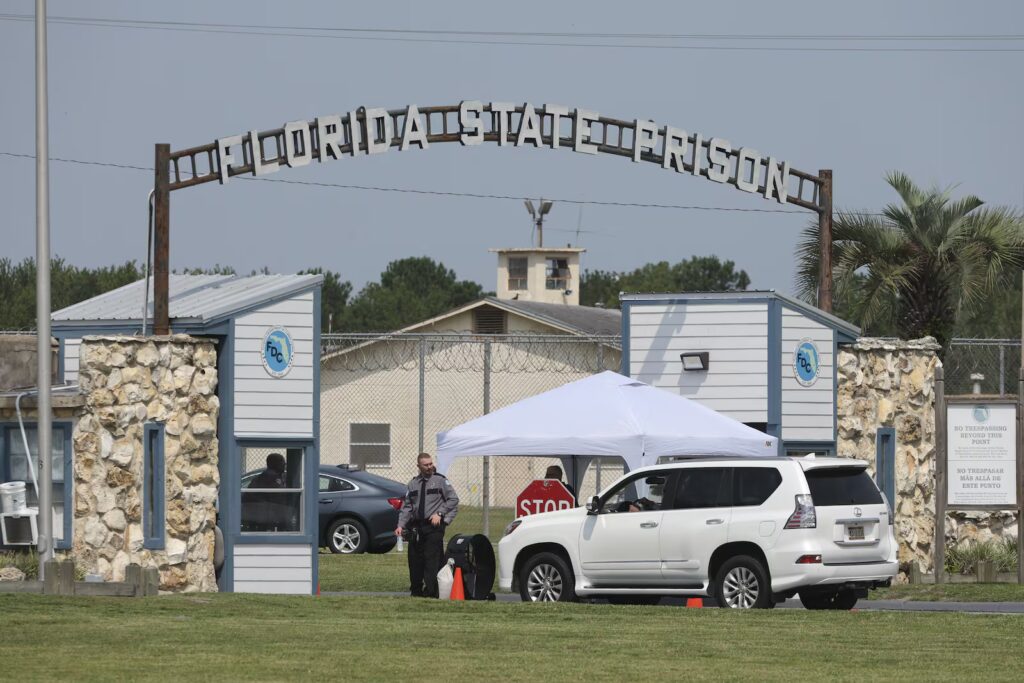
In the coming weeks, as Florida prepares to execute Harold Lucas on September 1 and Daniel Conahan on September 10, people across the state are organizing to gather in prayer, protest, and public witness at the hour each execution is carried out. The Florida Abolitionists for Death Penalty have been clear about why this matters: there is real and demonstrable power in the knowledge that, at the same hour an execution is proceeding inside Florida State Prison, people are gathering in communities across the state to say that this is not happening in silence and not in their names. This is especially significant in a gubernatorial election year, when the political cost of Florida’s pace of executions is most visible to the officials who have the power to stop it.
How to Participate
Find an existing vigil near you on the FADP website. If there is not one in your community, organize one. The FADP encourages people not to wait for an elaborate event structure: choose an accessible location, invite a few people from your community, and gather for prayer, reflection, or a period of silence at the scheduled hour. FADP can provide readings, signs, and other materials, and will help publicize your gathering to other supporters in your area.
- Harold Lucas execution: 6 PM on September 1
- Daniel Conahan execution: 6 PM on September 10
- Contact FADP at info@fadp.org to register your vigil or request materials
Florida is executing people at a pace that exceeds the combined total of every other state in the country this year. The governor is signing warrants for men whose innocence claims remain unresolved, whose DNA testing requests have not been answered, and whose mental illness was documented and acknowledged at their own trials. The fifty years since Gregg v. Georgia have produced enough evidence about how the death penalty actually operates, who it kills, and what it fails to accomplish, that any governor, any legislator, and any citizen who looks honestly at the record faces a real choice about what they want their state to represent. The people organizing vigils, filing amicus briefs, writing op-eds, and registering for Zoom conversations with Republican lawmakers about House Bill 888 are making their choice. The question is what everyone else will do while the calendar keeps filling up.