
There is a word for what happens when the same danger produces the same kind of tragedy, again and again, and the people with the power to end it choose not to act. The word is negligence. And in the case of New York City’s horse-drawn carriage industry, it is the only honest word left.
On the evening of June 9, 2026, a 16-year-old horse named Deniz collapsed and died in Central Park while pulling two passengers near West Drive and 72nd Street. He was gone within ten minutes. Animal welfare advocates who had been fighting for years to end the industry that killed him were at City Hall the following morning, calling on the New York City Council to pass Ryder’s Law — legislation that would phase out horse-drawn carriages and provide job transition support for the drivers who work them — before anything worse happened.
One week later, something worse happened.
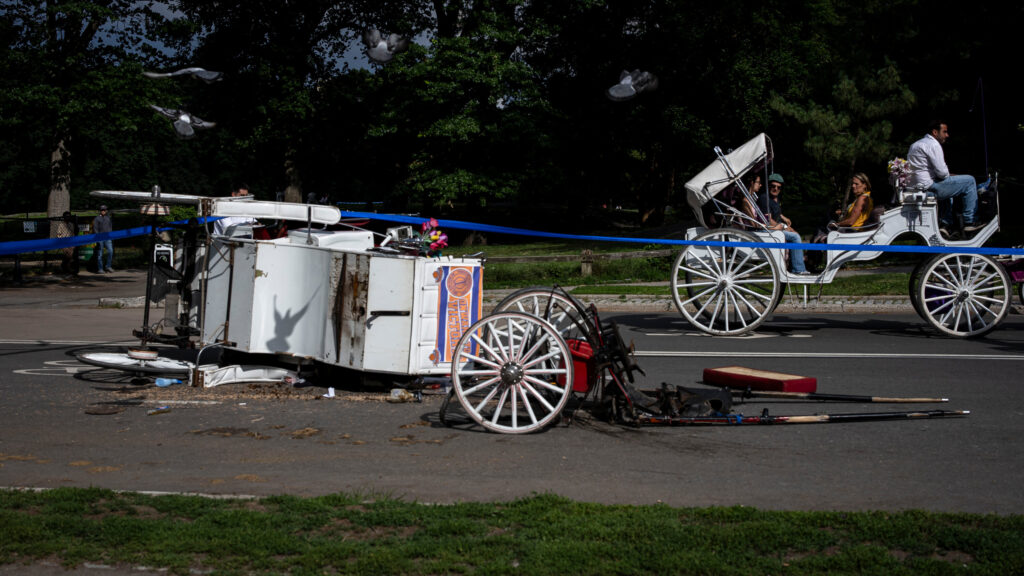
On June 17, 2026, a carriage horse bolted from its driver in Central Park, sending the four-wheeled hansom cab careening through the park. An 18-year-old tourist from India named Romanch Mahajan, who is believed by both the carriage industry’s union and the Central Park Conservancy to be the first person ever killed in a Central Park horse carriage accident in the industry’s 150-year history, fell from the carriage and suffered fatal head trauma. He had jumped to try to help his mother after she fell. He died doing what any of us would have done. He died in a public park that 42 million people visit every year because the City of New York has allowed a dangerous, anachronistic industry to operate in the middle of it despite years of warnings, incidents, injuries, and at least one prior horse death — and despite the fact that 78 percent of New York City voters, according to a 2025 poll, support banning horse-drawn carriage rides.
At Sustainable Action Now, we are not willing to soften what this is or who is responsible for it. The deaths of Deniz and Romanch Mahajan were preventable. The legislation to prevent them existed. The political will to pass it did not. That is the story, and New Yorkers — and everyone who cares about animal welfare and basic public safety — deserve to hear it clearly.
The History That Brought Us Here
The horse-drawn carriage industry in New York City has been the subject of sustained reform and ban efforts for more than a decade. The debate is not new. Neither are the incidents.
A 2014 Freedom of Information Act lawsuit filed by the Animal Legal Defense Fund against the NYPD revealed that carriage drivers had been involved in more than a dozen hit-and-run incidents over the previous five years. The records from that lawsuit documented a catalogue of injuries to children, cyclists, pedestrians, carriage drivers, passengers, and NYPD officers. A child had been rushed to the hospital after falling from a carriage and being run over by a wheel. A driver had been found unresponsive in the street after being thrown to the ground. These were not isolated incidents. They were a pattern. And they were happening in 2014.
The industry has continued to operate in the years since. Horses have continued to bolt, collapse, and die. In September 2025, two tourists jumped from a carriage after a horse bolted. In January 2026, a horse ran into oncoming traffic, ripping the bumper off a cab and colliding with up to five cars. On May 19, 2026, a horse spooked and hit another carriage, causing it to tip over. The Central Park Conservancy — which manages the 843-acre park and, in 2025, publicly threw its support behind a carriage ban for the first time — has documented eight separate horse-related incidents in Central Park in the 13 months leading up to Romanch Mahajan’s death. Eight incidents in 13 months. In one of the most visited public spaces in the world.
The legislation that could have prevented all of it has been in various stages of introduction, advocacy, defeat, and revival for years. Ryder’s Law — named after a carriage horse who collapsed on Ninth Avenue in Hell’s Kitchen in 2022, was filmed lying in the street while his driver slapped him and screamed at him to get up, was retired to a farm outside the city, and was euthanized months later — was first introduced after that incident went viral. Video of Ryder on the pavement, combined with public outrage at his treatment, produced the political pressure that led to the bill’s introduction. The bill attracted significant support, including from former Mayor Eric Adams who publicly backed it in his final months in office. It failed in committee in November 2025, with four members of the Health Committee voting against sending it to the full council despite the bill having 22 sponsors and the support of a clear supermajority of New York City voters.
Eight Days That Changed the Argument Forever
The events of June 9 through June 17, 2026 compressed what had been a long-running policy debate into a ten-day sequence of tragedy that has shifted the political ground in ways that the industry’s defenders can no longer easily manage.
Deniz died on June 9. He was a spotted draft horse, 16 years old — middle-aged for his breed, which has an average lifespan of 20 to 25 years — who had been in the care of his driver, Nurettin Kirbiyik, for a decade. The TWU Local 100, the union representing carriage drivers, said Kirbiyik saw no signs that Deniz was ill that evening and that the horse had received veterinary care as recently as January. A necropsy was conducted at Cornell University’s College of Veterinary Medicine. Whatever the specific medical cause of his death, it did not occur in isolation — it occurred on a street in the middle of a major urban park, while pulling a carriage, at the end of a workday in a June heat. The debate about whether individual horses are well cared for by their individual drivers is not the same debate as whether the conditions of the industry itself are compatible with equine health and welfare. Deniz’s death reopened both conversations simultaneously.
City Council Member Christopher Marte had already been planning to reintroduce Ryder’s Law for the current council session. Deniz’s death accelerated that timeline. On June 10, Marte rallied with other lawmakers and advocates on the steps of City Hall. On June 11, he reintroduced the bill with a new slate of co-sponsors. The Central Park Conservancy renewed its call for the ban. PETA placed a sky-high advertisement at 40th Street and Eighth Avenue — near the Hell’s Kitchen stables where carriage horses are housed — with a photo of Deniz and a message directed at the City Council. The momentum built.
On June 17, a carriage horse bolted in Central Park. The driver lost control. Romanch Mahajan, 18 years old, visiting New York City from India, fell from the carriage and died of head trauma. His father later told reporters that Romanch had jumped out to try to help his mother after she fell. He was the first person in 150 years of the industry’s operation in Central Park to die in a horse carriage accident.
The family released a statement addressed directly to Mayor Zohran Mamdani that should be read in full by every member of the New York City Council: “We are officially calling on the New York City Council and the mayor to take immediate, decisive action, we demand an immediate action of the passage of Romanch’s Law to permanently phase-out horse-drawn carriages before another life is lost. Allowing horse carriages back onto the streets, while our family is planning a funeral, proves that the city values tourism over human life.”
Romanch’s Law: The Renamed Bill That Now Carries a Name Nobody Wanted It to Need
At a vigil held in Central Park on June 22, City Council Member Christopher Marte announced that Ryder’s Law would be renamed Romanch’s Law in honor of the young man who died the week before. He read statements from Mahajan’s family at the ceremony. NYCLASS Executive Director Edita Birnkrant, whose organization has been fighting for this ban for years, stated the essential truth that no amount of additional regulation can change: there is no way to prevent a horse from spooking in an urban environment filled with joggers, cyclists, motorized scooters, and the unpredictable stimuli of one of the world’s most densely trafficked public spaces. The hardwired flight instinct of a horse — the same instinct that kept horses alive for millions of years of evolution — does not disappear when the horse is harnessed to a carriage. It activates without warning. And when it activates in Central Park, the consequences fall on whoever is nearby.
Council Member Marte made the point with the kind of directness this moment requires: “The only way you get Vision Zero in Central Park is by having no horse carriages here.”
City Council Speaker Julie Menin announced that the council would hold a hearing on Romanch’s Law. Mayor Mamdani, who had previously expressed support for banning horse carriages specifically within Central Park, reiterated his position and said he would work with the council, the industry, and animal welfare advocates to deliver what he described as a just transition that protects workers while ending the industry permanently.
This political alignment — the mayor supporting the ban, the council speaker scheduling a hearing, the bill carrying 22 sponsors, 78 percent of voters on record as supporting it, the Central Park Conservancy calling for passage, PETA mounting a citywide campaign, and Romanch Mahajan’s family speaking directly to the council in the week following their son’s death — represents a moment of convergence that has not existed in all the years this debate has been ongoing. The carriage industry’s defenders have responded by calling for better regulations and additional safety protocols. They halted operations briefly after Mahajan’s death to conduct internal safety reviews. They argue that drivers cannot be held responsible for every unpredictable behavior of an animal in a complex environment.
The response misses the point in a way that is by now familiar. The argument for Romanch’s Law is not that individual drivers are irresponsible or that individual horses are poorly treated. It is that placing large, flight-instinct-driven animals in the middle of one of the most heavily used public parks in the world — where they share roads with cyclists, pedestrians, joggers, children, motorized scooters, and vehicles — creates a category of risk that cannot be engineered away. Other cities have already reached this conclusion. Chicago ended horse-drawn carriage rides. San Antonio ended them. Key West ended them. Biloxi ended them. They reached this conclusion without the deaths of a horse and a young tourist in the span of eight days. New York City has been presented with more than enough evidence, over more years than should have been necessary, to reach the same conclusion.
The Horses and the Workers
The case for Romanch’s Law is, at its core, a dual case: one for the safety of the public and one for the welfare of the horses who spend their working lives in conditions that no serious animal welfare standard would endorse.
Carriage horses in New York City work in traffic, in summer heat, in winter cold, on hard pavement that causes the same kind of repetitive joint and leg damage in horses that it causes in humans who work on concrete. They inhale exhaust fumes from the vehicles that surround them. They are exposed to the full range of urban noise and stimuli — honking horns, construction sounds, sudden movements, large crowds — that trigger the flight response their biology has hardwired into them. They have no choice about any of it. They work until they cannot, and then they are retired to farms outside the city — or, in cases that the industry’s critics have raised repeatedly over the years, sold into other uses that are not always adequately disclosed or monitored.
Ryder — the horse whose 2022 collapse gave the original bill its name — was filmed lying on Ninth Avenue while his driver screamed at him and struck him. He was retired after the video went viral. He was euthanized months later. Deniz died in the park at 16, which is not old for a draft horse. The system that placed both of them in those conditions is the system that Romanch’s Law would end.
The legislation is not designed to leave carriage drivers without support. The bill explicitly includes provisions for a workforce development program to help drivers transition to other employment. Previous versions of the legislation proposed replacing horse-drawn carriages with electric replica vehicles that would provide a similar tourist experience without the animal welfare and public safety consequences of living horses on urban roads. These transition provisions are real, and they reflect a genuine commitment to ensuring that the workers whose livelihoods depend on the current industry are not simply discarded in the transition to a safer system.
The Transportation Workers Union Local 100, which represents approximately 170 carriage drivers, has opposed the ban consistently and argues that the industry can be made safe with better protocols. The union’s argument deserves to be heard. It does not, however, deserve to be the decisive voice in a debate about public safety in a park used by tens of millions of people, animal welfare standards for horses who cannot advocate for themselves, and the lessons of a string of incidents that culminated in the death of an 18-year-old tourist from India who came to New York City to see one of the most famous parks in the world and did not go home.
The Question for the City Council Is Simple
New York City has had this debate before, and the council has failed to resolve it before, and the failure to resolve it has had consequences that are now fatal and irreversible. The political alignment that exists right now — a mayor who supports the ban, a council speaker who has committed to a hearing, 22 sponsors already on the bill, and a public mandate of 78 percent — is the most favorable environment Romanch’s Law has ever had. It is also an environment created by the deaths of a horse and a young man, and that fact should weigh on every council member who has not yet committed to a yes vote.
The Central Park Conservancy, which manages the park and was once reluctant to enter this debate, has now stated with clarity: “A young man came to enjoy our park and lost his life. That is not an acceptable cost of an antiquated industry operating in the middle of one of the most heavily used public spaces in America.” PETA Director Ashley Byrne has asked the question that the council owes New York City an answer to: how many more horses and people must suffer and die before the council acts?
Sustainable Action Now is asking the same question. And we are calling on every New Yorker who shares our commitment to animal welfare and public safety to make their voice heard to the New York City Council right now, before the political momentum of this moment dissipates and the industry’s defenders find new ways to delay, deflect, and run out the clock on another council session.
Romanch Mahajan’s family is planning a funeral. Deniz is gone. The horse who gave this bill its first name, Ryder, is gone. The council has a bill, a hearing date, a mayor who supports it, and a public that demands it. There are no more excuses. There is only the vote.
Sustainable Action Now will continue following the progress of Romanch’s Law through the New York City Council and covering the broader fight for animal welfare and public safety reform in New York and across the country.