
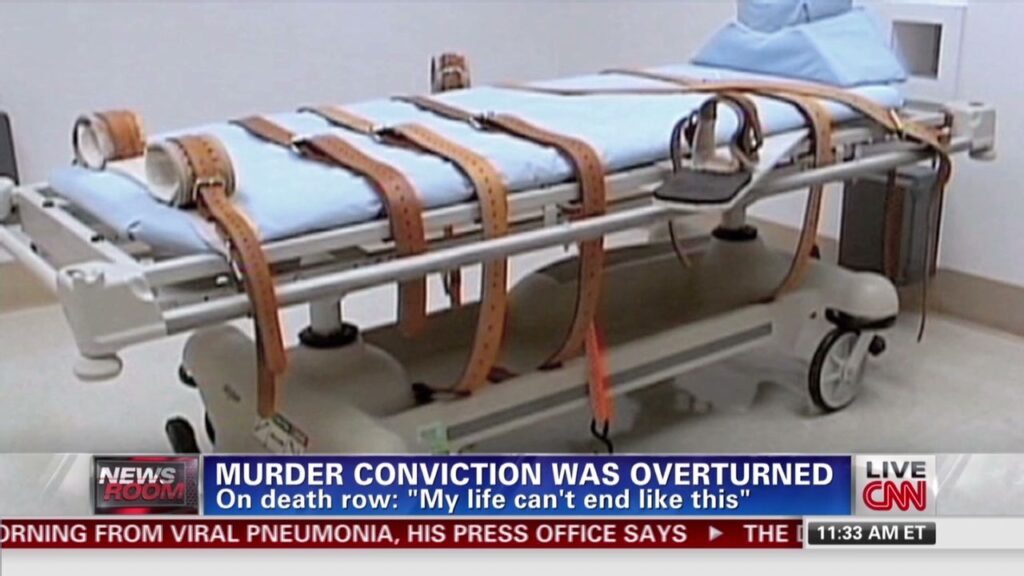
Florida is preparing to carry out three executions in just over three weeks. Three people on death watch. Three lives placed on a fast-moving schedule of irreversible punishment. And one system, increasingly defined by secrecy, speed, and documented failure, asking the public to trust what its own records contradict.
At Sustainable Action Now, our work confronting the death penalty is rooted in a growing body of reporting, legal filings, and advocacy documented through our ongoing coverage of current death penalty causes and campaigns, where communities across the country are challenging the machinery of state violence and demanding accountability.
On Tuesday, February 10, the State of Florida plans to execute Ronald “Ronnie” Heath for the murder of Michael Sheridan. Ronnie’s participation in a robbery that ended in tragedy is undisputed and deeply serious. But the facts surrounding his sentence and Florida’s conduct are far more complicated—and far more alarming—than the state is willing to confront.
Ronnie’s own brother has never denied responsibility for committing the killing. Yet today, Ronnie faces execution while his brother remains legally eligible for parole. That disparity alone raises profound questions about fairness, proportional punishment, and the integrity of Florida’s sentencing outcomes. But the inequity does not stop there.
Florida still has not offered a meaningful public explanation for its own extensive documentation showing that the Department of Corrections failed to follow its lethal injection protocol repeatedly during recent executions. The records reveal the use of expired drugs, preparation of incorrect dosages, administration of substances not authorized under Florida’s written procedures, and failures to properly document what drugs were used or when. In some cases, execution records were filled in only after executions had already occurred.
These are not allegations from outside groups. They are Florida’s own internal logs. And they remain unrebutted.
Ronnie’s legal team has now brought his case to the United States Supreme Court, filing an emergency application asking the Court to halt the execution and review a fundamental constitutional question that Florida courts refused to meaningfully address: whether a documented, repeated pattern of lethal injection errors violates the Eighth Amendment’s prohibition against cruel and unusual punishment.
Ronnie is asking for something profoundly reasonable—that Florida not be allowed to carry out an irreversible punishment while unresolved constitutional violations remain under active litigation. Yet the state is pressing forward anyway.
We are asking the public to stand with Ronnie in the court of public opinion and to take action now:
- Sign the petition to stay Ronnie Heath’s execution
- Send a message urging state officials to pause this execution
- Tell at least two people about Ronnie’s case
- Join an execution vigil in person or online
More than 4,000 people have already signed a petition urging Governor Ron DeSantis and the Clemency Board to stop Ronnie’s execution. The goal is to reach 5,000 signatures before Tuesday. If the execution proceeds, advocates and community members will gather at Florida State Prison at 5 p.m. and at vigils across the state.
This moment is not isolated. It is part of a rapidly accelerating pattern.
Just two weeks after Ronnie’s scheduled execution, Florida plans to kill Melvin Trotter, a 65-year-old man who has spent nearly four decades on death row. His execution is scheduled for February 24.
Melvin’s case is now before the Florida Supreme Court. Earlier this week, his attorneys filed an emergency petition asking the court to stay the execution and order an independent investigation into Florida’s lethal injection practices—again relying on Florida’s own execution records documenting repeated departures from written protocols.
His lawyers have made their position unmistakably clear. Courts do not need to “wait and see” what happens when execution procedures are ignored. History has already shown what happens when safeguards collapse.
Melvin is not asking for extraordinary relief. He is asking Florida’s highest court to do what courts and governors have done before when execution systems fail: pause, investigate, and ensure that constitutional rights are not being violated in the name of the public.
Melvin was sentenced to death for the 1986 murder of Virgie Langford. That crime caused devastating harm, and nothing about opposing Melvin’s execution denies the suffering of those who loved her. But Florida’s response to that violence has long since shifted away from justice and toward institutional routine.
Melvin’s sentence was imposed by a system that routinely discounted severe trauma, instability, and intellectual limitations. Decades later, the state is not evaluating who Melvin is now, what he has become, or whether killing him serves any legitimate public purpose. It is simply carrying out a punishment by rote. Clemency exists for moments like this. Florida is choosing execution because it is easy, familiar, and politically convenient.
The public is being asked to take action for Melvin as well:
- Sign the petition to stay Melvin Trotter’s execution
- Send a message urging a pause and independent investigation
- Learn more about Melvin’s case and the systemic failures that brought Florida here
And still, the execution schedule continues to expand.
On March 3 at 6 p.m., Florida plans to execute Billy Leon Kearse. His death warrant was signed yesterday afternoon. That makes three people on death watch at once. Three executions scheduled in just over three weeks. All three death watch cells filled.
It is an execution assembly line—and it is still early in the year.
Billy was sentenced to death for the 1991 killing of Officer Danny Parrish. Nothing about opposing Billy’s execution diminishes the gravity of that loss or the pain endured by Officer Parrish’s family. But killing Billy now will not bring accountability or healing. It will only add another irreversible act of violence carried out by a system already demonstrating a dangerous disregard for its own safeguards.
Billy was just 18 years old at the time of the crime. His case reflects severe childhood abuse, extreme neglect, and lifelong intellectual and neurological impairments. His death sentence was imposed under an unconstitutional sentencing scheme, yet courts have repeatedly declined to remedy that injustice.
After more than three decades on death row, Billy is no longer the traumatized teenager Florida condemned to die. He is widely described as a thoughtful, deeply spiritual, and remorseful man who has dedicated himself to reflection, faith, and helping others. That transformation has never been meaningfully considered by the Governor, the Clemency Board, or the courts.
Advocates are asking the public to act now by signing Billy’s petition urging the Governor and Clemency Board to stop this execution before it happens.
This rapid succession of death warrants is not an accident. It is the direct result of policy choices made at the highest levels of Florida government. As we continue documenting through our work on death penalty advocacy and reform, Florida’s current leadership has embraced a pace of executions that places speed above transparency and certainty above scrutiny.
Last year alone, Florida carried out nineteen executions—an unprecedented number in the modern era and more than double the state’s previous post-Furman record. Advocacy organizations have described a system increasingly defined not by deliberation or caution, but by procedural acceleration and political messaging.
Governor Ron DeSantis’s willingness to sign death warrants at breakneck speed has continued into 2026. Ronnie Heath is scheduled for execution on February 10. Melvin Trotter is scheduled for February 24. Billy Leon Kearse is scheduled for March 3. Each case carries unresolved legal questions. Each case is moving forward despite documented procedural failures. Each case compounds the risk of irreversible constitutional harm.
Florida’s own records reveal a lethal injection system the state cannot reliably document, explain, or defend. Expired drugs. Unauthorized substances. Incorrect dosages. Missing records. Post-execution documentation. These failures have not been corrected. Instead, investigations have been blocked, and executions have been accelerated.
This is beyond reckless. It is an extraordinary breakdown of public accountability.
While Florida accelerates executions, a very different conversation is unfolding elsewhere in the country.
In California, calls are growing for Governor Gavin Newsom to go further than the moratorium he announced in March 2019, when he halted executions and dismantled the state’s execution protocol. At the time, Newsom stated openly that he had opposed the death penalty his entire life and that voters elected him knowing that position. The decision was widely viewed as a landmark moment in national death penalty reform.
A year later, Newsom authorized the transfer of more than 700 people sentenced to death out of San Quentin and the Central California Women’s Facility and into general population housing across the state. Today, approximately 580 people remain under death sentences in California.
Yet despite those early actions, the Governor has remained largely silent on the broader future of capital punishment in the state and has not used his authority to commute existing death sentences. Advocacy organizations are now urging him to exercise that power and complete what the moratorium began.
Nationally, the landscape is shifting in other ways as well. Even Texas—long described as the nation’s most aggressive execution state—has set fewer execution dates than it has in at least three decades. While Texas remains deeply entangled in capital punishment, the reduction in execution activity signals that change, however uneven, is possible when political leadership and public pressure align.
Florida, however, is moving in the opposite direction.
There is something deeply bitter about continuing to appeal to a clemency process that has so thoroughly failed the people of this state. It is infuriating that communities are repeatedly forced to beg the very officials who created this crisis to stop it. But there is one truth Florida’s leaders cannot escape: these executions exist because they chose them. And they can be undone the same way they were imposed—by the same pen, at any moment.
As Ronnie Heath’s case now sits before the Florida Supreme Court and the United States Supreme Court, the stakes could not be higher. Florida is asking courts and the public to accept an execution system that cannot reliably follow its own rules. It is asking people to trust a process that its own documents show is broken.
Melvin Trotter’s petition before the Florida Supreme Court demands what any functioning justice system would require in the face of such evidence: pause, investigate, and repair.
Billy Kearse’s pending case forces Florida to confront whether a life shaped by trauma, neurological impairment, and extraordinary transformation deserves even a moment of reconsideration before execution.
Across the country, military veterans, legal experts, and advocates are also confronting how extreme punishment intersects with untreated trauma, PTSD, moral injury, and systemic failure—issues that will be explored in an upcoming public webinar hosted by advocacy organizations working to expose how courts and juries have failed to meaningfully evaluate the lives and service histories of defendants facing death sentences.
Meanwhile, faith communities in Florida are raising their voices through the For Whom the Bells Toll campaign, inviting people of faith to publicly oppose executions, toll bells in remembrance, and stand in prayer for all those affected by violence and state killing. From St. Petersburg to Orlando, Jacksonville, Coral Gables, Winter Park, Starke, and Gainesville, communities are gathering for vigils, worship services, and public witness events in the days surrounding these executions.
What unites all of these efforts—from court filings to public vigils, from petitions to national policy debates—is a shared recognition that executions do not heal communities. They do not repair harm. They do not deliver accountability. They extend violence under the authority of the state.
We can acknowledge the gravity of the crimes involved in these cases while refusing to accept execution as the answer. Victims and their loved ones deserve honesty, care, and long-term support—not a justice system that substitutes speed for reflection and secrecy for transparency.
What Florida chooses to do in this moment will be remembered.
But so will what the people of this state choose to do in response.
We are here. We are watching. And together, through sustained public action and continued advocacy across the movement to end the death penalty, we are building the power needed to stop these executions and dismantle a system that has proven, again and again, that it cannot be trusted with life and death.