
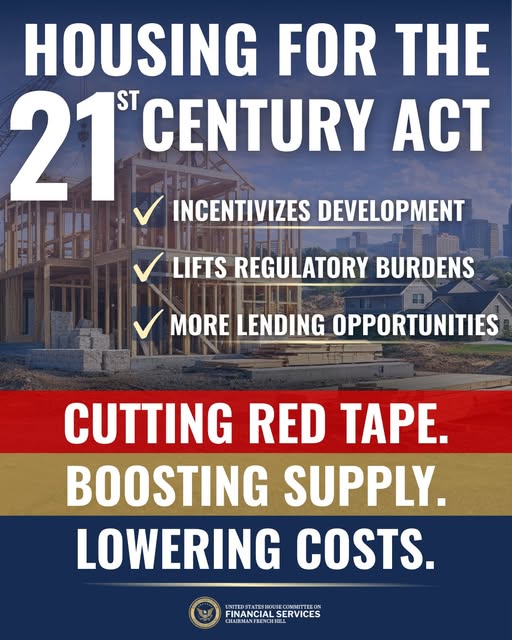
The national housing crisis has become one of the defining economic and social challenges of the 21st century. Across the United States—from dense urban regions to rapidly growing suburban corridors—communities are facing escalating home prices, a shortage of available housing units, and mounting barriers that prevent new construction from keeping pace with demand. Against this backdrop, federal lawmakers have taken a significant step toward addressing the issue with the advancement of the Housing for the 21st Century Act (H.R. 6644), a sweeping bipartisan legislative package designed to increase housing supply, reduce regulatory obstacles, and modernize federal housing programs.
In early March 2026, the United States Senate moved the legislation forward in dramatic fashion. By a decisive 90–8 vote, senators approved a Motion to Proceed, officially bringing the bill to the Senate floor for debate and amendments. While the vote does not represent final passage, it signals overwhelming bipartisan recognition that the nation’s housing shortage requires urgent policy action.
For advocates of sustainable development, local economic stability, and equitable housing access, the advancement of the Housing for the 21st Century Act represents a pivotal moment in federal housing policy. The legislation focuses on structural reforms intended to unlock housing production, mobilize private investment, and modernize federal programs that shape how communities grow.
Understanding the significance of this moment requires a closer look at the bill’s legislative trajectory, its key policy provisions, and the broader implications it may have for sustainable housing, municipal planning, and economic resilience nationwide.
A Rare Moment of Bipartisan Agreement on Housing
Housing policy has often been politically contentious, particularly when it comes to balancing development, affordability, environmental protections, and local governance. Yet the Housing for the 21st Century Act has managed to achieve something rare in Washington: broad bipartisan support.
The legislative momentum began in the House of Representatives, where the bill passed on February 9, 2026, by an overwhelming 390–9 vote. That level of support underscored a growing consensus among policymakers that the country’s housing shortage is not simply a regional issue—it is a national economic challenge that affects workforce mobility, economic productivity, and community stability.
Following its House passage, attention shifted to the Senate. The chamber’s recent 90–8 Motion to Proceed vote cleared a key procedural hurdle, allowing the bill to move forward into formal debate and amendment discussions. Such a lopsided procedural vote is often interpreted as a strong signal that lawmakers from both parties are committed to advancing housing policy reform.
This level of consensus reflects mounting evidence that restrictive zoning rules, lengthy regulatory processes, and insufficient financing mechanisms have significantly constrained housing production across the country.
Rather than focusing on subsidies or short-term interventions, the Housing for the 21st Century Act attempts to address what policymakers increasingly describe as the “supply-side problem” in housing markets.
Why Housing Supply Has Become a National Economic Issue
For years, economists and urban planners have warned that the United States is facing a structural housing shortage. Estimates suggest the country may be millions of units short of the housing needed to meet demand.
Several factors have contributed to this imbalance:
• Lengthy permitting and environmental review processes
• Restrictive zoning and land-use regulations
• Rising construction costs
• Limited financing pathways for affordable housing development
• Infrastructure limitations in growing communities
The consequences are visible across the country. Housing costs have risen faster than wages in many regions, putting pressure on middle-class households and working families. Communities struggling to attract workers increasingly find that housing availability—not job creation—is the bottleneck for economic growth.
The Housing for the 21st Century Act attempts to address these structural issues by focusing on reforms that make it easier to build more homes while still preserving essential environmental protections and community oversight.
Streamlining Regulatory Barriers to Housing Development
One of the most consequential components of the legislation involves changes to regulatory review processes that often delay housing construction.
The bill proposes targeted exemptions from the National Environmental Policy Act (NEPA) review process for certain categories of housing development. Specifically, the reforms are aimed at:
• Infill housing projects
• Rehabilitation of existing structures
• Smaller-scale residential developments
These types of projects often take place in already developed areas and can help communities increase housing density without expanding into undeveloped land. By reducing lengthy environmental review timelines for qualifying projects, lawmakers hope to accelerate construction timelines while still maintaining environmental safeguards for larger or more sensitive developments.
Supporters argue that the reforms are not about weakening environmental protections but about tailoring regulatory oversight to the scale and impact of specific housing projects.
Unlocking Private Capital for Affordable Housing
Another major pillar of the Housing for the 21st Century Act involves expanding the flow of private capital into affordable housing development.
Under current federal banking regulations, financial institutions are limited in how much they can invest in community development and affordable housing projects under the public welfare investment cap. The legislation proposes increasing that cap from 15 percent to 20 percent.
While that change may appear modest on paper, the implications could be significant. By raising the investment threshold, banks would gain greater flexibility to finance affordable housing developments, mixed-income communities, and revitalization projects.
In practical terms, this reform could unlock billions of dollars in new investment capacity for housing development nationwide. For cities and municipalities seeking to address housing shortages, increased access to financing could accelerate the construction of both affordable and workforce housing.
Modernizing Federal Housing Programs
Federal housing programs have long played a central role in supporting community development, but many of these programs were designed decades ago and have struggled to keep pace with changing housing markets.
The Housing for the 21st Century Act includes several updates to the HOME Investment Partnerships Program, one of the federal government’s most important tools for funding affordable housing initiatives.
Proposed updates include:
• Expanded income eligibility thresholds
• Greater flexibility for infrastructure support tied to housing development
• Modernized program structures that reflect today’s housing needs
By updating these programs, lawmakers aim to make federal housing investments more adaptable and responsive to local conditions.
Reimagining Manufactured Housing
Manufactured housing has long been viewed as an important but underutilized component of the nation’s housing supply. These homes can often be produced at lower costs than traditional site-built housing, making them a potential solution for affordability challenges.
However, outdated federal requirements have limited how manufactured homes are classified and financed.
The Housing for the 21st Century Act proposes eliminating the federal requirement that manufactured homes must include a permanent chassis, a legacy design standard that historically distinguished manufactured homes from conventional housing.
Removing that requirement could allow these homes to be treated more like traditional site-built residences in financing, zoning, and regulatory frameworks. Advocates believe the change could open the door to broader acceptance of manufactured housing as a viable option for expanding housing supply.
Strengthening Housing Support for Veterans
Housing stability is a critical issue for veterans, particularly those transitioning from military service into civilian life.
The legislation includes a provision designed to improve access to supportive housing programs for veterans by excluding veterans’ disability benefits from income calculations when determining eligibility for the Veterans Affairs Supportive Housing (VASH) program.
This change would ensure that disability benefits intended to support veterans do not inadvertently disqualify them from housing assistance programs designed to address homelessness and housing insecurity.
Innovative Design Solutions: The “Pattern Book” Approach
One of the most innovative aspects of the legislation involves the introduction of “pattern book” grants, which aim to simplify and accelerate local housing approvals.
Pattern books consist of pre-approved housing designs that meet local building codes, zoning standards, and design guidelines. By establishing a library of pre-reviewed housing templates, municipalities could dramatically reduce the time required for design review and permitting.
For developers, this approach offers a faster pathway to project approval. For communities, it ensures that new housing aligns with established design and planning standards.
Pattern book systems have historically been used in some American cities to maintain architectural consistency while allowing efficient development. By supporting these programs at the federal level, lawmakers hope to encourage broader adoption of streamlined planning frameworks.
The Next Phase: Reconciling Housing Legislation
Although the Senate’s Motion to Proceed represents a major milestone, the legislative process is far from complete.
The Senate is currently expected to reconcile H.R. 6644 with its own housing legislation known as the ROAD to Housing Act. The two bills share similar goals but include different policy approaches in certain areas.
The reconciliation process will involve negotiations aimed at merging the two frameworks into a unified bill that can pass both chambers of Congress.
Once finalized, the legislation would then be sent to the President for signature, marking the culmination of one of the most ambitious federal housing reform efforts in decades.
What This Means for Sustainable Development and Community Planning
For advocates of sustainable growth and responsible development, the Housing for the 21st Century Act could have far-reaching implications.
Increasing housing supply in already developed areas can help reduce urban sprawl, preserve open space, and support more efficient infrastructure use. Infill development and rehabilitation projects often align closely with sustainability goals by revitalizing existing communities rather than expanding into undeveloped land.
Similarly, increasing housing density near transportation corridors and employment centers can reduce commuting distances and lower transportation-related emissions.
The legislation’s emphasis on streamlined permitting, modernized housing programs, and expanded financing opportunities could also empower local governments and developers to pursue housing projects that align with both economic and environmental objectives.
A Defining Moment for Housing Policy
Housing affordability and availability are no longer isolated policy concerns—they are central to the economic health and social stability of communities across the country.
As the Housing for the 21st Century Act advances through the Senate, policymakers, housing advocates, local governments, and developers will be watching closely to see how the final legislation takes shape.
What is clear is that the national conversation around housing is shifting. Rather than focusing solely on short-term interventions, lawmakers are increasingly looking at structural reforms designed to increase housing supply, modernize regulatory frameworks, and mobilize private investment.
If the current momentum continues, the Housing for the 21st Century Act could become one of the most significant housing policy reforms in modern American history—reshaping how communities build, grow, and provide housing opportunities for generations to come.