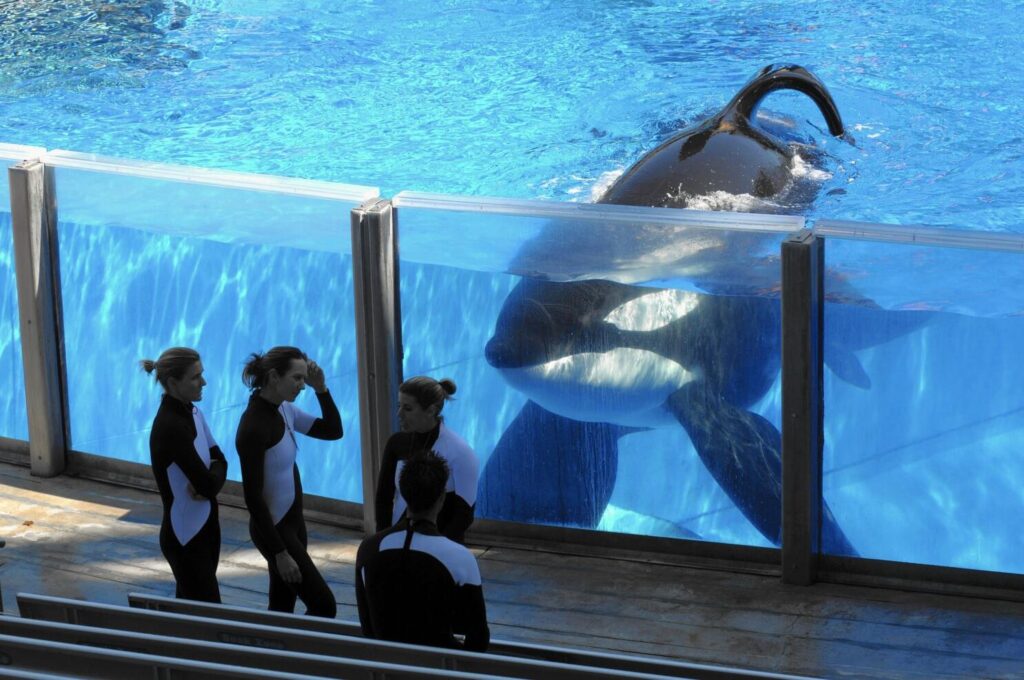
A decade after SeaWorld publicly committed to ending its orca breeding program, the conversation surrounding captive marine mammals has entered a new and far more consequential phase. What was once framed as a gradual transition is now being tested by legal scrutiny, safety concerns, public pressure, and a rapidly evolving standard for animal welfare.
At Sustainable Action Now, this moment represents more than a series of headlines—it is a structural inflection point. The intersection of corporate accountability, animal ethics, and environmental sustainability is no longer theoretical. It is playing out in real time, with implications that extend far beyond a single company.
The 2016 Commitment—and What It Meant
When SeaWorld announced in 2016 that it would end its orca breeding program, the decision was widely seen as a milestone.
The commitment effectively established that the orcas currently in its care would be the last generation held at its parks. It marked a departure from decades of breeding and performance-driven operations, signaling an acknowledgment of shifting public sentiment and ethical expectations.
But commitments are only as meaningful as their execution.
Nearly ten years later, the reality is more complex. The orcas remain in captivity, the timeline for transition remains undefined, and the broader question—what comes next—has become increasingly urgent.
A Surge of Legal and Operational Challenges
Recent developments have intensified scrutiny around SeaWorld’s operations.
In March 2026, a wrongful death lawsuit was filed against SeaWorld Orlando, alleging that operational and maintenance failures contributed to the death of a visitor in 2024. While not directly tied to animal care, the case raises broader questions about safety protocols and organizational oversight.
At the same time, a high-profile legal conflict with Sesame Workshop has added another layer of complexity. The nonprofit organization behind Sesame Street is seeking to terminate a decades-long licensing agreement, citing financial disputes and reputational concerns.
These legal challenges are not isolated—they reflect growing pressure on the company from multiple directions.
Each case contributes to a broader narrative about accountability, governance, and the expectations placed on institutions that operate at the intersection of entertainment and animal care.
Safety Concerns and the Human-Animal Interface
The issue of safety has also re-emerged as a critical point of focus.
In 2025, a federal workplace safety agency proposed a fine following an incident in which a trainer was injured while working with an orca. The findings pointed to insufficient protective measures for employees interacting closely with these animals.
This is a recurring theme in the history of captive orca programs.
Orcas are apex predators with complex social structures and immense physical power. Managing interactions between humans and such animals inherently involves risk. The question is not whether risk exists—it is how it is mitigated.
In this case, the incident has reinforced concerns that existing protocols may not be sufficient, particularly as expectations around workplace safety continue to evolve.
The Status of the Orcas: Aging Populations and Uncertain Futures
Beyond the legal and operational issues lies the most important factor: the animals themselves.
SeaWorld Orlando recently reported the death of its oldest orca, Kina, at the age of 50. Her passing highlights a critical reality—the current population is aging.
As these animals grow older, their needs change. Health care becomes more complex. Environmental conditions become more significant. And the question of long-term planning becomes unavoidable.
If breeding has ended, then the focus must shift entirely to care, quality of life, and eventual transition.
But what does that transition look like?
The Rise of the Seaside Sanctuary Movement
One of the most prominent proposals gaining traction is the relocation of captive orcas to seaside sanctuaries.
Unlike traditional marine parks, these sanctuaries are designed to provide a more natural environment—open water enclosures that allow for greater space, environmental variation, and autonomy.
Advocacy groups have increasingly pushed for this model, arguing that it represents a more ethical and sustainable approach to long-term care.
The concept is not without challenges.
Logistics, funding, environmental conditions, and animal health all factor into the feasibility of such transitions. Moving large, highly specialized marine mammals is a complex undertaking that requires extensive planning and expertise.
But the conversation has shifted.
What was once considered an ambitious idea is now being discussed as a viable pathway forward.
Public Perception and the Changing Cultural Landscape
Perhaps the most significant driver of change is public perception.
Over the past decade, awareness around marine mammal captivity has grown substantially. Documentaries, advocacy campaigns, and increased access to information have reshaped how audiences view these animals and the institutions that house them.
The expectation is no longer entertainment—it is responsibility.
Visitors, consumers, and stakeholders are increasingly evaluating organizations based on their ethical practices. This shift has tangible consequences, influencing everything from attendance and partnerships to legal exposure and brand reputation.
For SeaWorld, navigating this landscape requires more than incremental change. It requires a clear, credible vision for the future.
Sustainability Beyond the Environment
At Sustainable Action Now, sustainability is understood as a multi-dimensional concept.
It is not limited to environmental impact—it includes ethical consistency, operational integrity, and long-term viability.
In the context of marine parks, sustainability raises fundamental questions:
Can a model built on captivity evolve into one centered on conservation and rehabilitation?
Can institutions transition from performance-based experiences to education-driven engagement?
Can animal welfare be fully aligned with public expectations?
These are not simple questions, but they are essential ones.
The Business Model at a Crossroads
SeaWorld’s current situation reflects a broader challenge faced by legacy institutions.
Business models that were once widely accepted are now being reevaluated under new standards. Adaptation is not optional—it is necessary for survival.
This does not mean abandoning core operations overnight. It means redefining them.
It means investing in new forms of engagement, exploring alternative revenue streams, and aligning practices with evolving values.
For marine parks, this could involve expanded conservation programs, partnerships with research institutions, and the development of sanctuary-based models.
What Comes Next
The path forward remains uncertain, but the direction is becoming clearer.
Legal pressures, safety concerns, and public expectations are converging, creating a moment that demands decisive action.
For SeaWorld, this is an opportunity.
An opportunity to lead rather than react.
An opportunity to redefine its role within the broader ecosystem of marine conservation.
And an opportunity to set a precedent for how institutions can evolve in response to changing realities.
A Defining Moment for Marine Animal Welfare
The story unfolding in 2026 is not just about one company or one group of animals.
It is about a shift in how society understands its relationship with wildlife.
It is about moving from control to care, from spectacle to stewardship.
And it is about recognizing that sustainability—true sustainability—requires alignment between what we do and what we believe.
At Sustainable Action Now, we will continue to follow this story closely, connecting developments to the larger conversation around ethics, conservation, and the future of human-animal interaction.
Because the decisions made now will shape not only the fate of these orcas, but the standards that define marine animal welfare for generations to come.