
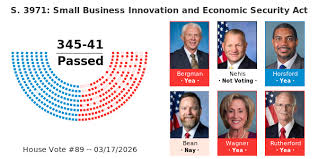
In a decisive move that signals a renewed federal focus on economic resilience and innovation-driven growth, the Small Business Innovation and Economic Security Act (S. 3971) has passed the House—marking a significant milestone in the evolving relationship between public policy and the small business ecosystem.
For Sustainable Action Now, this is not simply a business headline. It is a sustainability story—one that connects economic empowerment, local resilience, clean innovation, and long-term systemic stability. At its core, S. 3971 represents a recognition that the future of sustainable progress in the United States will be shaped not just by large institutions, but by small, agile enterprises operating at the community level.
Why S. 3971 Matters Now
Small businesses are the backbone of the American economy, but their role extends far beyond job creation and local commerce. They are incubators of innovation, drivers of regional identity, and increasingly, leaders in sustainable practices.
In recent years, however, these businesses have faced mounting challenges: supply chain disruptions, inflationary pressure, shifting consumer expectations, and limited access to capital.
S. 3971 emerges in this context as a targeted response—designed to strengthen economic security while unlocking the potential of small businesses to lead in innovation, including sustainability-focused sectors.
The timing is critical. As global markets evolve and environmental priorities intensify, the ability of small businesses to adapt and compete will play a central role in determining the trajectory of both economic and environmental outcomes.
Breaking Down the Core Objectives
While the full scope of the legislation encompasses multiple provisions, its strategic intent can be understood through three primary pillars: innovation acceleration, economic stabilization, and access expansion.
First, the bill emphasizes innovation. By enhancing support structures for research, development, and commercialization, it aims to position small businesses as key contributors to technological advancement. This includes areas such as clean energy, resource efficiency, and sustainable product development.
Second, it focuses on economic security. This involves creating mechanisms that help businesses withstand volatility—whether through improved access to financing, streamlined regulatory processes, or targeted support during periods of disruption.
Third, it expands access. This is particularly significant for underserved communities, where barriers to entry and growth have historically limited participation in the broader economy. By addressing these gaps, the legislation seeks to create a more inclusive and dynamic business landscape.
The Sustainability Connection: Innovation at the Local Level
One of the most important aspects of S. 3971 is how it intersects with sustainability.
Large-scale climate solutions often capture headlines, but meaningful change frequently begins at the local level. Small businesses are uniquely positioned to implement sustainable practices quickly, experiment with new models, and respond directly to community needs.
From zero-waste retail concepts to energy-efficient manufacturing processes, these enterprises are already shaping the future of sustainable commerce.
By strengthening the infrastructure that supports them, S. 3971 indirectly accelerates this transformation.
It creates conditions where sustainable innovation is not just possible, but practical.
Economic Security as a Sustainability Strategy
Sustainability is often framed in environmental terms, but economic stability is a critical component.
Communities that lack economic security are less able to invest in sustainable infrastructure, adopt new technologies, or prioritize long-term environmental goals. Conversely, strong local economies provide the foundation for broader progress.
S. 3971 addresses this dynamic by reinforcing the financial and operational stability of small businesses.
This is not a secondary benefit—it is central to the legislation’s impact. By ensuring that businesses can survive and grow, it enables them to participate in and contribute to the transition toward more sustainable systems.
Policy Meets Practice: What This Means on the Ground
The passage of S. 3971 is not an endpoint—it is the beginning of implementation.
For small business owners, the legislation opens new pathways to funding, support, and collaboration. It encourages engagement with federal programs, partnerships with research institutions, and exploration of new markets.
For policymakers and administrators, it introduces the responsibility of execution. The effectiveness of the bill will depend on how well its provisions are translated into accessible, actionable programs.
For communities, it represents an opportunity.
An opportunity to support local enterprises, foster innovation ecosystems, and build economic structures that are both resilient and forward-looking.
The Competitive Landscape: Positioning the U.S. for the Future
On a broader scale, S. 3971 reflects a strategic effort to enhance the United States’ competitive position in a rapidly changing global economy.
Innovation is no longer optional—it is a requirement.
Countries that invest in small business development, technological advancement, and sustainable practices are better positioned to lead in emerging industries.
By focusing on these areas, the legislation aligns economic policy with long-term strategic goals.
It acknowledges that competitiveness is not just about scale—it is about adaptability, creativity, and the ability to respond to change.
Challenges and Considerations
While the passage of S. 3971 is a positive development, it also introduces challenges.
Implementation complexity, resource allocation, and program accessibility will all influence outcomes. Ensuring that support reaches the businesses that need it most—particularly in underserved areas—will require careful coordination.
There is also the question of measurement.
How will success be defined? By job creation, innovation output, sustainability metrics, or a combination of factors?
These considerations will shape how the legislation is perceived and how its impact is evaluated over time.
The Role of Sustainable Action Now
At Sustainable Action Now, our focus is on connecting policy developments to real-world outcomes.
The passage of the Small Business Innovation and Economic Security Act is a clear example of how legislative action can influence the direction of sustainable progress. It provides a framework, but the results will depend on how that framework is used.
Through continued coverage, analysis, and engagement, we will track how S. 3971 unfolds—highlighting success stories, identifying challenges, and exploring opportunities for further advancement.
A Defining Opportunity for Sustainable Growth
The advancement of S. 3971 represents more than a policy milestone—it is an opportunity to redefine how economic growth and sustainability intersect.
It recognizes the power of small businesses to drive change.
It reinforces the importance of innovation as a catalyst for progress.
And it underscores the need for systems that support both economic resilience and environmental responsibility.
As this legislation moves forward, the focus shifts from passage to impact.
Because ultimately, the success of S. 3971 will not be measured by what it promises—but by what it delivers.
And for those committed to building a more sustainable, inclusive, and resilient future, that delivery has the potential to be transformative.