

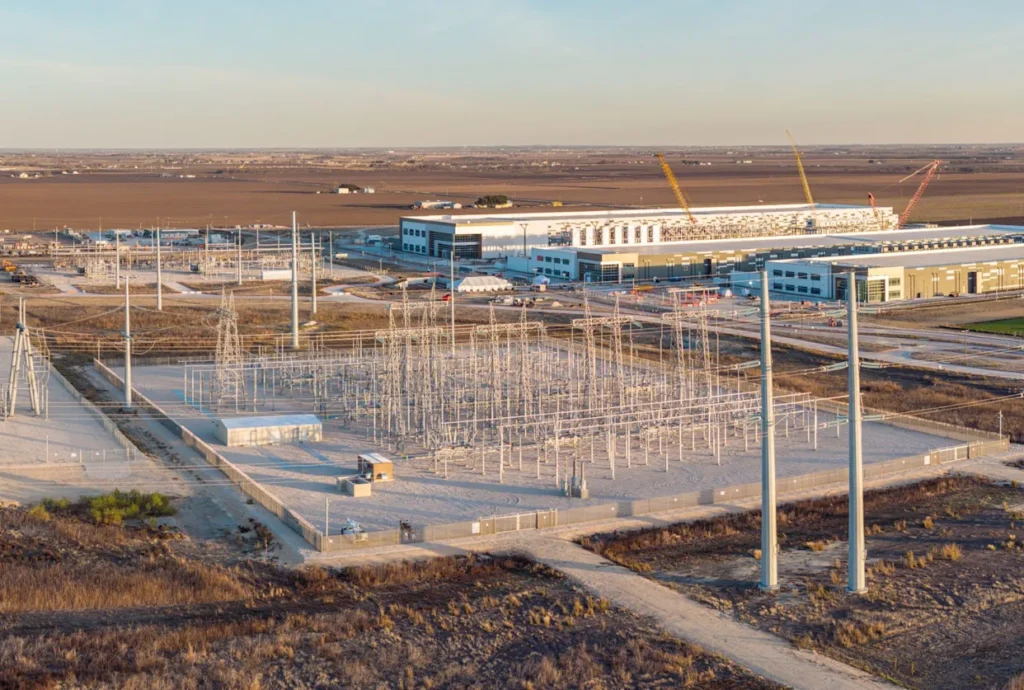
For years, data centers existed largely out of public view — anonymous industrial facilities powering cloud storage, social media platforms, streaming services, financial systems, and the invisible architecture of the modern internet. Most people rarely thought about where digital infrastructure physically lived, how much energy it consumed, or what happened environmentally when massive computational systems expanded into small communities.
That era is ending rapidly.
As artificial intelligence accelerates global demand for computing power at unprecedented scale, rural communities across the United States are increasingly finding themselves on the front lines of a new industrial expansion wave: the race to build hyperscale data centers capable of feeding the exploding energy and processing demands of the AI economy.
Now, one rural Texas county has become the latest flashpoint in that rapidly intensifying national battle.
Hill County, Texas, facing the possibility of eight separate data center developments in its unincorporated areas, has approved a one-year moratorium on new data center construction projects — a move that immediately exposed the growing tension between local communities, corporate technology expansion, environmental sustainability, infrastructure strain, and legal uncertainty. The moment became even more striking when officials reportedly acknowledged the likelihood of legal backlash directly during discussions surrounding the ban.
“We’re gonna get sued.”
That statement may ultimately capture the defining reality of the next major climate and infrastructure conflict emerging across America.
At Sustainable Action Now, conversations surrounding climate and sustainability increasingly involve far more than fossil fuels or renewable energy alone. They now include examining the physical environmental footprint of digital infrastructure itself — especially as artificial intelligence, cloud computing, cryptocurrency operations, and hyperscale server expansion begin consuming staggering quantities of electricity, water, land, and cooling resources.
The Hill County moratorium matters because it reveals something fundamental changing in public awareness: communities are beginning to recognize that the digital economy is not environmentally weightless.
Every AI prompt, cloud service, streaming platform, search query, data transfer, and machine learning system ultimately relies on physical infrastructure somewhere. Massive buildings. Continuous electricity consumption. Industrial cooling systems. Water-intensive operations. Transmission upgrades. Backup generators. Land acquisition. Constant expansion.
The environmental scale involved is enormous.
Modern hyperscale data centers can consume as much electricity as small cities. Some facilities require millions of gallons of water annually for cooling systems. Others demand major transmission infrastructure upgrades capable of reshaping local power grids entirely. As AI development accelerates, the industry’s appetite for energy and resources is expected to grow dramatically larger.
This is precisely why rural communities like Hill County are increasingly becoming battlegrounds.
Data center developers often target rural regions because land costs are lower, permitting can initially appear easier, and large tracts of undeveloped space allow massive industrial expansion. Yet once projects begin moving forward, communities frequently realize the scale of transformation involved may far exceed what residents originally anticipated.
That realization appears to be driving much of the tension now unfolding in Texas.
The proposed one-year moratorium specifically impacts unincorporated areas of Hill County, where concerns surrounding multiple potential developments reportedly triggered fears about long-term infrastructure strain, environmental consequences, land use disruption, and the county’s overall ability to regulate rapid industrial expansion responsibly.
Importantly, this is not merely a local zoning disagreement.
It represents a much larger national conflict involving how communities balance economic development promises against environmental sustainability, resource limitations, quality-of-life concerns, and local autonomy in the age of AI infrastructure expansion.
At Sustainable Action Now, one of the most important aspects of this emerging conflict is how effectively it exposes the hidden environmental costs of the modern digital economy.
For years, much of the tech industry benefited from perceptions of immateriality. Unlike factories, pipelines, mines, or heavy industrial operations, digital platforms often appeared relatively detached from visible environmental impact. Yet the infrastructure supporting modern computational systems increasingly resembles a new form of industrial expansion itself — one requiring enormous resource consumption operating continuously around the clock.
Artificial intelligence has intensified this dramatically.
Large-scale AI systems require extraordinary computational power not only for deployment, but for training models involving massive datasets and energy-intensive processing operations. The race among technology companies to dominate AI development is now driving urgent demand for additional server capacity nationwide.
The result is a rapidly accelerating data center construction boom.
But communities are beginning to push back.
Hill County’s moratorium reflects growing concern that local governments may not yet possess adequate regulatory frameworks to fully evaluate the long-term consequences of large-scale data infrastructure projects before approvals occur. Water usage, electrical demand, environmental resilience, tax structures, emergency services, land use compatibility, and sustainability impacts all become major issues once multiple projects cluster within the same region.
This creates a difficult political and economic dilemma.
Data center developers often promote projects through promises of economic growth, tax revenue, infrastructure investment, and technology-sector expansion. Local officials facing budget pressure or seeking economic development opportunities may initially welcome those proposals enthusiastically.
Yet critics increasingly argue the economic benefits do not always align proportionally with environmental and infrastructural burdens placed on communities.
Unlike manufacturing industries generating large long-term labor forces, many data centers create relatively limited permanent employment once construction concludes. At the same time, they may consume enormous amounts of local energy and water infrastructure continuously.
This imbalance is fueling rising skepticism nationwide.
The Texas moratorium therefore reflects more than caution. It reflects a deeper reassessment of what sustainable economic development actually means in the AI era.
The legal tension surrounding the decision also reveals another major reality shaping modern climate and infrastructure politics: local governments increasingly fear litigation when attempting to regulate powerful industries.
The reported acknowledgment that the county could face lawsuits demonstrates how difficult it has become for municipalities to navigate large-scale development conflicts involving corporate investment interests. As data infrastructure becomes economically central to national technology competition, local resistance may increasingly encounter aggressive legal and political pressure.
This dynamic mirrors earlier environmental conflicts involving pipelines, fracking, industrial agriculture, mining, and energy infrastructure projects. Communities attempting to slow or regulate development often face accusations of obstructing progress, economic growth, or technological competitiveness.
Yet the concerns themselves remain deeply legitimate.
Texas already faces significant challenges involving energy reliability, water stress, extreme heat, population growth, and climate vulnerability. Adding multiple hyperscale data facilities into rural infrastructure systems naturally raises serious questions regarding long-term sustainability and resilience.
The climate implications are especially important.
Data centers increasingly sit at the center of contradictory narratives surrounding technological progress. On one hand, AI and digital systems may assist with climate modeling, efficiency optimization, scientific research, grid management, and sustainability innovation. On the other hand, the infrastructure supporting those technologies may itself dramatically increase electricity demand and environmental strain if growth remains unchecked.
This contradiction may become one of the defining environmental debates of the next decade.
Can societies simultaneously expand AI infrastructure exponentially while reducing emissions and resource consumption sustainably? Can renewable energy deployment scale quickly enough to support exploding computational demand? Can water-intensive cooling systems remain viable in drought-prone regions increasingly stressed by climate change itself?
Communities like Hill County are confronting these questions earlier than many others.
At Sustainable Action Now, another crucial aspect of the story involves democratic participation itself. Residents in rural communities often feel excluded from major development decisions occurring rapidly around them. Large-scale projects negotiated between corporations and local officials can fundamentally reshape landscapes, infrastructure systems, environmental conditions, and community identity long before residents fully understand the implications.
Moratoriums therefore frequently emerge not simply as opposition, but as demands for time.
Time to evaluate environmental studies. Time to understand infrastructure needs. Time to assess legal authority. Time to involve residents meaningfully in decisions potentially altering their communities for generations.
That pause itself becomes politically controversial because the AI economy is moving at extraordinary speed.
Technology companies are racing aggressively to secure land, power agreements, cooling access, and server capacity before competitors dominate emerging AI markets. Delays therefore carry significant financial implications. This creates enormous pressure on local governments to approve projects rapidly even when long-term consequences remain uncertain.
The Hill County decision reflects growing discomfort with that acceleration.
It also reveals how climate conversations are evolving beyond traditional environmental frameworks. The future of sustainability increasingly involves digital infrastructure, computational growth, energy-intensive AI systems, and resource allocation questions that barely existed in mainstream climate discourse a decade ago.
The image of rural Texas communities confronting hyperscale AI infrastructure would have seemed almost surreal not long ago. Today, it may represent the beginning of a much larger national trend.
As data center demand expands nationwide, more counties, municipalities, and residents are likely to begin questioning how much infrastructure growth local ecosystems and utilities can realistically absorb. Water scarcity concerns, energy reliability pressures, land use disputes, and environmental review battles will almost certainly intensify.
And perhaps most importantly, communities are beginning to understand something the broader public is only starting to fully grasp:
The future of artificial intelligence is not floating invisibly in “the cloud.”
It is being built physically, industrially, and environmentally on real land, inside real communities, consuming real resources at scales increasingly impossible to ignore.