
The death penalty in the United States continues to operate with a rhythm that is as relentless as it is contested. In 2026, that rhythm has already produced executions across multiple states, with more scheduled and pending as the year unfolds. Yet within this system—often described as procedural and definitive—recent developments have exposed something far less certain: a structure repeatedly interrupted by doubt, legal challenge, and the undeniable weight of unresolved evidence.
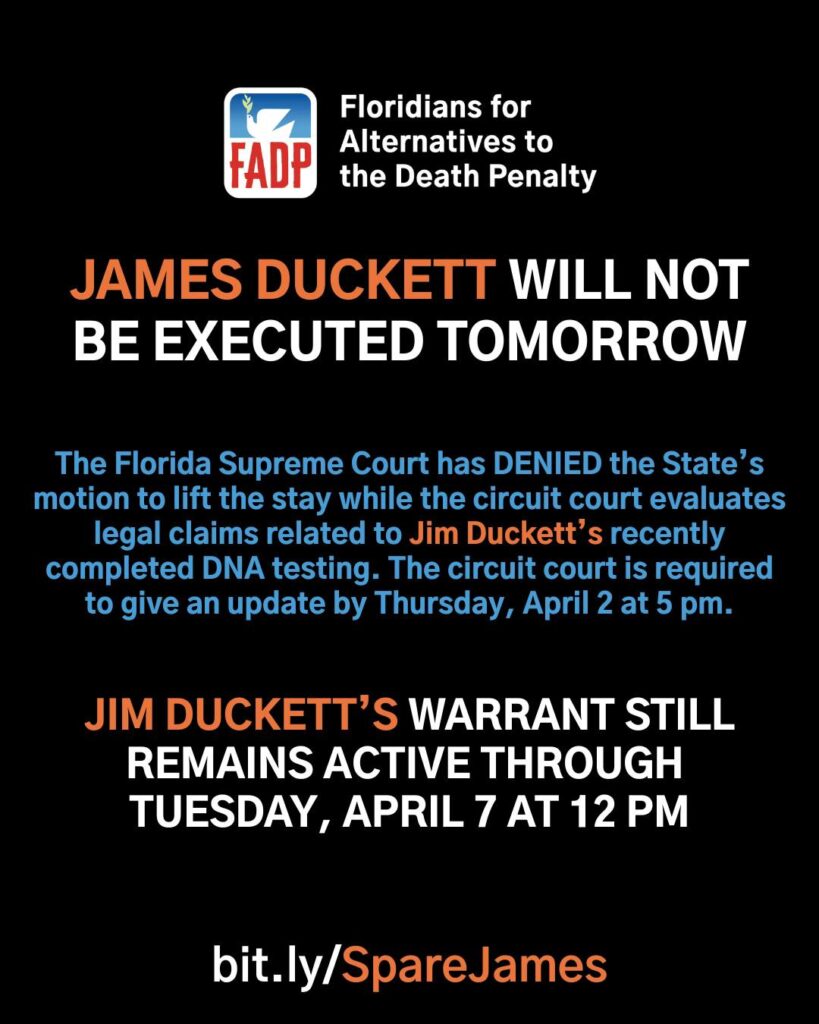
At the center of this moment is a case that has captured national attention not because of its finality, but because of its interruption. James Duckett, a man who has spent decades on Florida’s death row while maintaining his innocence, was scheduled to be executed under an active death warrant. What followed was not a routine progression toward execution, but a series of legal interventions that have, at least for now, halted that outcome and reopened fundamental questions about evidence, process, and the risks embedded within capital punishment.
The Florida Supreme Court’s decision to issue a stay of execution marked a critical turning point. The basis for that decision was not procedural delay, but the existence of ongoing DNA testing—evidence that had not yet been fully examined or resolved. The implications of this are profound. In a system where execution is irreversible, the presence of incomplete or inconclusive evidence introduces a level of uncertainty that cannot be reconciled with finality. The Court’s intervention acknowledged this tension, pausing the process to allow for further review.
What has unfolded since that initial stay reflects the complexity and fragility of capital cases. The testing in question did not produce definitive results, yet the State itself acknowledged that more advanced analysis could potentially yield greater clarity. Despite this, access to the underlying data—necessary for independent evaluation—was denied at the circuit court level. This decision effectively limits the ability to fully interrogate the evidence, raising concerns about whether the pursuit of finality is being prioritized over the pursuit of truth.
The Florida Supreme Court’s subsequent actions have extended the timeline beyond the original warrant period, ensuring that execution cannot proceed under the current schedule. This development is significant, not only because it prevents an immediate execution, but because it reinforces the role of judicial oversight in a system where errors cannot be undone. The case remains active, and the questions at its core—about evidence, access, and interpretation—are far from resolved.
This moment is not isolated. It exists within a broader landscape where capital punishment continues to be applied unevenly and, at times, inconsistently. So far this year, executions have been carried out in a small number of states, while dozens more are scheduled across the country. Yet even within this framework, variability is evident. Some states face logistical barriers, such as the inability to obtain lethal injection drugs, effectively halting executions despite active warrants. Others continue to move forward, maintaining a pace that reflects both legal authorization and political will.
The uneven application of the death penalty is further illustrated by recent decisions at the state level. In Alabama, the commutation of a death sentence to life without parole in the case of Charles “Sonny” Burton highlights the role of executive discretion in correcting disparities. The reasoning behind the decision—that it would be unjust to execute one participant in a crime while another, more directly responsible, was not—underscores the inconsistencies that can arise within capital sentencing.
Similarly, judicial developments in Pennsylvania have challenged aspects of sentencing that intersect with the broader framework of capital punishment. The determination that mandatory life without parole for felony murder is unconstitutional reflects an ongoing reassessment of how punishment is applied, particularly in cases where individual culpability may vary significantly.
These developments are part of a larger pattern, one that reveals a system in constant tension between enforcement and reconsideration. The death penalty is often presented as a fixed mechanism, but in practice, it is subject to continuous adjustment—through court rulings, executive actions, and logistical constraints. Each of these factors contributes to an environment where outcomes are not as predictable as they may appear.
Within this context, the role of advocacy and public engagement becomes increasingly significant. The pause in James Duckett’s case did not occur in isolation; it was shaped by legal efforts, investigative work, and sustained public attention. This convergence of factors demonstrates that the system is not impervious to influence. It can be challenged, slowed, and, in some cases, redirected.
The broader conversation around capital punishment is evolving, reflecting a growing awareness of its limitations and risks. Questions about wrongful convictions, evidentiary standards, and the potential for irreversible error are no longer peripheral—they are central to the debate. The existence of cases where DNA evidence remains unresolved at the point of execution highlights a fundamental contradiction within the system: the pursuit of certainty in the absence of complete information.
This contradiction is increasingly recognized across platforms dedicated to examining justice and reform, including ongoing analysis within Sustainable Action Now’s death penalty coverage. The focus is not only on individual cases, but on the structures that produce them—systems that must be evaluated not just for their outcomes, but for their processes.
At the same time, the machinery of capital punishment continues to operate. New execution dates are set even as others are delayed or halted. The signing of additional death warrants, including recent developments in Florida, reflects a system that moves forward even as it is being questioned. This duality—progression alongside interruption—defines the current moment.
The implications extend beyond any single case. They speak to the broader issue of how justice is administered when the stakes are absolute. The possibility of executing an individual before all evidence has been fully examined is not a theoretical concern; it is a present risk, one that has been brought into sharp focus by recent events.
What emerges from this landscape is not a clear resolution, but a heightened awareness of the system’s vulnerabilities. The pauses, stays, and reversals are not signs of failure alone—they are also indicators of a system under pressure, responding to challenges that cannot be ignored.
As the year progresses, the trajectory of capital punishment in the United States will continue to be shaped by these dynamics. Legal challenges will persist, new evidence will emerge, and the balance between enforcement and reconsideration will remain in flux. The outcome of individual cases will matter, but so too will the broader patterns that define how those cases are handled.
In this environment, the importance of vigilance cannot be overstated. The decisions made at each stage—from evidence collection to final ruling—carry consequences that extend far beyond the courtroom. They determine not only the fate of individuals, but the integrity of the system itself.
The stay in James Duckett’s case is, for now, a moment of reprieve. It is not an endpoint, but a pause that allows for further examination. It is a reminder that within even the most entrenched systems, there remains space for intervention, for reconsideration, and for the possibility that outcomes are not fixed until they are carried out.
And in a system where the ultimate outcome cannot be undone, that space—however temporary—matters.