This week in Tuscaloosa, a truck transporting live chickens overturned on a busy roadway, sending birds scattering across the highway. For a brief moment, they experienced something the system never intended to give them: freedom. That moment was short-lived. The chickens were rounded up, reloaded, and returned to the same industrial pipeline that will ultimately end their lives.
The incident was treated as a traffic disruption. It should have been treated as a warning.
What happened in Alabama is not an isolated accident. It is a visible fracture in a global system that treats living beings as cargo—stacked, shipped, and discarded in the name of efficiency and profit. From U.S. highways to European ports, live animal transport continues to expose animals to extreme suffering with little accountability and even less public scrutiny.
To understand why this matters—and why it must change—visit Sustainable Action Now’s in-depth coverage on live animal transport at https://sustainableactionnow.org/live-animal-transport/.
When Animals Become “Spillage”
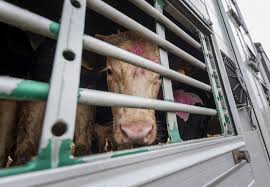
Live animal transport accidents occur with disturbing regularity. Trucks carrying chickens, pigs, cows, and other animals crash, tip, or malfunction, often resulting in mass injury or death. Survivors are rarely treated as victims. Instead, they are considered recoverable inventory.
In Tuscaloosa, the chickens that spilled onto the road were not rescued. They were reclaimed.
This response is standard. Animals involved in transport accidents are almost always returned to the supply chain if they can still stand, regardless of trauma. Veterinary care is minimal or nonexistent. Euthanasia, when it occurs, is typically carried out for economic—not humane—reasons.
The system is designed this way. Once animals are loaded onto trucks, trains, or ships, their welfare becomes secondary to delivery schedules.
Europe’s Live Export Ports: Suffering on an Industrial Scale
The same logic governs live animal exports overseas, where cruelty is magnified by distance and duration. At the port of Cartagena, Spain—one of Europe’s primary live animal export hubs—investigators recently documented conditions that reveal the true cost of this trade.
Thousands of animals arrived by truck in continuous convoys stretching to the horizon. Sheep and other animals were unloaded only to be forced onto massive transport vessels bound for destinations outside the European Union. Once these ships leave EU waters, oversight effectively ends.
Investigators observed animals in severe distress:
- Sheep biting metal bars in visible desperation
- Animals overheating in extreme temperatures
- Bodies packed so tightly movement was nearly impossible
- Untreated wounds, infections, and injuries clearly visible
These are not rare violations. They are routine conditions within a system built for volume, not welfare.
Every year, hundreds of thousands of animals pass through ports like Cartagena. For them, there is no exit. No refuge. No meaningful protection once the ship sails.
Out of Sight, Out of Protection
Live animal transport by sea is particularly dangerous because enforcement collapses once vessels leave regulated waters. Existing laws—where they exist at all—are difficult to monitor and even harder to enforce.
Animals may spend days or weeks at sea enduring:
- Heat stress and dehydration
- Inadequate ventilation
- Disease outbreaks
- Injuries from constant motion and overcrowding
- Deaths with bodies left among the living
There is no emergency response for animals at sea. No independent inspections. No accountability when animals die in transit.
This is not a gap in regulation. It is a known and accepted feature of the system.