

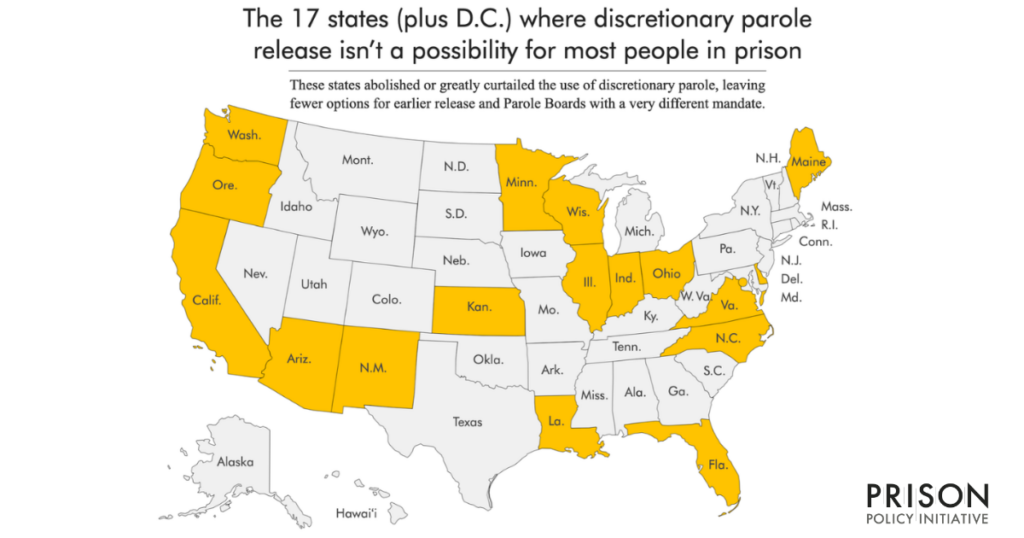
The American criminal justice system loves a clean narrative, and one of the tidiest stories it has told for decades is this: some states have parole, and some states do not. The implication is clear — states that “abolished” parole are tougher, more serious about accountability, more committed to making people serve the sentences courts handed down. It is a narrative that has shaped legislation, influenced elections, and kept hundreds of thousands of people behind bars longer than the evidence suggests is necessary or just. It is also, in critical respects, not accurate.
A rigorous new analysis from the Prison Policy Initiative, published in June 2026, dismantles the binary in precise and consequential detail. Seventeen states and the District of Columbia have eliminated discretionary parole for most or all incarcerated people — a category that includes some of the country’s largest prison systems, among them California, Florida, and Illinois. But what that headline number obscures is that every single one of those jurisdictions still maintains a functioning parole authority, still conducts release hearings, and still operates a range of mechanisms by which incarcerated people can leave prison before the absolute end of their sentence. The parole is not gone. It has been narrowed, restricted, and redesigned in ways that strip most people of access to it — while preserving the administrative infrastructure and, critically, the continued carceral benefit of keeping the population inside.
Understanding what is actually happening in these so-called “no parole” states is not an academic exercise. It is essential context for anyone trying to evaluate the argument — now being made with increasing urgency by criminal justice researchers, advocates, and economists — that American prisons are holding far more people for far longer than public safety requires, at an enormous cost to the people incarcerated, their families and communities, and the taxpayers who fund a carceral system that incarcerates more people per capita than any other nation on earth.
The Discretionary Parole Rollback: What Actually Happened
Beginning in the 1970s and accelerating through the 1980s and 1990s, a wave of “tough on crime” legislation swept through state legislatures across the country. One of its central targets was discretionary parole — the system by which a parole board could evaluate an incarcerated person’s rehabilitation, conduct, and readiness for reentry and authorize their release before the end of their maximum sentence. Critics of discretionary parole argued that it created sentencing uncertainty, allowed violent offenders to return to communities too early, and introduced subjectivity into what should be a predictable punishment structure. The political momentum behind these arguments was powerful, and it produced results.
Seventeen states and the District of Columbia have since formally abolished or severely curtailed discretionary parole for most or all people sentenced under post-abolition laws. This structural change is often described under the banner of “truth in sentencing” — the idea that a sentence should mean what it says, that a person sentenced to ten years should serve ten years rather than becoming eligible for release at the discretion of a board that meets behind closed doors and applies criteria that can be opaque, inconsistent, and subject to racial and socioeconomic bias.
The truth-in-sentencing argument is not without merit on its face. Parole systems across the country have significant documented problems: inconsistent standards, racial disparities in release rates, insufficient transparency, and inadequate support for people navigating the reentry process. But the response to a broken discretionary parole system was not to fix it. In seventeen states and the District of Columbia, the response was to eliminate it for most people — and the consequences of that choice are still being borne by the men and women inside these systems today.
What “Abolished” Actually Looks Like in Practice
The Prison Policy Initiative’s June 2026 analysis makes clear that the phrase “abolished discretionary parole” describes a legal change to who can access what kind of release, not the elimination of parole infrastructure altogether. Every jurisdiction that has formally abolished discretionary parole still has a parole board or equivalent authority. Those boards still hold hearings, still process applications, and still make consequential decisions about conditional release and supervision. What has changed is the population they serve — in most cases narrowed dramatically to people sentenced under pre-abolition laws, people serving certain types of life sentences, and individuals in specific carve-out categories defined by the age at which they committed their offense or the nature of their sentence.
The scale of that narrowing is striking when you look at the actual numbers. In California, which moved away from discretionary parole beginning in 1976, approximately 41,464 people retained access to the traditional discretionary system as of 2021 — a fraction of the state’s overall incarcerated population of well over 100,000. In Illinois, which abolished discretionary parole in 1978, only 39 people were eligible for discretionary release as of 2022. The board continues to exist. It continues to convene. It continues to make decisions. But the population it can actually reach has been reduced to near-zero over the decades since the law changed.
The states that have abolished or curtailed discretionary parole span every region of the country and represent some of the most politically and demographically diverse states in the union: Arizona, California, Delaware, Florida, Illinois, Indiana, Kansas, Maine, Minnesota, Mississippi, New Mexico, North Carolina, Ohio, Oregon, Virginia, Washington, and Wisconsin, along with the District of Columbia. What they share is not a common political identity — this list includes both deep-red and deep-blue states — but a common policy choice made during the peak years of the incarceration boom, often in response to a specific high-profile crime or sustained political pressure that made expanding prison sentences the path of least resistance.
The Release Mechanisms That Remain — and Their Limitations
Abolishing discretionary parole did not eliminate all pathways out of prison before the end of a sentence. What it did was replace a flexible, individualized assessment system with a set of more rigid, less accessible mechanisms that operate under different names and different rules across different states.
Mandatory supervised release is one of the most common substitutes. Under this model, a person is automatically released after serving a defined portion of their sentence — the discretion of a board is removed, but so is the flexibility to release someone earlier if their circumstances warrant it or later if genuine safety concerns remain. The release happens on a schedule determined at sentencing, not through an ongoing assessment of the individual’s development and risk profile. Illinois uses this model, requiring mandatory supervised release of six months to three years following the prison term, depending on the class of felony.
Mandatory conditional release programs, used in Florida and several other states, apply specifically to certain categories of offense — violent crimes, repeat offenses, or people with certain felony histories — and impose a period of post-release supervision structured by the sentencing court rather than a parole authority. Post-release community supervision programs, used in Arizona and California, function similarly but with varying levels of oversight and support. These mechanisms provide some structured transition between incarceration and full community reentry, which is valuable. What they do not provide is the individualized assessment of rehabilitation and readiness that the discretionary parole process, at its best, was designed to deliver.
The critical gap that the Prison Policy Initiative’s analysis identifies is this: all of these alternative release mechanisms are less flexible, less individualized, and in most cases less responsive to what is actually happening with the person inside than a well-functioning discretionary parole system would be. They release people on a calendar, not on a judgment. And in states where discretionary parole still exists, the system — whatever its flaws — at least creates the theoretical possibility that a person who has demonstrably transformed can make that case to a board and earn their way home.
The Comparison That Changes the Narrative
One of the most significant findings in the Prison Policy Initiative’s analysis is that the parole and conditional release systems in states that have abolished discretionary parole are not, in practice, as radically different from active discretionary parole states as the political rhetoric around parole abolition has suggested. The mechanisms are different. The legal frameworks are different. The names are different. But the basic infrastructure of conditional release — hearings, supervision requirements, revocation processes, board oversight — exists in both categories of state.
This comparison matters because it undermines the premise that parole abolition was a fundamental restructuring of how states manage release. In most cases, it was a narrowing — a decision to remove access to the most flexible and individualized form of release for the largest number of people, while preserving the apparatus and the secondary mechanisms in a more restricted form. The people who lost access to discretionary parole did not gain a cleaner or more just system in its place. They gained a more rigid one that responds less to who they have become and more to the arithmetic of their original sentence.
The Stakes: Mass Incarceration, Human Cost, and Public Safety
The United States incarcerates more people per capita than any other country in the world. That fact is not a function of unusually high crime rates — research consistently shows that incarceration rates are driven far more by policy choices about sentence length and release criteria than by underlying rates of criminal behavior. The decision made by seventeen states and the District of Columbia to remove discretionary parole for most incarcerated people was one of the most consequential of those policy choices, and it has contributed meaningfully to the scale of the carceral system that the country now maintains.
The human cost of that choice is carried by incarcerated people who could be safely released but are not, by their families who live with the consequences of prolonged separation, by communities that lose the economic and social contribution of people who remain imprisoned, and by a public that funds a system far larger than public safety requires. Research on recidivism consistently shows that the marginal public safety benefit of longer incarceration diminishes significantly after a person has served the initial portion of their sentence — the period during which the incapacitation effect is most meaningful. Keeping people incarcerated well beyond that point does not make communities safer in any measurable way, and it comes at enormous financial and human cost.
The Prison Policy Initiative’s analysis makes a point that deserves to sit at the center of every policy conversation about parole: the states that have abolished discretionary parole still have the infrastructure to do more. The parole boards are there. The hearing processes are there. The supervision systems are there. What is missing is the political will to expand access to release mechanisms that the research says are safe, effective, and necessary for a carceral system that has grown far beyond what justice or public safety can justify.
What Reform Looks Like From Here
The path forward in states that have abolished discretionary parole does not require reinventing the wheel. It requires expanding access to the mechanisms that already exist — broadening the categories of people eligible for early release hearings, requiring boards to apply transparent and evidence-based criteria, creating meaningful opportunities for people to demonstrate their rehabilitation and have that demonstration actually matter, and ensuring that supervision conditions after release are designed to support successful reentry rather than to create technical violations that return people to prison.
Several states are already moving in this direction. California’s Proposition 57, which created a pathway for nonviolent third-strikers to seek early parole consideration, is one example of the kind of targeted expansion that can meaningfully reduce prison populations without compromising public safety. Emerging adult provisions — the recognition that people who committed their offenses before age 26 have significantly higher capacity for rehabilitation than older adults — are being incorporated into parole eligibility criteria in states including California and Illinois.
These are genuine steps, and they deserve recognition. But they are also modest relative to the scale of the problem. Seventeen states and the District of Columbia have systems that are keeping large numbers of people incarcerated past the point where their continued imprisonment serves any demonstrable public purpose. The research is clear. The infrastructure exists. What the moment requires is the political courage to acknowledge that “truth in sentencing” produced a truth about American punishment that the country needs to confront honestly: we built a carceral system larger than justice requires, and we can build something better.
At Sustainable Action Now, the connection between private prison interests and the political resistance to parole reform is not incidental. The private prison industry — which profits directly from high incarceration rates and long sentence lengths — has invested consistently in the political infrastructure that supports mandatory minimums, truth-in-sentencing laws, and the rhetorical framework that frames parole as a threat to public safety rather than as a tool of justice. Understanding who benefits from keeping parole systems restricted, in states that nominally abolished it and states that nominally retained it, is essential context for understanding why reform has been so slow even as the evidence for its necessity has grown so strong.
The people inside these systems are not abstractions. They are human beings whose capacity for growth, transformation, and contribution to their communities does not disappear because a legislature in 1983 or 1993 decided that parole boards should no longer have the authority to recognize it. The least the systems that hold them owe them is an honest accounting of what “abolished parole” actually means — and a genuine commitment to using the mechanisms that remain to do far more than they currently do.
Sustainable Action Now will continue covering criminal justice reform, private prison accountability, and the policy debates shaping mass incarceration in America.