
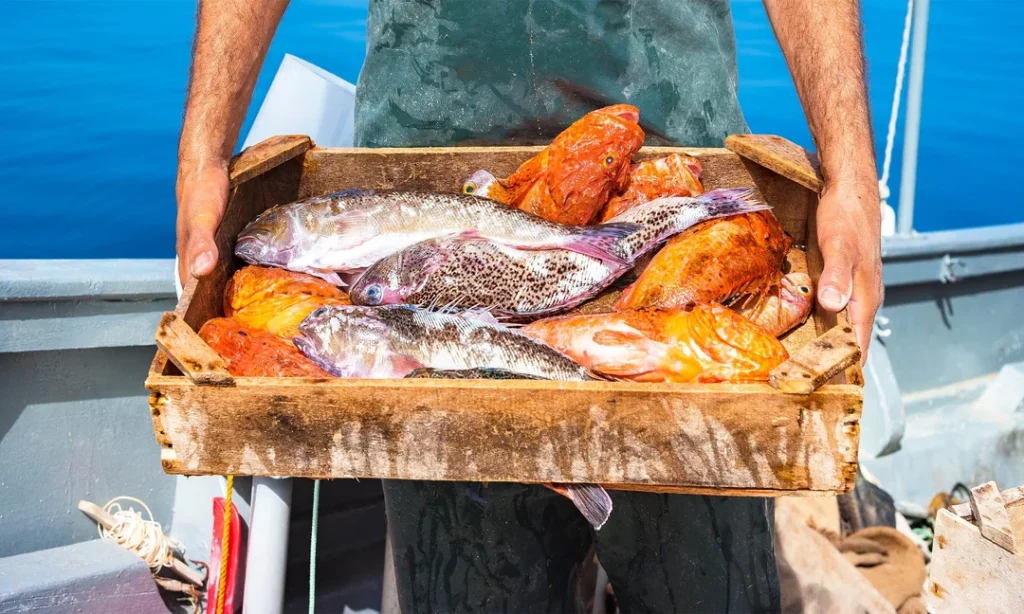
For decades, the question of whether fish and crustaceans feel pain has lingered at the edges of public awareness, often dismissed or simplified in ways that allowed industries and consumers alike to continue longstanding practices without scrutiny. That era is ending. The scientific conversation has evolved, and with it, a growing body of evidence is reshaping how we understand the inner lives of animals pulled from the water, handled, processed, and consumed on a global scale. What was once debated as uncertain is now increasingly understood with clarity: these animals do not simply react—they experience distress, discomfort, and conditions that align with what we define as pain.
At the center of this shift is the recognition that fish, lobsters, crabs, and other marine species possess the biological and neurological mechanisms necessary to detect and respond to harmful stimuli.
These are not primitive systems operating on simple reflex alone. They include specialized sensory structures known as nociceptors—receptors designed specifically to identify damaging conditions such as extreme heat, chemical exposure, or physical injury.
The presence of these receptors is not incidental. It is a functional adaptation, one that signals the importance of detecting harm and responding to it in ways that protect the organism. When an animal’s body is wired to identify damage with this level of specificity, the implication is not neutrality—it is sensitivity.
This biological foundation is reinforced by observable behavior that goes far beyond automatic response. Fish subjected to injury demonstrate actions that mirror attempts to alleviate discomfort. When exposed to irritants, they do not simply swim away; they engage in repeated rubbing of the affected area against surfaces, a behavior that serves no mechanical survival function but appears to address a lingering sensation.
This is not a fleeting reflex. It is sustained, deliberate, and indicative of an internal state that persists beyond the initial stimulus.
Equally significant is the evidence of decision-making under competing pressures. In controlled environments, fish have been shown to enter areas associated with discomfort when food is present, but avoid those same areas when hunger is not a factor. This behavior suggests a form of prioritization—an ability to weigh competing needs and make choices accordingly. Such responses imply a level of processing that cannot be reduced to simple stimulus and reaction. It reflects a system capable of evaluating conditions and adjusting behavior based on internal experience.
Physiological responses further reinforce this understanding. When removed from water, fish exhibit a dramatic increase in cortisol, the hormone associated with stress in vertebrates, including humans. This is not a mild fluctuation; it is a full-scale stress response, consistent with a state of acute distress. The visible behaviors—gasping, thrashing, and attempts to escape—are not random movements. They are physical manifestations of a body struggling against a life-threatening condition.
The process of asphyxiation is central to this experience. For a fish, being out of water is not a neutral state; it is the functional equivalent of suffocation. Their gills, designed to extract oxygen from water, collapse in air, leaving them unable to breathe. The frantic movements observed on the decks of boats or in processing environments are not incidental—they are the direct expression of an organism attempting to survive a condition that it cannot physiologically endure. The duration of this process, often extending for minutes or longer, raises profound questions about the ethics of current harvesting practices.
Crustaceans, long excluded from considerations of pain due to assumptions about their neurological simplicity, are now at the center of a similar reevaluation. Their nervous systems, while structurally different from those of mammals, are complex and highly responsive. When exposed to extreme conditions such as boiling, they exhibit intense neural activity and escape behaviors that suggest more than reflexive response. The argument that these reactions are purely mechanical is increasingly difficult to sustain in the face of mounting evidence.
One of the most compelling lines of inquiry comes from the use of analgesics. When fish are administered substances such as morphine or lidocaine following injury, their distress-related behaviors diminish or cease entirely. If these behaviors were purely reflexive, there would be no mechanism for such substances to alter them. The fact that they do change suggests that the animals are experiencing a condition that can be alleviated—an experience that aligns with our understanding of pain.
These findings are not isolated. They form part of a broader reevaluation of how animals are perceived and treated, a conversation that extends across multiple domains of animal welfare. Within the ongoing advocacy highlighted across Sustainable Action Now’s animal and wildlife coverage, the treatment of marine life is increasingly recognized as a critical issue, one that intersects with environmental sustainability, ethical responsibility, and public awareness.
The implications of this shift are significant. For industries built on the harvesting of marine life, it challenges longstanding practices that have prioritized efficiency over welfare. For consumers, it introduces a level of awareness that cannot be easily ignored. The question is no longer whether these animals feel something—it is what we choose to do with that knowledge.
Cultural narratives have long framed seafood as a category distinct from other forms of animal consumption, often distancing it from considerations of suffering. This separation is no longer tenable. As scientific understanding advances, it becomes clear that the lines we have drawn are not based on the capacities of the animals themselves, but on our willingness to recognize those capacities.
Public awareness campaigns and advocacy efforts are playing an increasingly visible role in this conversation. By challenging assumptions and presenting the realities of how marine animals are treated, these initiatives are prompting a reevaluation of everyday choices. The imagery of a lobster struggling in a pot or a fish gasping for air is not intended to shock without purpose—it is meant to highlight a reality that has long been obscured by distance and abstraction.
The broader question that emerges is one of responsibility. As knowledge evolves, so too must the frameworks through which decisions are made. This applies not only to policy and industry standards, but to individual behavior. The choices made at the level of consumption are part of a larger system, one that shapes demand and, by extension, the conditions under which animals are harvested.
Addressing this issue does not require a single, uniform response. It does, however, require acknowledgment. It requires a willingness to engage with the evidence, to consider its implications, and to recognize that the treatment of marine life is not separate from the broader conversation about animal welfare. It is a central component of it.
The idea that a fish or a lobster might experience pain challenges deeply ingrained perceptions, but it also opens the door to a more informed and compassionate approach. It invites a reconsideration of practices that have long been accepted without question and encourages a dialogue that is grounded in both science and ethics.
In the end, the shift in understanding is not merely academic. It is practical, immediate, and consequential. It asks us to look more closely at what has been hidden in plain sight and to respond not with indifference, but with intention.