
There are moments when a single image or allegation cuts through years of carefully managed corporate messaging and forces the public to confront realities many people would rather never see.
The latest allegations involving Tyson Foods have become one of those moments.
According to disturbing claims now circulating widely through animal welfare advocacy channels, footage reportedly captured inside Tyson-linked operations allegedly shows a worker decapitating a conscious chicken — an incident that has reignited fierce debate surrounding industrial poultry production, slaughterhouse oversight, worker desensitization, animal suffering, and the broader ethical structure of factory farming itself.
For many consumers, the emotional reaction is immediate shock.
But at Sustainable Action Now, stories like this demand deeper examination beyond outrage alone because they expose larger systemic questions about what industrialized food production actually requires operationally in order to function at massive global scale.
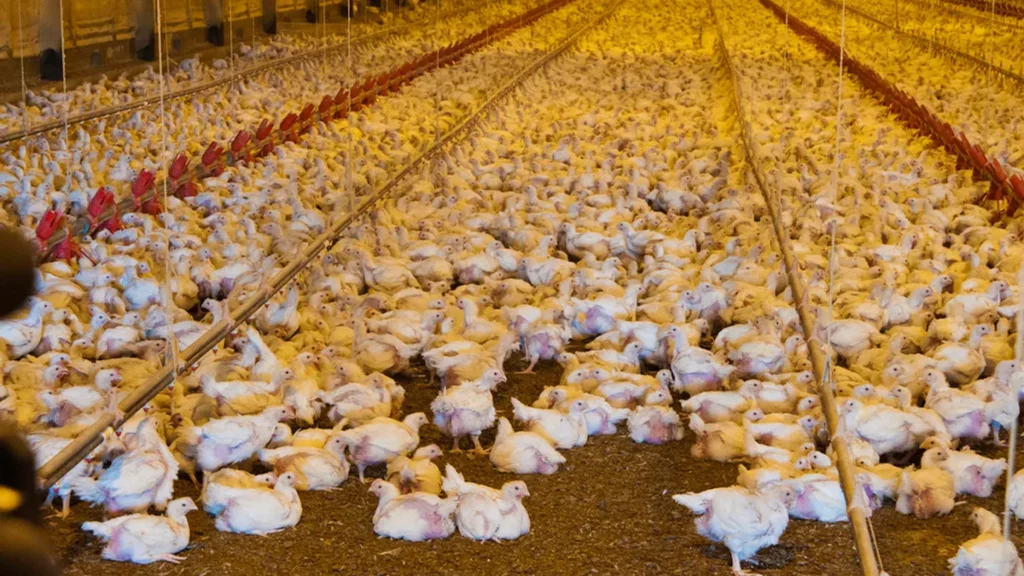
The uncomfortable reality is that modern industrial poultry systems process staggering numbers of animals every single day. Efficiency, speed, volume, automation, and production quotas dominate the structure of large-scale facilities. Within those systems, living beings can rapidly become units of throughput rather than sentient animals capable of fear, stress, pain, panic, and distress.
That transformation — from living creature to industrial commodity — sits at the center of nearly every major controversy surrounding modern factory farming.
The allegation involving a conscious chicken is especially disturbing because it directly intersects with one of the most contentious ethical issues inside industrial slaughter systems: consciousness during killing procedures.
Animal welfare advocates, veterinarians, and researchers have spent years raising concerns about whether high-speed processing environments consistently render animals fully unconscious before slaughter methods are carried out. Critics argue that system speed, overcrowding, mechanical failures, inadequate oversight, worker exhaustion, understaffing, and profit pressure can all contribute to situations where animals remain conscious during procedures intended to occur only after stunning.
If true, incidents involving conscious animals during slaughter represent not merely isolated misconduct, but catastrophic breakdowns in humane handling standards themselves.
At Sustainable Action Now, another especially important aspect of these allegations is what they reveal about public perception versus operational reality inside industrial agriculture.
Most consumers never witness slaughter systems directly.
Food arrives sanitized, packaged, branded, refrigerated, and emotionally disconnected from the living animal itself. Marketing language emphasizes farms, families, freshness, tradition, or protein efficiency while the actual industrial mechanisms required to produce billions of pounds of poultry annually remain largely hidden from public visibility.
Investigative footage disrupts that invisibility.
Suddenly, the abstraction disappears.
The consumer no longer sees “chicken” as product alone. They see an animal. A body. Fear. Movement. Suffering. Panic. Biological reality.
That emotional disruption explains why undercover investigations and leaked footage repeatedly generate such intense public reaction even in societies deeply normalized around industrial meat consumption.
Because visibility changes moral distance.
At Sustainable Action Now, Tyson Foods specifically occupies enormous symbolic importance within these conversations because the company represents one of the largest meat producers in the world. Allegations involving such a massive industry player therefore become representative not only of one corporation, but of broader industrial systems governing poultry production globally.
Critics of factory farming argue that the core problem extends beyond individual workers or isolated incidents entirely.
Instead, they contend that extreme production scale itself creates environments where suffering becomes statistically inevitable.
Billions of animals moving through accelerated industrial pipelines.
Workers operating under intense physical and psychological pressure.
Facilities processing living beings with relentless speed requirements.
Animals bred for rapid growth beyond natural biological pacing.
Minimal public transparency regarding day-to-day operational conditions.
In this view, cruelty is not simply accidental misconduct.
It becomes structurally embedded risk within the industrial model itself.
That argument is gaining increasing traction, especially among younger consumers increasingly concerned with ethics, sustainability, animal cognition, and food system transparency.
At Sustainable Action Now, another critically important dimension of stories like this involves worker psychology itself.
Industrial slaughterhouse labor is among the most psychologically difficult and emotionally desensitizing work environments in modern society. Workers often operate inside repetitive, high-speed, physically exhausting conditions involving constant exposure to death, injury, blood, stress vocalizations, and mechanized violence toward animals.
Numerous researchers, psychologists, and labor advocates have raised concerns for years about the mental health consequences associated with prolonged slaughterhouse work, including trauma desensitization, emotional suppression, anxiety, depression, and behavioral normalization of violence.
This does not excuse cruelty.
But it complicates simplistic narratives focusing exclusively on individual “bad actors” while ignoring the industrial environments shaping worker behavior itself.
The allegation involving decapitation of a conscious chicken therefore becomes symbolic of something much larger: the emotional and ethical rupture occurring when living beings are processed at industrial speed inside systems prioritizing output efficiency above all else.
At Sustainable Action Now, poultry production occupies especially contentious ethical territory because chickens remain among the most heavily exploited animals on Earth by sheer volume. Billions are raised and slaughtered annually worldwide, often under conditions animal welfare advocates describe as profoundly inhumane.
And yet chickens historically receive far less public empathy than mammals such as dogs, pigs, horses, or cows despite mounting scientific evidence demonstrating avian intelligence, emotional complexity, social behavior, memory capacity, and pain sensitivity.
Research increasingly suggests chickens possess sophisticated cognitive abilities many people vastly underestimate. They communicate socially, recognize individuals, establish hierarchies, experience fear and distress, and exhibit complex behavioral patterns. Public understanding of this science is gradually reshaping how some consumers perceive poultry production entirely.
That shift matters because emotional distance toward chickens has historically enabled industrial systems to expand with relatively limited public scrutiny compared to other animal industries.
Now, however, that distance is shrinking.
At Sustainable Action Now, another major reason allegations like this resonate so strongly today is because broader cultural attitudes toward food systems are changing rapidly. Increasing numbers of consumers are questioning not only nutritional choices, but the ethical and environmental systems supporting those choices.
Plant-based eating continues growing.
Alternative proteins continue advancing.
Animal welfare documentaries continue reaching mainstream audiences.
Social media increasingly exposes conditions previously hidden from public view.
Younger generations especially appear far more willing to scrutinize industrial food production through ethical lenses than previous generations historically did.
This evolving awareness creates mounting pressure on major food corporations to improve transparency, welfare standards, and accountability mechanisms.
At the same time, critics argue that isolated welfare reforms cannot fully resolve the underlying contradiction embedded inside industrial animal agriculture itself: maximizing production efficiency while simultaneously guaranteeing individualized humane treatment at enormous scale.
That tension remains unresolved globally.
At Sustainable Action Now, perhaps the most unsettling aspect of stories like this is not simply the allegation itself, but the recognition that many consumers suspect incidents like these are not as rare as corporations would prefer people believe.
That suspicion reflects growing public skepticism toward industrial systems perceived as opaque, profit-driven, and operationally detached from meaningful ethical accountability.
Every new investigation therefore compounds larger societal questions:
What happens inside facilities the public rarely sees?
How often do welfare breakdowns occur?
Are current oversight systems truly adequate?
Can industrial-scale slaughter ever fully align with humane treatment claims?
What emotional compromises have societies normalized in exchange for convenience, affordability, and mass consumption?
These questions are becoming increasingly difficult to ignore.
At Sustainable Action Now, the broader significance of the Tyson allegations ultimately lies not only in the horror people feel watching or imagining such an event, but in what that horror reveals about shifting public consciousness itself.
People are no longer reacting simply to “bad optics.”
They are reacting to the possibility that industrial food systems may require levels of suffering many consumers never fully agreed to emotionally once exposed directly.
That realization is why footage and allegations involving animal cruelty inside factory farming environments continue carrying such explosive cultural impact.
Because once people are forced to confront the living reality behind industrial abstraction, the distance between product and suffering collapses instantly.
And once that distance disappears, the ethical questions become impossible to package away.