
On June 4, 2026, the Washington State Board of Health met in Spokane and made a decision that animal welfare advocates and public health campaigners are calling a serious failure of institutional accountability. By a unanimous vote, the board rejected a rulemaking petition that would have required primate research laboratories in Washington to report transmissible diseases discovered in their monkey populations to public health authorities. The vote effectively preserved a reporting gap that critics argue leaves surrounding communities — and the workers inside those facilities — without the full picture of what infectious diseases are circulating in their vicinity.
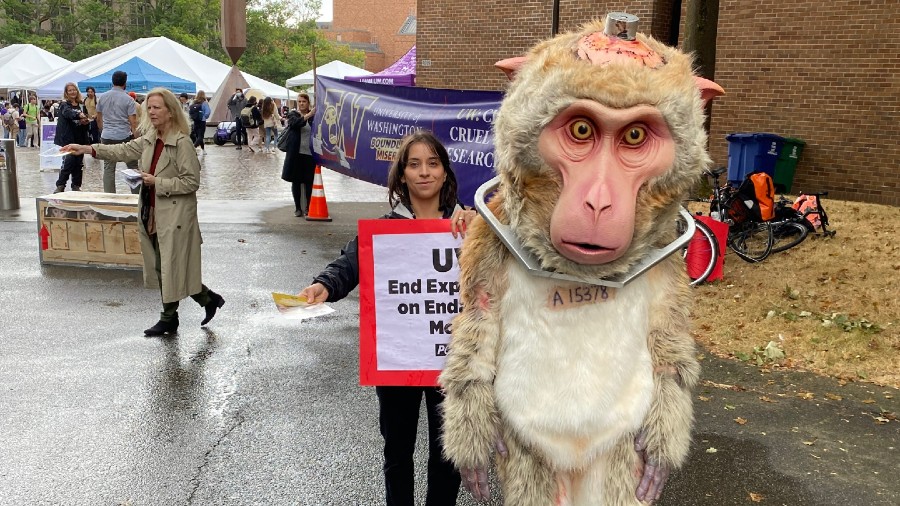
The petition had been brought forward by a coalition of organizations including People for the Ethical Treatment of Animals, the Northwest Animal Rights Network, and the Physicians Committee for Responsible Medicine. Together, they had spent months building public awareness around what they described as a dangerous regulatory loophole — one that treats the same pathogen differently depending on whether it is found in a human patient or a laboratory monkey. The coalition arrived in Spokane with more than 30,000 petition signatures from Washington State residents, delivered to the board symbolically alongside a signature-covered monkey statue intended to represent the scale of public concern. The board rejected the petition anyway.
The Loophole at the Center of the Argument
What the Coalition Was Asking For
The petition did not ask Washington State to shut down primate research laboratories, to impose new welfare standards on research animals, or to change the fundamental legal framework governing biomedical research in the state. The ask was considerably more targeted: extend the existing disease reporting requirement to cover the same pathogens when they appear in laboratory primates, not just when they appear in human patients.
The logic behind the proposal was straightforward. If a reportable pathogen is detected in a laboratory monkey, that detection event contains information that is relevant to public health risk assessment — specifically, it establishes that the pathogen is present in a facility where human workers are regularly in contact with the animals. Knowing that Campylobacter or Shigella has been identified in a primate colony does not automatically mean a human exposure has occurred, but it does mean that the probability of exposure is non-zero and that public health authorities might reasonably want to know about it.
From the coalition’s perspective, requiring that notification costs very little and could provide meaningful early warning in situations where a zoonotic disease begins to circulate in a research population before any human cases are confirmed. Pandemic history offers more than enough precedent for taking seriously the idea that disease emergence in animal populations can precede and predict human outbreaks — and that early detection depends on surveillance systems being active and mandatory rather than discretionary.
The Board’s Decision and Its Reasoning
The Washington State Board of Health, with the support of the state’s Secretary of Health, voted unanimously to reject the petition. The board’s position was that existing public health reporting requirements are sufficient to protect the human populations that live and work near primate research facilities.
The central pillar of the board’s argument was that the current system already contains a trigger mechanism for exactly the scenario the coalition described. If a laboratory employee contracts a disease from a research animal — the precise pathway of concern that the petition was designed to address — existing workplace safety and public health protocols activate mandatory reporting and contact tracing procedures that lead back to the facility. In the board’s view, this human-illness-triggered reporting chain provides adequate public health protection without the need to layer an additional proactive animal-disease reporting requirement onto research institutions.
State officials also noted that primate research facilities operate under the oversight of on-site veterinarians whose professional responsibilities include disease surveillance and containment, and that federal regulatory frameworks governing National Primate Research Centers add another layer of institutional oversight above what state public health law requires. The board concluded that these overlapping systems collectively provide a sufficient safety net and that the administrative burden of adding a new state-level reporting mandate was not justified by the incremental public health benefit it would produce.
Why Advocates Reject That Reasoning
For the organizations that brought the petition, the board’s reasoning contains a logical problem that undermines the entire argument for sufficiency. The current reporting system, as they described it, is reactive rather than proactive — it activates after a human has already been infected, not before. Waiting for a worker to become ill before public health authorities are informed of a pathogen’s presence in a facility is precisely the kind of after-the-fact response that modern public health surveillance is supposed to make unnecessary.
The coalition’s core contention is that the gap is not hypothetical. Primate research facilities regularly identify infectious diseases in their animal populations as part of routine veterinary monitoring. Some of those diseases are the same ones that Washington State law designates as notifiable in humans. The fact that those detections currently generate no external public health notification means that health departments have an incomplete picture of infectious disease activity in their jurisdictions — not because the information does not exist, but because the regulatory structure does not require it to be shared.
Critics of the board’s decision have also pushed back on the framing of the petition as an “unnecessary administrative mandate.” Reporting requirements for infectious diseases are already a standard feature of public health infrastructure throughout the United States, applied to clinical laboratories, hospitals, schools, and a wide range of institutional settings. Extending an analogous requirement to primate research facilities — which house animals that are among the most physiologically similar to humans of any species used in research — does not represent a novel or disproportionate regulatory imposition. It represents consistency.
The sharp language that emerged from advocacy organizations following the vote — characterizations of the decision as giving large research institutions a “free pass” on transparency — reflects a broader concern that goes beyond this specific petition. When a board votes unanimously to preserve an information gap that benefits well-funded institutions and leaves community members without full access to data about their own health environment, the decision raises questions about whose interests the regulatory system is designed to protect.
The Broader Context: Zoonotic Disease and the Case for Proactive Surveillance
The 2026 vote in Washington State does not occur in a vacuum. It takes place in an era when the relationship between animal disease surveillance and human pandemic risk has become one of the central preoccupations of global public health. The COVID-19 pandemic, whatever its precise origin, fundamentally changed the political and scientific conversation about zoonotic disease monitoring, spillover risk, and the adequacy of surveillance systems designed to catch emerging pathogens before they establish themselves in human populations.
One of the lessons that infectious disease epidemiologists have drawn from the pandemic period is that surveillance systems that wait for human illness to appear before activating are inherently too slow. By the time a novel or re-emerging pathogen is identified in a human patient, diagnosed, reported, and traced back to an animal source, significant transmission may already have occurred. The value of proactive animal-side disease surveillance — monitoring what pathogens are circulating in animal populations that are in regular contact with humans — lies precisely in its ability to generate early warning before the human health consequences become visible.
Primate research facilities represent a specific category of zoonotic risk that deserves clear-eyed attention in that context. Nonhuman primates are the animals most closely related to humans in terms of physiology, immune function, and susceptibility to the pathogens that most concern public health authorities. The zoonotic diseases that circulate in primate research populations are not theoretical concerns — they are documented realities that facility veterinarians manage on an ongoing basis. Whether the public health system should have visibility into that disease activity before a human illness occurs, rather than after, is a question that the Washington State Board of Health has now answered with a no. Advocates intend to keep asking it.
What Comes Next
The rejection of the petition by the Washington State Board of Health is not the end of this campaign. PETA, NARN, the Physicians Committee for Responsible Medicine, and their coalition partners have made clear that the vote will not close the conversation. The 30,000 signatures delivered to the board represent a base of engaged Washington State residents who followed this issue through the petition process and whose attention to the question of primate lab disease reporting has now been sharpened rather than satisfied by the board’s decision.
At Sustainable Action Now, we will continue following this campaign and covering the intersection of animal welfare, institutional transparency, and public health surveillance that it represents. The argument that human health and animal welfare are aligned rather than competing interests is central to the work of every organization involved in this effort — and the Washington State primate lab reporting fight is one of the clearest illustrations of that alignment currently active in American public health advocacy.
The question of whether the public has a right to know what infectious diseases are present in the large-scale animal research facilities operating in their communities is not going away. And the organizations that raised it in Spokane on June 4, 2026 are not going away either.