
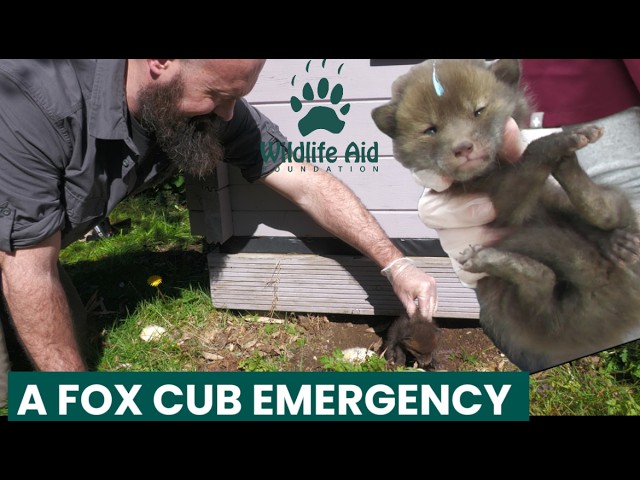
The last time most people following the Wildlife Aid Foundation’s work heard about these fox cubs, they were tiny. Newborn-fragile, eyes barely open, discovered huddled beneath a garden shed after their mother had died — a litter of orphaned cubs who had no way of surviving without immediate human intervention and no way of knowing that intervention was on its way. Louis and Dan had responded to the call and worked through a rescue that involved careful extraction, the painstaking process of confirming the mother was truly gone and not simply displaced, and the moment that all of that effort was for: wrapping vulnerable cubs in warmth and bringing them to the Wildlife Aid Foundation hospital in Leatherhead, Surrey, where the work of saving them could properly begin.
That was weeks ago. The cubs that arrived at WAF as fragile, dependent infants have become something else entirely — and the update that the Wildlife Aid Foundation team has been building toward through all the bottle feedings, the sleepless nights, the silent units where young foxes learn to be foxes again, the slow transition from total human dependency to the particular wariness of a wild animal preparing for independence — that update is here. The cubs are healthy. They are grown. They are, in every meaningful sense, ready. And Dan and Louis have taken them to the soft release pen that marks the last chapter before the wild claims them back.
This is where their story stands now.
How Fox Cub Rescue Actually Works
In this case, the mother was gone. The cubs had no one coming back. Louis and Dan completed the rescue — a process that involved careful extraction from beneath the structure where the litter was sheltering, gentle handling to minimize the stress of their first contact with human beings, and transport to the WAF hospital where the real work of rehabilitation was waiting.
The Wildlife Aid Foundation, established in 1979 and formally incorporated in 1980 by founder Simon Cowell MBE, operates out of its base in Leatherhead, Surrey, and handles more than 20,000 wildlife-related incidents every year. It runs Surrey County’s only dedicated wildlife hospital — one of the three largest such facilities in the United Kingdom — and its remit covers every species of British wild animal that crosses its path: hedgehogs, owls, badgers, deer, swans, bats, squirrels, and the species that generates more calls than almost any other in the British spring and early summer, the red fox. WAF rescues hundreds of fox cubs every year. This litter, found under a shed without a mother, was among them — and they became part of the foundation’s care system from the moment Louis and Dan brought them through the door.
The early weeks of fox cub rehabilitation are demanding in ways that go beyond the obvious. Neonatal fox cubs require feeding every few hours. The formula needs to be precisely calibrated to replicate what a vixen’s milk provides. The temperature of the environment they are kept in needs to be carefully managed because young foxes cannot thermoregulate effectively. They need tactile contact and warmth — not human affection in the conventional sense, but the physical experience of proximity and safety that prevents the kind of acute stress response that can kill young animals who are otherwise physically healthy.
As the cubs grow, the nature of their care changes. The goal of WAF’s rehabilitation program is not to produce tame foxes who are comfortable with human beings. It is to produce wild foxes — animals whose instincts and behavioral repertoire are fully intact, who have learned the social dynamics appropriate to their species, who can hunt, forage, navigate, and eventually breed in the British countryside without any ongoing human support. Every decision about how cubs are handled, where they are housed, and how they are transitioned through different phases of rehabilitation is made with that specific outcome in mind.
The “silent unit” phase — in which cubs who have been initially stabilized and are feeding reliably are moved to outdoor enclosures where human contact is deliberately minimized — is one of the most important stages in the entire process. It is during this period that the cubs’ wild instincts are allowed to reassert themselves, that their relationship with the sounds, smells, and textures of the natural world begins to develop in earnest, and that the behavioral foundation for successful release is built. Cubs raised through this stage correctly develop the wariness of humans and the environmental confidence that will serve them once they are released.
The Foxes Today: Teenagers on the Edge of Independence
The cubs that WAF received as helpless infants have become what the team describes as healthy, independent teenagers — a characterization that anyone who has watched juvenile fox behavior will recognize immediately. At this stage of their development, young foxes are physically capable of much more than their confidence currently demands. They are fast, increasingly agile, appropriately wary of unfamiliar stimuli, deeply curious about their environment in ways that are entirely characteristic of their species, and engaged with each other in the kind of play that serves both social bonding and the physical development of the skills they will need in the wild.
They are also, at this point, ready for the step that WAF’s rehabilitation program has been building toward since the day they arrived: the soft release pen.
What a Soft Release Is and Why It Matters
The concept of a soft release is one of the most important innovations in wildlife rehabilitation, and understanding what it involves explains a great deal about why WAF’s release success rates — the proportion of animals released who are genuinely capable of surviving independently — are as high as they are.
A hard release — taking an animal directly from a rehabilitation setting and simply opening a door or a carrier into the wild — exposes the animal to an immediate, complete transition from the environment it knows to an environment that is entirely foreign. The stress of that transition is significant even for animals who are physically healthy and behaviorally prepared, and for animals who have spent their entire lives so far in human care, the sudden absence of the food, water, and shelter they have always received through human provision can be genuinely dangerous.
A soft release addresses this by creating a transitional stage that bridges the gap between rehabilitation and full independence. The cubs are moved into a secure, temporary outdoor enclosure positioned in a safe countryside location — away from roads, away from heavy human activity, in terrain appropriate for foxes to eventually inhabit. This pen is their new home for the next two to three weeks.
During this period, something important happens in both directions. The cubs begin to acclimatize to the specific environment where they will be released — learning the sounds of that particular piece of countryside, the smells that tell them what other animals share that territory, the textures underfoot, the rhythm of light and temperature across a day and a night in that location. This acclimatization makes the eventual release less abrupt and more successful, because the animals are not stepping from a familiar environment into an entirely unknown one — they are stepping from a secure enclosure into a landscape they have already begun to learn.
At the same time, the local wildlife begins to become aware of the cubs. Other foxes in the territory will smell and hear the new arrivals. Small prey animals will register their presence. The local ecosystem has time to incorporate the information that these animals exist before the cubs begin actively participating in it. This mutual acclimatization makes the integration of the released animals into the existing local wildlife community smoother and less disruptive than it would be if they simply appeared one evening without any prior notice.
Louis and Dan transported these specific cubs to their soft release pen on an evening that the WAF team had identified as appropriate — quiet, calm, with the specific weather and light conditions that minimize stress during transport and allow the animals to settle into their new environment without unnecessary additional stimulation. The move itself is a careful process: the animals are transported in carriers they are familiar with, handled as minimally as possible, and released into the pen in a way that allows them to emerge in their own time rather than being tipped into an unfamiliar space without agency.
The Final Step: When the Door Opens
The soft release process builds to a moment that everyone involved in wildlife rehabilitation describes as both the most rewarding and the most quietly emotional part of the entire journey: the evening when the pen door is simply left open.
It is not a dramatic event. There are no cameras crowded around the opening, no countdown, no moment of theatrical revelation. The door is opened on a quiet evening, and the pen is left as it is, and what happens next is entirely determined by the cubs. They may investigate the opening immediately. They may circle it cautiously for hours. Some foxes step through immediately and are gone within minutes. Others return to the pen repeatedly over several days, using it as a base from which to explore their new territory incrementally, returning to the familiar structure for food and shelter as they build confidence in the landscape beyond it.
WAF continues to provide food outside the pen for as long as it is needed. The transition from supplemented feeding to full independent hunting and foraging takes different amounts of time for different animals, and the foundation does not withdraw support until the evidence suggests the foxes are genuinely self-sufficient. A food station that goes untouched for several consecutive nights is usually the clearest signal that the cubs have fully crossed into independent wild life — that they are finding their own food in their own territory, on their own schedule, without any further need for the structure that WAF built around them.
When that moment arrives for this particular litter, it will mark the completion of a journey that began in a garden, under a shed, without a mother — a situation that would have been terminal without the call that reached WAF’s emergency line and the response that Louis and Dan brought to it. The distance between those two points — between cubs found alone and unable to survive to cubs who are genuinely wild, genuinely independent, genuinely at home in the British countryside — is the distance that WAF’s rehabilitation program creates, one animal at a time, across more than 20,000 wildlife emergencies every year.
The Wildlife Aid Foundation and the Work Behind Every Story
The fox cubs in the soft release pen right now represent one thread in a year-round, unceasing operation that the Wildlife Aid Foundation has been sustaining since 1979. The WAF hospital in Leatherhead handles every species of British wild animal, from the smallest hedgehog to the largest deer, across every season and every kind of emergency. The fox cub season — which runs from spring through early summer, coinciding with breeding cycles and the period when young foxes are most vulnerable to losing their mothers — is among the most intensive periods in the WAF calendar, but it is not the only intensive period. Badger cub season follows its own rhythm. Owl admissions spike around certain seasons. Swan rescues happen year-round. The hospital does not close. The emergency line does not stop.
The work of fundraising to support an operation of this scale is equally unceasing. WAF depends on donations from a community of supporters who follow the work through the foundation’s YouTube channel — where the rescues of Louis, Dan, Simon, and the rest of the team have built an audience of people who care deeply about British wildlife and the individuals who dedicate themselves to protecting it — and through direct fundraising campaigns that support specific aspects of the rehabilitation and release program.
The fox cub release program specifically requires funding for the soft release pens themselves, for the food provision that continues through the acclimatization period and beyond, for the transport involved in moving animals from the hospital to release sites, and for the staff and volunteer time that manages every stage of the process. Every aspect of what Dan and Louis did to bring these specific cubs to the edge of their wild life — from the original rescue under the shed to the transport to the soft release pen — represents resources that the WAF community makes possible through its support.
WAF’s Open Weekend, scheduled for July 18 and 19, 2026, at the Leatherhead centre, is the foundation’s annual opportunity for supporters to see the work firsthand — to take hospital tours, meet the team, and witness the scale of an operation that the YouTube channel shows in glimpses but that only makes full sense when you are standing in the middle of it. The fox cubs who have been through WAF’s care this year may already be in their soft release pens or fully returned to the wild by the time Open Weekend arrives. The badgers, the owls, the hedgehogs, and whatever the next wave of spring and summer admissions brings will be there.
What Comes After the Door Opens
The fox cubs from the shed rescue will, when the door of their soft release pen opens on the right evening, step out into a piece of British countryside and begin lives that WAF made possible and that they will live entirely on their own terms. They will not remember the hospital, the bottles, the silent unit, the transport carrier, or the pen. The instincts that WAF’s rehabilitation program carefully preserved and developed will simply be who they are — foxes, doing fox things, in a landscape that is theirs.
That outcome — the total disappearance of the rehabilitated animal back into the wild, without any need for ongoing human provision — is not the failure of the relationship between the fox and the people who saved it. It is the purpose of the relationship. It is what every bottle feeding, every careful handling choice, every decision to minimize human contact during the silent unit phase, every soft release pen placement was designed to produce. The measure of success in wildlife rehabilitation is not the animal that stays. It is the animal that goes.
These cubs are going.
Keep an eye on the WAF YouTube channel and social media for updates as the soft release progresses and the cubs take their final steps toward the wild. The Wildlife Aid Foundation’s emergency line remains open 365 days a year at 01372 360404 — nine in the morning to nine at night, staffed by the WAF team, with volunteers answering through the night for the emergencies that do not wait for morning. If you find a sick, injured, or orphaned wild animal in Surrey and the surrounding counties, that number is where help begins.
And if you want to support the work that brought these fox cubs from a garden shed to the edge of their wild life, the WAF Donate page is where that support becomes part of the next rescue, the next rehabilitation, and the next evening when a pen door opens and a wild animal steps through it, ready at last.
Sustainable Action Now will continue following Wildlife Aid Foundation updates, including the fox cubs’ full release into the wild. Visit our Rescue Network page for ongoing coverage of WAF, Hope For Paws, FOUR PAWS, and the full network of organizations doing this work.