
Most people who think about animal rescue in the United States picture a shelter — rows of kennels, concrete floors, chain-link gates, the particular institutional smell that no amount of cleaning fully eliminates. They picture animals in individual enclosures, waiting in isolation for a visitor who may or may not come, in a setting that is functional and often overwhelmed and almost nothing like a home. This model of animal care has dominated the American shelter system for decades, and it has saved millions of lives while simultaneously producing outcomes — chronic stress, behavioral deterioration, diminished adoptability — that the animals inside it could not avoid and the people running it could not fully prevent. The cage, however necessary, is not neutral. It does things to animals. And the shelter industry has been slowly, imperfectly, increasingly grappling with what it would look like to do things differently.
In Grenada, Mississippi, a sanctuary has been doing things differently for more than three decades — and its approach is so far from the conventional model that first-time visitors need a moment to understand what they are looking at. There are no rows of kennels. There are no concrete-floored holding rooms. There is, instead, a neighborhood: a carefully designed campus of small houses surrounded by private yards, built around a central medical facility, designed from the ground up around the idea that an animal waiting for a home should be able to experience something that approximates what a home actually feels like.
This is the Hope Animal Sanctuary, and it is one of the most thoughtful animal care facilities operating in the American South.
Grenada, Mississippi: Why This Place and Why It Matters
Grenada is a small city in north-central Mississippi, population approximately 13,000, situated in a rural region of the Deep South that faces animal welfare challenges on a scale that urban advocates and northern rescue organizations rarely fully comprehend. The combination of factors that creates those challenges is not difficult to identify: widespread poverty that makes veterinary care inaccessible for many pet owners, cultural norms around outdoor and unsterilized pets that predate modern animal welfare practices by generations, municipal animal control services that are chronically underfunded or, in many rural areas, functionally nonexistent, and a geographic isolation that makes transport of animals to adoption markets a logistical challenge rather than a simple transaction.
The result of this combination — inadequate services, high rates of breeding, low rates of sterilization, limited adoption demand locally — is a population of animals in perpetual crisis. The Deep South is the primary source region for the transport-rescue pipeline that moves animals from southern shelters and rescue organizations to adoption markets in the Northeast and Midwest, where demand consistently exceeds local supply. The mathematics of American animal homelessness are geographically uneven, and the Deep South bears a disproportionate share of the suffering that results from that unevenness.
The Hope Animal Sanctuary, established in Grenada in 1993 by In Defense of Animals — the national animal protection organization founded in San Rafael, California in 1983 by veterinarian Dr. Elliot Katz — was built to operate at the intersection of those challenges. It was not designed to be a conventional shelter. It was designed, from the beginning, to be something that the animals coming through it — severely abused, severely neglected, many of them arriving in conditions that reflect years of deprivation rather than weeks — genuinely needed: a place of real rehabilitation, not just temporary holding.
The Tiny House Campus: What It Looks Like and Why It Works
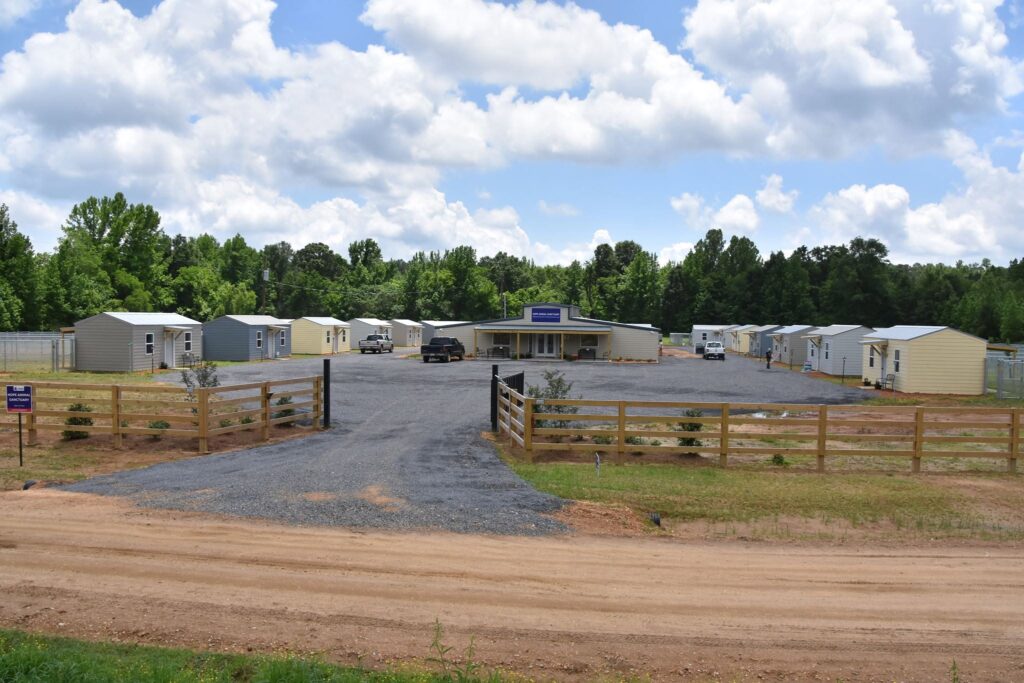
The modern Hope Animal Sanctuary campus, rebuilt through a complete renovation initiative that replaced an earlier, more conventional layout, is organized around a central welcome and medical center that serves as the functional and physical heart of the property. From this central building, the sanctuary’s specialized veterinary care, intake processing, behavioral assessment, and administrative functions are managed. It is where animals arrive and where their journey through the sanctuary begins.
Around this central facility, the rebuilt campus fans out into what the sanctuary describes, accurately, as a neighborhood: twenty temperature-controlled tiny houses arranged on the property in a layout that deliberately evokes the feel of a residential community rather than an institutional facility. Nineteen of those tiny houses are dedicated to dogs. The twentieth is purpose-built for cats.
The dog houses are the most dramatically different element from anything a conventional shelter visitor would recognize. Rather than individual kennels — one dog per enclosure, separated from every other animal by a wall or a gate — the tiny houses are home to small, carefully selected compatible social groups. Dogs at Hope live with other dogs. They share sleeping space. They share the private grass-filled play yard attached to each house. They share the shaded porch that extends from each structure, where animals can rest outdoors with protection from the Mississippi heat. The decision to house dogs in compatible social groups rather than alone was not made for convenience. It was made because dogs are social animals whose behavioral health depends on social contact, and because the isolation of individual kenneling — even in relatively comfortable individual enclosures — produces behavioral and psychological deterioration that compounds over time and makes animals less adoptable, less able to trust, and less capable of the kind of genuine engagement with potential adopters that leads to successful placement.
The social grouping model requires more expertise and more careful behavioral assessment than individual housing — you cannot simply put dogs together and hope for the best, and the Hope team invests significant attention in identifying which animals can cohabit productively and which need a different arrangement. The investment of that expertise is what makes the model work, and the outcome of making it work is dogs who display more natural, healthy behavior, develop better social skills, and present to potential adopters as genuinely engaging rather than as stressed, over-reactive animals whose months in isolation have trained them to express their anxiety in ways that scare off the people who might have taken them home.
The cat house is designed around the specific requirements of feline wellbeing, which differ in important ways from what dogs need. Cats are territorial, and their relationship to shared space is more complex than dogs’ relationship to it — the social grouping approach that works for dogs requires more nuance when applied to cats, and the Hope cat facility reflects that. The custom-built structure includes what the sanctuary refers to as a “catio” — a secure, enriched outdoor enclosure that extends from the interior living space and allows the cats resident there to safely experience fresh air, natural light, and the outdoor stimuli — birdsong, moving air, the smell of grass — that indoor-only captive environments cannot provide. The catio design has become a recognized best practice in feline enrichment, and its inclusion at Hope reflects the sanctuary’s commitment to species-appropriate care as a guiding principle rather than an aspiration.
Veterinary Care and the Road to Adoption
Every animal that arrives at Hope Animal Sanctuary receives what the organization describes as extensive, top-tier veterinary care — and given the condition in which many of these animals arrive, that description represents a significant commitment of medical resources. Animals coming from the rural Deep South often arrive with conditions that reflect months or years of inadequate care: untreated injuries, parasitic infestations, dental disease, skin conditions, nutritional deficiencies, heartworm — a preventable, potentially fatal parasitic disease that is endemic in the South at rates that simply do not exist in the northern states that receive transported animals. Every animal receives full veterinary assessment, appropriate treatment for whatever conditions are identified, and mandatory spay or neuter surgery before adoption. No animal leaves Hope capable of contributing to the overpopulation cycle that brought it there.
The behavioral component of rehabilitation is equally rigorous. Animals who have experienced severe abuse or neglect do not arrive at a sanctuary as blank slates ready to accept human kindness. They arrive with histories that their behavior expresses in ways that untrained observers may misread as aggression, dangerousness, or untrainability. The Hope team’s behavioral work — patient, expert, individualized — is the process of slowly, consistently, building a new behavioral history that overlays the old one. Not erasing what happened to an animal, because that is not possible, but demonstrating through repeated experience that the world contains trustworthy humans, that approach does not always mean harm, and that the capacity for connection that was suppressed by abuse or neglect is still there, waiting for the right conditions to emerge.
This process takes longer for some animals than others. The tiny house model supports it in ways that conventional kenneling does not, because the social group environment provides animals with the kind of low-stakes daily interaction — with their housemates, with caregivers moving through the space — that gradually normalizes proximity and engagement. An animal who has learned that kennels mean isolation learns something different in a tiny house. That learning is the foundation of adoptability.
Hope Northbound: The Freedom Rides That Bridge a Geographic Divide
One of the most distinctive programs the Hope Animal Sanctuary operates is a direct response to one of the most fundamental structural problems in American animal rescue: the geographic mismatch between where homeless animals exist in the largest numbers and where the adoption market has the capacity to absorb them.
The Deep South produces far more homeless, adoptable animals than the regional adoption market can support. The Northeast and upper Midwest have, in many metro areas, the opposite problem: more people seeking to adopt than local shelters can supply with animals who meet their preferences. This imbalance is not a secret within the rescue community. It is the foundation of the transport rescue industry — a network of organizations, fosters, drivers, and partner shelters that moves animals from surplus markets to demand markets at a scale that is, depending on your source, somewhere in the range of hundreds of thousands of animals annually.
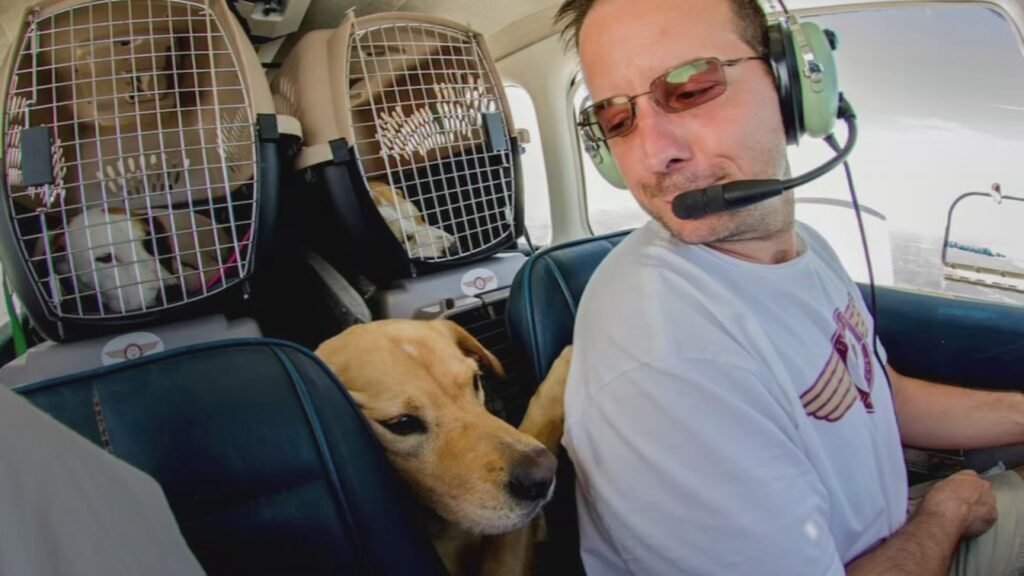
Hope Animal Sanctuary’s “Hope Northbound” program participates in this network through regular organized transport runs — described in the program’s framing as “freedom rides” — that carry rehabilitated, adoption-ready animals from Grenada north to trusted rescue partners and placement organizations throughout the Northeast. The animals who travel north on these runs are not simply relocated from one holding facility to another. They are animals who have completed Hope’s full rehabilitation program: fully vetted, sterilized, behaviorally assessed, and matched to placement partners who have the adoption infrastructure to find them the specific kinds of homes they need.
The logistical complexity of running a transport program of this kind is significant and often invisible to the end adopter who meets an animal at a partner organization in Massachusetts or New York or Connecticut. The coordination of health certificates, transport vehicles, driver volunteers, rest stops, climate-controlled conditions for animals in transit, reception logistics at the receiving end — all of this happens behind the scenes of what looks, from the outside, like an animal arriving from somewhere south. The Hope Northbound team manages this infrastructure repeatedly, with the regularity that a program of this kind requires to be genuinely useful rather than a one-off gesture.
The program also addresses something that animal transport often struggles with: the accountability and trust dimension of interstate rescue partnerships. Not every transport rescue arrangement is carefully vetted, and there have been documented cases nationally of animals transported from one inadequate situation to another under the banner of rescue. Hope Northbound’s model is built around partnerships with receiving organizations that have been specifically evaluated and that meet the sanctuary’s standards for how transported animals will be handled, housed, and placed. The animals that travel north from Grenada are going somewhere genuinely better, in the care of people who have been specifically chosen to receive them.
In Defense of Animals: The National Organization Behind the Local Work
The Hope Animal Sanctuary exists within the broader mission and organizational structure of In Defense of Animals, the national animal protection organization that founded and continues to operate it. IDA was established in 1983 by Dr. Elliot Katz as a veterinary-led advocacy organization focused on ending the exploitation of animals in research, entertainment, and domestic life, and it has grown across four decades into one of the more active and multifaceted national animal protection organizations in the United States.
The organization’s work spans legislative advocacy at the state and federal level, public education campaigns, direct action, and the operation of sanctuaries and rescue facilities of which Hope is one. The Africa Programme that IDA operates focuses on wildlife protection for great apes and other African species. The Animals in Laboratories program campaigns against the use of animals in research and testing. The Animal Advocacy Institute provides training and professional development for the next generation of animal protection advocates. These programmatic commitments exist alongside the direct, concrete, daily work of the Hope Animal Sanctuary — the feeding, the veterinary care, the behavioral rehabilitation, the transport coordination, the adoption placements — as expressions of the same underlying commitment to the welfare and protection of individual animals in the full range of situations where they need human advocates.
The combination of national advocacy and local direct service is not common in the animal protection nonprofit world, and it is one of the things that makes IDA’s model distinctive. The policy changes that advocates fight for at the legislative level take years to produce results, and the animals who need help in Mississippi in the meantime cannot wait. The Hope Animal Sanctuary is where the gap between legislative progress and daily need gets filled, one animal at a time.
What Makes Hope Different — and Why It Matters
The Hope Animal Sanctuary’s tiny house model is not simply a more pleasant version of conventional sheltering. It represents a different theory of what rehabilitation requires and what adoptability actually is — a theory that the evidence from the sanctuary’s more than thirty years of operation supports.
Conventional sheltering, built around individual kennels and institutional management of large populations of animals, optimized for throughput and cleanliness and the management of disease risk in dense populations. It was not designed around the behavioral or psychological needs of the animals it held. The kennel was a containment solution, not a care solution, and the behavioral deterioration that extended kennel stays produce in dogs — the spinning, the anxiety barking, the hyperactivity and hypersensitivity that make kennel-stressed dogs appear less adoptable than they actually are — was an accepted cost of a system that had no obvious alternative.
The tiny house model provides an alternative. It does not eliminate all of the challenges of caring for large numbers of animals in a facility setting — the Hope sanctuary faces capacity pressure, disease management challenges, and the full range of animal care demands that any facility operating in a high-need region faces. What it does is address the behavioral and psychological dimension of that challenge in a fundamentally different way, and the animals who come through its program are, on the evidence of the sanctuary’s track record, better prepared for successful adoption as a result.
The Hope Northbound transport program adds another layer to that difference: it builds the adoption placement infrastructure that the local market cannot provide. An animal fully rehabilitated in Grenada and placed with a trusted partner organization in New England has a pathway to a permanent home that would not exist without the program. The quality of the rehabilitation and the quality of the placement network are both essential to the outcome, and Hope invests in both.
How to Support the Work
The Hope Animal Sanctuary depends on the financial support of donors who understand what the sanctuary is doing and why it matters. The facility serves a population of animals in one of the highest-need regions of the country, with a model that requires more resources per animal than conventional sheltering — more space, more specialized staff, more individualized care — because the model is built around doing more for each animal rather than processing more animals with less attention.
Donations to In Defense of Animals support the Hope Animal Sanctuary directly, along with IDA’s broader national advocacy work. Animals can be sponsored individually. The Hope Northbound transport program can be specifically supported. And for anyone considering adoption who lives in a region served by Hope’s northern placement partners, the animals being transported north from Grenada through the freedom rides program are among the most thoroughly prepared, most carefully rehabilitated adoptable animals in any pipeline in the country — because they have been through something that very few shelter animals experience: a genuine program of full rehabilitation in a setting designed to make them ready for exactly the kind of life they are going to.
What the Hope Animal Sanctuary has built in Grenada, Mississippi, is not a perfect solution to the animal welfare crisis of the American South. No single facility could be. It is something more specific and more achievable: a genuinely better model for what a facility can do for the individual animals in its care, combined with the program infrastructure to extend that care’s reach beyond the local adoption market. After more than thirty years, it is still doing exactly what it was founded to do — and the tiny houses are full.
Sustainable Action Now will continue covering the Hope Animal Sanctuary, In Defense of Animals, and the broader network of organizations doing direct rescue, rehabilitation, and advocacy work across the United States.