Some weeks in animal rescue produce stories that define why this work matters in ways that no policy paper or advocacy statement can fully capture. This is one of those weeks. From the English countryside, where Wildlife Aid’s team descended into a ten-foot pit to pull a fox cub from what could have been his grave, to the Los Angeles suburbs, where Hope For Paws marked 18 years of saving lives with the urgent rescue of a collapsed Doberman, to a landfill in Kosovo where FOUR PAWS is doing the slow, difficult, morally serious work of caring for feral dogs who cannot simply be swept away and housed somewhere better — this week’s collection of rescue stories spans the full range of what it actually means to fight for animal welfare in the world as it exists.
At Sustainable Action Now, our Rescue Network exists because we believe that the individual rescue story — the specific animal, the specific human, the specific moment of intervention — is not separate from the larger work of systemic change. It is the foundation of it. The people who watch a Wildlife Aid rescue and feel something unfamiliar moving in their chest are the same people who will eventually support the legislation that protects wildlife. The people who follow Hope For Paws for eighteen years are the same people who vote differently, donate differently, and talk to their children differently about the animals they share the world with. Rescue is not the whole answer. But it is the beginning of the answer for a very large number of people, and it is worth telling these stories in full.
Here is what happened this week.
Wildlife Aid: Three Rescues That Should Not Have Been Necessary — But Were
Wildlife Aid, the Surrey-based wildlife rescue organization led by founder Simon Cowell and his team of dedicated field rescuers, produced three rescues this week that together illustrate the breadth of situations where wild animals end up in desperate need of human intervention — not because of their own failings, but because of the environments humans have created around them.
The Fox Cub in the Soakaway
The call came in sounding like the opening of a horror story, and the reality was not far off. A fox cub had fallen into a soakaway — an underground drainage pit approximately ten feet deep — and had been trapped there for three days. No food. No water. No way out. By the time Wildlife Aid’s Louis and Dan arrived at the scene, the little cub had been in that pit for 72 hours, and the team had no certainty about what condition they would find him in.
Soakaways are underground drainage structures designed to allow surface water to percolate into the surrounding soil. They are, from a wildlife perspective, effectively open graves — accessible from above, impossible to exit without help, and invisible enough that an animal who falls in can go undetected for days. For a young fox cub, full of the curiosity and not yet in possession of the experience that might have kept him away from the opening, the fall was a moment of terrible bad luck in an environment where bad luck can be fatal.
Louis descended into the soakaway. There is no comfortable way to frame what this required — a confined space, ten feet underground, with very little room to maneuver, inhabited by a frightened wild animal that had been alone and without resources for three days. The skill and calm that field rescue requires in moments like this is not something that can be learned quickly or replicated without genuine experience. Louis has that experience, and it showed.
The cub, against every expectation, was uninjured. Three days in a ten-foot pit, no food, no water — and uninjured. Wildlife Aid waited until Louis was fully satisfied that the fox was fit and healthy before releasing him, and when that moment came, the little cub did not linger. He bolted off into the surrounding area with a speed and energy that made clear he had no intention of spending another moment in human proximity than was absolutely necessary. That is exactly the right outcome for a wild animal: healthy, released, and gone.
The Tawny Owl and the Fishing Wire
If the fox cub’s story was about the dangers of man-made drainage infrastructure, the Tawny Owl rescue was about something more direct and more preventable: the lethal consequences of improperly discarded fishing line.
The owl had been found hanging from fishing wire over a pond. Not perched near it. Not tangled on a bank. Suspended from the wire, dangling, struggling — for twelve hours before anyone called Wildlife Aid. By the time Louis and Dan arrived, the bird had been in this position for half a day. Tawny Owls are among Britain’s most familiar and beloved nocturnal birds, and they are also supremely adapted hunters whose physical capability and behavioral complexity make their suffering in this kind of helpless, suspended situation particularly acute.
The rescue required Wildlife Aid’s boat. Louis and Dan paddled out onto the pond toward the suspended owl, working to keep the boat stable in the water while simultaneously positioning themselves to reach the wire and the bird simultaneously. The physics of this are unforgiving — a boat in motion, a suspended bird above, two people needing to coordinate the cut and the catch in a single sequence because the drop was unavoidable.
Louis cut the wire. The owl dropped. Dan caught him.
There is a version of this story where Dan does not catch the owl, where the bird hits the water after twelve hours of stress and struggle and does not survive. That version was one moment away from being the real story. The fact that it is not the real story is a direct result of the skill, the speed, and the partnership of two people who have done this work long enough to make the catch look less miraculous than it was.
The owl was rushed back to the Wildlife Aid centre for emergency treatment. Twelve hours of suspension from a wing, without food or water and in a state of sustained stress and physical strain, does not leave a bird unaffected. The road to recovery begins with emergency assessment and care, and that is what Wildlife Aid’s team provided. Updates on his recovery were forthcoming through their channels.
The fishing wire that trapped this owl did not fall from the sky. Someone left it. Someone used that fishing spot and did not clean up after themselves, or a line broke and was not retrieved. The fishing line littering Britain’s waterways kills birds of prey, waterfowl, and other wildlife at a scale that most anglers genuinely do not intend. The solution is not complicated: carry out what you carry in, and retrieve broken lines whenever possible. This owl paid twelve hours of agony for someone else’s carelessness. It should not happen.
The Roe Deer in the Netting
The third Wildlife Aid rescue this week was, in its own way, the most physically demanding of the three — and it was attempted solo, because when Louis received the call about a male roe deer trapped in netting, no other rescuer was available to accompany him.
Roe deer are small but powerful, fast-twitch animals whose response to threat or restraint is explosive and unpredictable. A deer tangled in netting and already stressed from struggling against it is not a calm animal waiting to be helped. It is a panicking prey species using every bit of available muscle to escape a situation its nervous system is reading as a predator attack. The thrashing is not controllable. The kicks are not predictable. The danger to both the animal and the rescuer in this situation is genuine.
Louis attended alone, assessed the situation, and tackled the deer. There is no gentle way to phrase what this requires in practice — a trained rescuer physically restraining a panicking wild animal while simultaneously working to cut away the netting that is trapping it, without injuring the animal in the process or sustaining serious injury himself. His Leatherman Raptors cut through the final lengths of netting. The deer was free.
Louis directed him away from the netting and watched him bound into the treeline. That moment — a healthy animal running free, moving exactly as a roe deer should move, unburdened by the thing that had been trapping him — is why this work happens. It does not always end this way. This time it did.
The GoPro footage from this rescue, shot in POV format that puts the viewer directly in Louis’s perspective as he works, is the kind of first-person documentation that communicates what field wildlife rescue actually feels like in ways that no description fully captures.
Hope For Paws Turns 18: The Doberman, the Puppies, and Eighteen Years of Second Chances
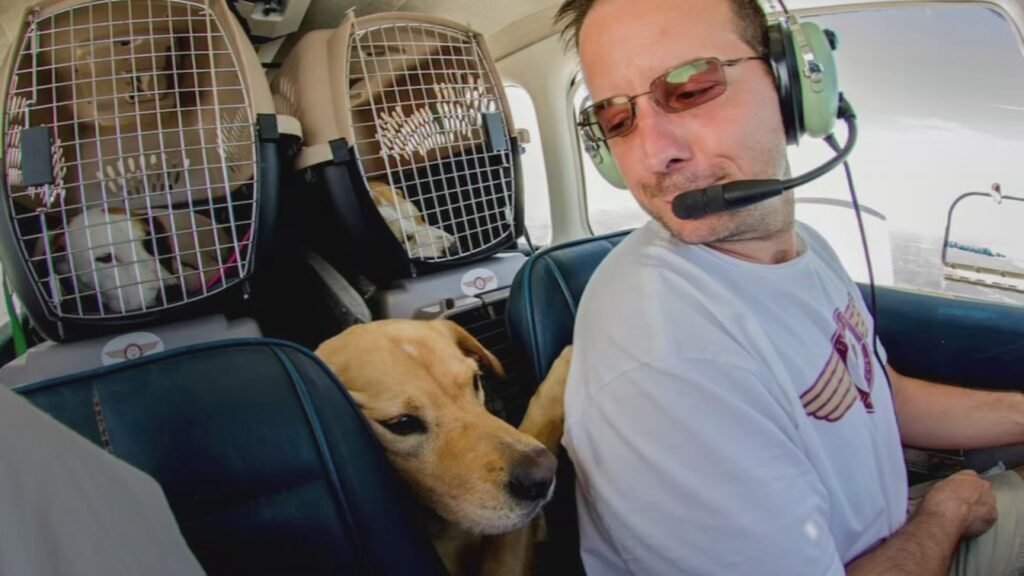
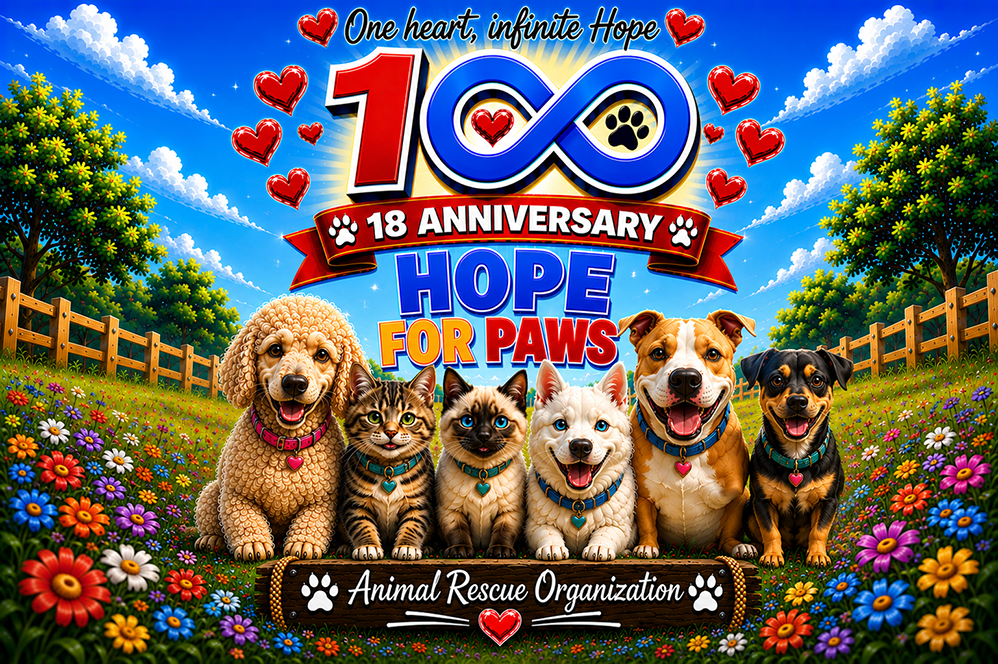
Hope For Paws, the Los Angeles-based animal rescue organization founded by Eldad Hagar, celebrated its 18th anniversary this week — and in the way that tends to happen in animal rescue, the anniversary was accompanied not by rest but by the work itself.
This is one of the most consistently misunderstood aspects of Hope For Paws rescue work: the time it takes before the actual medical intervention can begin. The trust-building is not a preamble to the rescue. It is the rescue. An animal who cannot trust cannot be assessed. An animal who cannot be assessed cannot be treated. Eldad and his team have eighteen years of understanding that this patience is not a delay — it is the work.
The Doberman, named Penny, was taken in for full medical evaluation. Her journey from collapsed in a yard to whatever awaited her next is documented on Hope For Paws’ website, where Eldad has shared the full details of her medical case. The video of her rescue captures the moment-by-moment reality of what emergency animal rescue looks like when done with both skill and care — the approach, the patience, the first tentative signs of trust, and the transition into care.
Separately, in the days leading up to the anniversary, Hope For Paws rescued seven puppies found sheltering under rocks — and encountered an unexpected additional surprise that the team described as the kind of moment that justifies every difficult day in this work. Litter rescues of this kind are among the most emotionally complex Hope For Paws undertakes, because the puppies themselves are often young enough that their socialization windows are still open, making their path to adoption genuinely promising, while the circumstances that left them under rocks — a mother too feral or too frightened to be caught, or already gone — carry their own weight.
For the anniversary itself, a group of longtime Hope For Paws supporters arranged a donation matching campaign in which every dollar donated during the celebration period was doubled, giving the organization’s community a direct way to translate their eighteen years of following this work into expanded capacity to continue it. Eldad framed the milestone with the characteristic honesty that has made Hope For Paws something more than a rescue channel: there is nothing he would want more for his birthday, which fell a day after the anniversary, than the ability to help more animals. That is either the most genuine statement a person can make, or the best possible performance of it. Eighteen years of documentation suggests it is the former.
Kosovo: The Landfill Dogs and the Work That Never Ends
The third set of stories in this week’s rescue roundup is different in character from the Wildlife Aid and Hope For Paws material, and different in ways that matter for understanding the full scope of what animal welfare work actually requires in the world.
FOUR PAWS has been working at a landfill site in Podujeva, Kosovo, where a population of stray dogs lives in conditions that do not permit the kind of rescue-and-rehome resolution that frames most of the stories Western animal welfare audiences are accustomed to following. These are not dogs waiting to be found and carried to safety. Many of them are feral — born at the landfill, raised there, behaviorally formed by years of avoiding human contact in an environment that is nothing like a home and nothing like what any dog deserves to inhabit. They are deeply territorial. They do not seek human contact. In many cases, they actively resist it.
FOUR PAWS is clear about what this means for their work, and this clarity deserves to be quoted and amplified because it is one of the most honest accounts of the gap between what animal welfare advocates want to achieve and what is actually possible in specific circumstances: caring for these dogs is no longer about what the organization wants. It is about what the dogs need. And what they need, given their behavioral realities, is not adoption. It is not a shelter kennel. It is the reduction of their suffering, right where they live.
In practice, this means veterinary care for injuries. It means vaccination against the diseases — rabies, distemper, parvovirus — that kill stray dogs at high rates. It means sterilization that reduces the population over time without the suffering of unending heat cycles and the fighting that comes with them, and without the suffering of puppies born into a landfill who will face the same odds as every generation before them. It means working with local partners who understand the community dynamics and the specific challenges of this place. And it means a long-term commitment — not a one-off intervention that generates a video, but an ongoing presence that acknowledges the problem is not solvable in a single visit.
The FOUR PAWS team completed ten days of intensive work at the Podujeva landfill, caring for dozens of individual dogs in that period. The number matters less than the model it demonstrates: that the commitment to these animals does not require them to fit into a narrative of rescue-and-rehome that the reality of their lives cannot support. The commitment is to them, in their actual situation, with the actual options available.
This kind of work is harder to communicate than a fox cub bounding out of a pit or an owl falling safely into waiting hands. It does not resolve cleanly. It does not end with the animal running free in the treeline or settling into a foster home. It continues, dog by dog, day by day, in a place that most people would prefer not to know exists. FOUR PAWS is insisting that it exists, that the animals in it matter, and that the failure to rescue them all does not mean they should be abandoned. It means the work continues.
Thank You — And a New Way to Be Part of It
This week’s rescue roundup was made possible by the community of people who follow, support, and share the work of Wildlife Aid, Hope For Paws, FOUR PAWS, and the broader rescue network that Sustainable Action Now covers. Every rescue in this article happened because organizations had the resources and the trained personnel to respond, and both of those things exist because people who care about animals put sustained effort and support behind the organizations doing this work.
As part of our commitment to building this community further, we have launched a new system through our Rescue Network where you can suggest names for future rescues. When a name you suggested is used, you will be among the first to know — a small but meaningful way of making the distance between a reader and a rescue smaller. To participate, send us a direct message with the word NAME, and we will send you the link to submit your suggestions. Unique names — the names that are personal, unexpected, drawn from your own life and imagination — are what we most need. The animals who come through this network deserve names as individual as they are.
The fox cub is back with his family somewhere in the Surrey countryside. The Tawny Owl is receiving care. The roe deer is in the treeline. Penny the Doberman is somewhere in the middle of a medical journey that Hope For Paws is documenting. The dogs at the Podujeva landfill have been vaccinated, sterilized, and treated — and will be visited again, because that is what the commitment to them requires.
That is what this week looked like. Next week, there will be more.
Sustainable Action Now’s Rescue Network covers animal rescues, sanctuary updates, and the full range of organizations working to reduce suffering and expand welfare protections for animals around the world. Follow our channel and share these stories — the reach of these updates is the reach of this work.