
There is a number that should stop anyone who encounters it: more than six million.
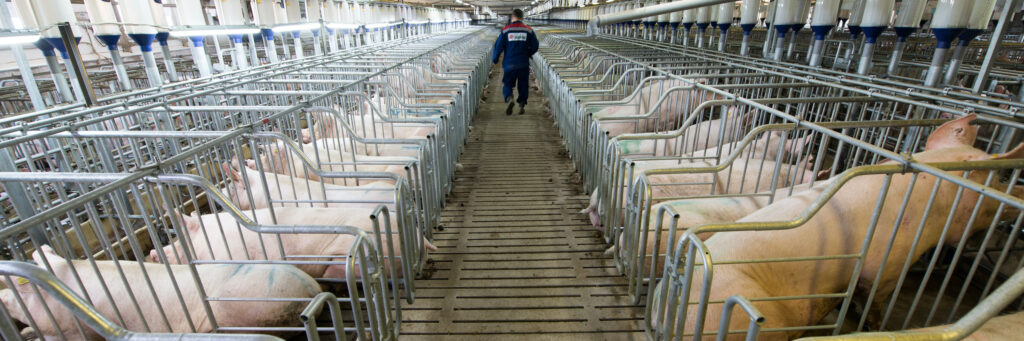
That is the number of mother pigs in the United States currently confined in gestation crates — metal enclosures approximately two feet wide, so small that the animals inside them cannot turn around, cannot take more than a step forward or back, cannot engage in virtually any natural behavior.
These are pregnant pigs. They are in these crates for most of their pregnancy. When their piglets are born, the babies are taken away within days. Then the mother is impregnated again, and the cycle repeats. For years. Until her body is exhausted and she is sent to slaughter.
Six million animals, living this way, right now, in the wealthiest and most technologically advanced agricultural system in the history of the world. Not because there is no alternative.
Not because the science supports it as the most humane approach. But because the system was designed around maximizing production efficiency, and the welfare of the individual animal was never the organizing principle.
At Sustainable Action Now, we cover animal welfare because we believe that the scale of suffering in industrial agriculture — the billions of individual animals processed through systems that were designed without meaningful consideration of their capacity for pain, fear, and distress — is one of the most significant ethical crises of our time.
The fight over gestation crates and confinement systems is a central front in that larger war, and it is a fight that is producing real results through a combination of state legislation, federal legal challenges, corporate accountability campaigns, and a growing public rejection of practices that the majority of Americans, when they actually understand what those practices involve, oppose.
This is where that fight stands today.
What a Gestation Crate Actually Is
The gestation crate is not a complicated piece of technology. It is a metal cage, typically between two and two and a half feet wide and roughly seven feet long, installed in rows inside a large, industrial barn alongside hundreds or thousands of identical crates. A pregnant pig is placed in this crate shortly after being confirmed pregnant and remains there for virtually the entire duration of her approximately four-month pregnancy. She cannot turn around. She can take small steps forward and backward. She can lie down — though only in one position, because the crate’s width is designed to barely accommodate her body. She eats from a trough in front of her. She stands on a concrete or slatted floor with no bedding for the duration of her confinement.
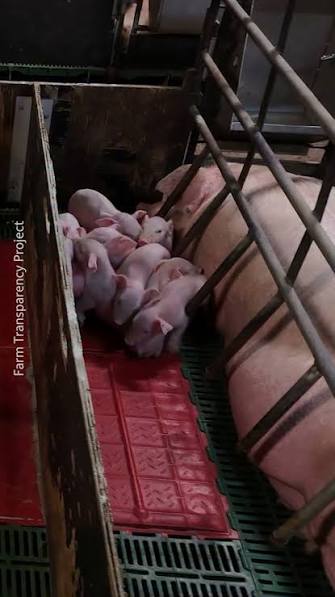
When she is moved to a farrowing crate to give birth, she has a marginally larger space, but she remains heavily restricted. Her piglets nurse from her through the bars of the crate. At approximately three weeks — when the piglets are not yet naturally weaned — they are taken away. She is then moved back to a gestation crate, inseminated again, and the process begins over.
In commercial pork production in the United States, this cycle continues for most of a sow’s productive life — typically two to five years of continuous pregnancies before she is considered spent and sent to slaughter. During that entire time, her existence has consisted primarily of a crate two feet wide.
The veal crate applies a similar logic to male calves born into the dairy industry. Because male dairy calves have no value to the milk production system, they are removed from their mothers within hours of birth — causing observable distress in both cow and calf — and placed in individual stalls where they are fed a restricted diet deliberately low in iron to produce the pale, soft meat that the veal market prizes. These stalls also restrict movement to the point where the animals cannot turn around. The result is muscle atrophy that affects the texture of the meat — which is, horrifyingly, the intended outcome.
What Confinement Does to an Animal
The animal welfare case against gestation crates is not built on sentiment. It is built on veterinary science, behavioral research, and the direct observation of what happens to pigs subjected to this system over the course of years.
The physical consequences begin immediately. Standing and lying on concrete or slatted floors with no bedding causes pressure sores, joint damage, and lameness that worsens over time. The muscles of a pig in a gestation crate atrophy from disuse. Her hooves, without the varied surfaces and movement that would naturally wear them down, can develop painful overgrowth. The physical deterioration of a sow over years of gestation crate confinement is measurable, documentable, and entirely predictable from the conditions of her housing.
The psychological consequences are, in some respects, even more revealing of what this system actually does to these animals. Pigs are highly intelligent animals — consistently ranked among the most cognitively sophisticated of the domesticated species, capable of learning, problem-solving, social recognition, and emotional responses that most people would not expect from an animal they associate primarily with food production. When an animal of this cognitive complexity is placed in a space so small it cannot turn around, with no stimulation, no social interaction, no ability to express any natural behavior, the result is a psychological state that animal behaviorists describe as chronic frustration and despair.
The behavioral signature of this state is what researchers call stereotypies — repetitive, purposeless behaviors that have no natural function but that emerge as responses to extreme confinement. Pigs in gestation crates bite the metal bars of their enclosures, sometimes until their mouths bleed. They perform repetitive head movements, rooting motions on concrete that produces nothing, pacing patterns constrained to the few inches of movement available to them. These are not quirks or individual personality traits. They are the predictable responses of a social, active, intelligent animal placed in conditions that deny every aspect of its natural behavioral repertoire. They are, in the plainest possible language, symptoms of suffering.
The public health implications of these systems are also documented and cannot be ignored. The American Public Health Association, the Infectious Diseases Society of America, and the Center for Food Safety have all noted that intensive confinement prevents sows from moving freely and performing almost all natural behaviors, inducing the levels of stress that compromise immune function and create conditions favorable to the spread of pathogens. The COVID-19 pandemic, which devastated large-scale meat processing facilities and raised urgent questions about the conditions in which food animals are raised, made the public health argument against industrial confinement systems more visible than it had previously been.
The Industry’s Defense — and Its Limits
The commercial pork industry defends gestation crates on grounds of animal management, disease control, and economic efficiency. These arguments deserve engagement, because they are not entirely without substance — and understanding where they are genuinely valid and where they are not is essential for anyone who wants to make the strongest possible case for reform.
The most substantive industry argument is that individual crating prevents fighting injuries among pregnant pigs. This is real. Pigs are territorial and competitive, and pregnant sows housed together without adequate space and management can injure each other in competition over food and social dominance. Poorly designed group housing systems do produce more injuries than individual crating. This is why well-designed group housing — with sufficient space, appropriate feeding systems, and proper management protocols — is necessary for a successful transition, not just the removal of the crates.
The existence of that management challenge does not justify the crate. It defines the design requirements for a better system. And the evidence from the numerous countries — including the entire European Union, the United Kingdom, Canada, and New Zealand — that have banned or severely restricted gestation crates is that group housing systems can be managed successfully. The EU banned gestation crates for the majority of a sow’s pregnancy in 2013, requiring only that group housing be provided from four weeks after insemination until a week before farrowing. Large-scale commercial operations across Europe have been managing pregnant sows in group housing successfully for more than a decade. The argument that it cannot be done is not supported by the evidence of how it has been done, at commercial scale, in most of the developed world outside the United States.
The efficiency argument is more transparently self-interested than it is compelling on animal welfare grounds. The crate system was designed to maximize throughput in a space — more animals per square foot, lower labor costs per animal, easier monitoring of individual food intake. These are real economic benefits to the producer. They are not benefits to the animal, and the question of whether those producer benefits justify the welfare costs to six million individual sentient animals is precisely the question that democratic societies are currently answering through legislation, and increasingly answering in the negative.
The Legislative Map: Where the Law Stands
The shift in American law on gestation crates has been one of the most significant developments in farm animal welfare over the past two decades, and it has been driven almost entirely by citizen ballot initiatives and state legislatures rather than federal action.
California led the way with Proposition 2 in 2008, which phased out battery cages, gestation crates, and veal crates for in-state production. In 2018, California voters went further with Proposition 12, which not only banned confinement systems for in-state production but also prohibited the sale of pork, veal, and eggs in California from animals raised in tight confinement anywhere in the country, regardless of where they were produced. The National Pork Producers Council challenged Proposition 12 all the way to the United States Supreme Court, arguing that it unconstitutionally burdened interstate commerce by effectively regulating how pigs are raised in Iowa, Indiana, and other major pork-producing states. The Supreme Court upheld Proposition 12 in 2023, establishing its constitutionality and sending a clear signal that state-level animal welfare sales bans are on solid legal footing.
That ruling has been the foundation on which subsequent state legislation has been built. Massachusetts voters passed a similar sales ban in Question 3. New Jersey enacted its gestation and veal crate ban in August 2023, following a 13-year campaign led by the Humane Society of the United States, the Animal Legal Defense Fund, and a coalition of more than 60 organizations. The bill passed with overwhelming legislative support and was signed by Governor Phil Murphy — a reflection of the 93 percent of New Jersey residents who polling showed supported the ban. Ohio, which is actually a significant pork-producing state, has been phasing out gestation crates under regulations passed in 2010 that took full effect in 2026, making it the largest hog-producing state to require the transition.
The full roster of states that have enacted laws restricting or banning extreme confinement now includes California, Colorado, Florida, Massachusetts, Michigan, New Jersey, Ohio, Oregon, Rhode Island, Utah, and Washington, among others. The trajectory is clearly toward expansion of these protections. The legal challenge to Proposition 12 having failed, the industry’s legislative strategy has shifted to the federal level.
The Farm Bill Threat: The Industry’s Attempt to Wipe the Slate Clean
Here is where the stakes of the current political environment become most immediate and most concrete for the animal welfare movement and for the millions of people who voted for the state-level protections that are now under threat.
The National Pork Producers Council and allied agricultural industry groups have been pushing Congress to include preemption language in the Farm Bill — the sweeping federal legislation that governs agricultural policy in the United States and is renewed approximately every five years. The version of this effort known as the EATS Act, the Exposing Agriculture Trade Suppression Act, would prohibit states from enforcing their own animal welfare standards against products imported from other states. If enacted, it would effectively nullify California’s Proposition 12, Massachusetts’ Question 3, New Jersey’s crate ban, and every similar state law in a single piece of federal legislation — undoing more than two decades of state-level democratic progress on farm animal welfare through a single congressional action.
The political framing of this effort is transparent but effective in certain constituencies. Iowa Senator Chuck Grassley has argued publicly that California’s Proposition 12 is preventing Iowa pork from being sold in California, which he frames as an overreach by California voters into Iowa farming practices. What this framing omits is that California — representing approximately 15 percent of the U.S. pork market — has the sovereign right to set its own standards for products sold within its borders, a right upheld unanimously by the Supreme Court. The EATS Act is not a defense of federalism. It is the opposite — it is an attempt to use federal legislation to override the democratic choices of state voters on an issue the Supreme Court has explicitly said is theirs to decide.
The Farm Bill fight is ongoing, and the outcome is not certain. Senate versions of the bill have thus far omitted the EATS Act preemption language, while House versions have included it. The final legislation will be determined by conference negotiations between the chambers. Animal welfare organizations, environmental groups, and public health advocates are engaged in active lobbying and public pressure campaigns to ensure that the preemption provisions do not survive the conference process.
For SAN readers in states with active gestation crate bans or sales bans — California, Massachusetts, New Jersey, and others — this fight is directly relevant to your own state’s law. If the EATS Act language survives into the final Farm Bill, the state ban your legislature passed and your governor signed will be rendered unenforceable against out-of-state producers. The sows in Iowa and Indiana will be back in crates, their products will flow into your state’s grocery stores, and the decade-long campaign that produced your state’s law will have been effectively nullified by a rider attached to agricultural appropriations legislation.
Corporate Pledges: When Promise and Performance Diverge
Parallel to the legislative fight, and interacting with it in complex ways, is the landscape of voluntary corporate commitments to eliminate gestation crates from supply chains. Beginning in the early 2010s, a wave of major food companies and fast-food chains made public pledges to go “100% gestation crate-free” by specific target dates. McDonald’s, Wendy’s, Burger King, Costco, Walmart, Kroger, and dozens of other major players in the food retail and restaurant industry announced their commitment to source pork only from suppliers that do not use gestation crates.
These pledges were made primarily in response to public pressure from animal welfare organizations and the growing consumer awareness of factory farming conditions. They were also, in most cases, made without the legal enforcement mechanisms that state laws provide. They were marketing commitments, not contractual obligations. And when the deadlines passed, many of the companies that made them had not met them — and faced no legal consequence for that failure.
This is the fundamental difference between a state law and a corporate pledge: the law has teeth. A restaurant chain that sources pork from gestation crate facilities and sells it in California is violating Proposition 12 and faces market exclusion from a 15 percent slice of the U.S. pork market. The same restaurant chain that simply fails to meet its voluntary pledge faces public shaming, activist campaigns, potential reputational damage with consumers — none of which carries anything close to the financial consequence of being locked out of the California market.
The practical result is that corporate pledges, however useful they are as signals of where consumer sentiment is heading, cannot be the primary mechanism for reform. They are supplementary to legislative change, not a substitute for it. The organizations that have been most effective in this space — including the Humane Society of the United States, Animal Equality, and the Animal Legal Defense Fund — have understood this from the beginning, which is why their energy has consistently been directed at state and federal legislation rather than primarily at corporate pressure campaigns, even as those campaigns have value as public awareness tools.
The Difference Between Then and Now
The pace of change on this issue has been genuinely significant, even if the pace has felt painfully slow against the backdrop of six million pigs in crates right now, today. When the first state-level gestation crate restrictions began passing in the early 2000s, the industry dismissed them as the work of urban activists who did not understand agriculture. The National Pork Producers Council’s legal challenge to Proposition 12 was designed to establish, once and for all, that states could not regulate how products sold within their borders were produced elsewhere. The Supreme Court’s 2023 ruling in the case established, once and for all, precisely the opposite.
That ruling changed the terrain of this debate in ways that are still playing out. It validated the sales ban approach as a legitimate exercise of state power, opening the door for other states to enact their own versions. It forced major pork producers to make genuine capital investments in facility conversions to maintain California market access — investments that, once made, shift the economics of the industry in ways that make returning to the old system less attractive. And it demonstrated that the democratic will expressed by voters in ballot initiative campaigns on farm animal welfare has a constitutional foundation that cannot simply be litigated away by the largest trade associations in the agricultural industry.
The fight is not over. The EATS Act threat is real. The corporate pledge gap between commitment and performance is real. The six million sows in crates are real. But the arc of movement on this issue has been consistently in one direction — toward recognition, in law and in public consciousness, that the conditions in which the American pork industry keeps its breeding animals represent a level of confinement-based suffering that a civilized society should not accept.
What You Can Do
The political fight over the Farm Bill preemption provisions is active and consequential right now. Contacting your congressional representatives — both in the House and Senate — to oppose any Farm Bill language that would override state animal welfare laws is one of the most direct actions available. The organizations leading this campaign, including the Humane Society of the United States, Animal Equality, and the Animal Legal Defense Fund, have active action alert systems that can direct you to the right contact information for your own legislators.
Consumer choices remain meaningful, even in the absence of complete legal reform. Seeking out pork products specifically labeled as crate-free or group-housed, reducing consumption of conventional pork from suppliers that have not completed the transition, and asking restaurants and grocery stores about their sourcing policies — these are individual actions that aggregate into market signals that the food industry monitors and responds to.
Supporting organizations that are doing the legislative advocacy, the litigation, the corporate accountability campaigns, and the public education work that has produced every state ban on this list is a direct contribution to the capacity of the movement to keep pressing.
And tell the story. The reason that 93 percent of New Jersey residents supported the state’s gestation crate ban is that when people understand what a gestation crate actually is — what a pig inside one experiences over the course of years of pregnancy cycles — they oppose it. The gap between public knowledge and the scale of this practice is still enormous. Closing that gap, conversation by conversation and article by article, is the foundational work that makes everything else possible.
Six million mother pigs cannot turn around right now. Every day that changes is a day worth fighting for.
Sustainable Action Now will continue covering the Farm Bill fight, state-level animal welfare legislation, and the full landscape of factory farming reform in the United States.