

The energy headlines of any given week in 2026 can feel contradictory, almost deliberately so, as though the news itself is designed to make it difficult to locate a coherent direction in the relationship between American politics, global oil markets, and the climate transition that the science has been demanding for decades. One story describes a Democratic governor defending her state’s clean energy credentials while quietly postponing a near-term climate deadline. Another shows Republican governors and utility companies rallying behind a White House initiative to give the fossil fuel industry a larger role in powering the data center boom. A third reveals that the administration’s deal with Iran has collapsed, sending oil markets back into the volatility that briefly, for about a month, had seemed to relent. And underneath all of it, the administration is offering Americans gasoline at 50 cents below market price through a program called the Freedom Fuel Network, funded in ways that have not been publicly explained.
These are not separate stories. They are different facets of the same fundamental moment: a country whose energy infrastructure, whose geopolitical relationships, and whose atmospheric chemistry are all under pressure simultaneously, and whose political responses to those pressures are pulling in directions that cannot all be sustained at once.
At Sustainable Action Now, we cover the intersection of climate, energy, and political accountability because the decisions being made right now, in state capitals and in Washington and in the oil markets that respond to diplomatic signals faster than any legislature can react, are the decisions that will determine whether the climate commitments of the past decade remain achievable or become historical footnotes. This week provided more material for that coverage than most.
New York’s Governor and the Credentials Question
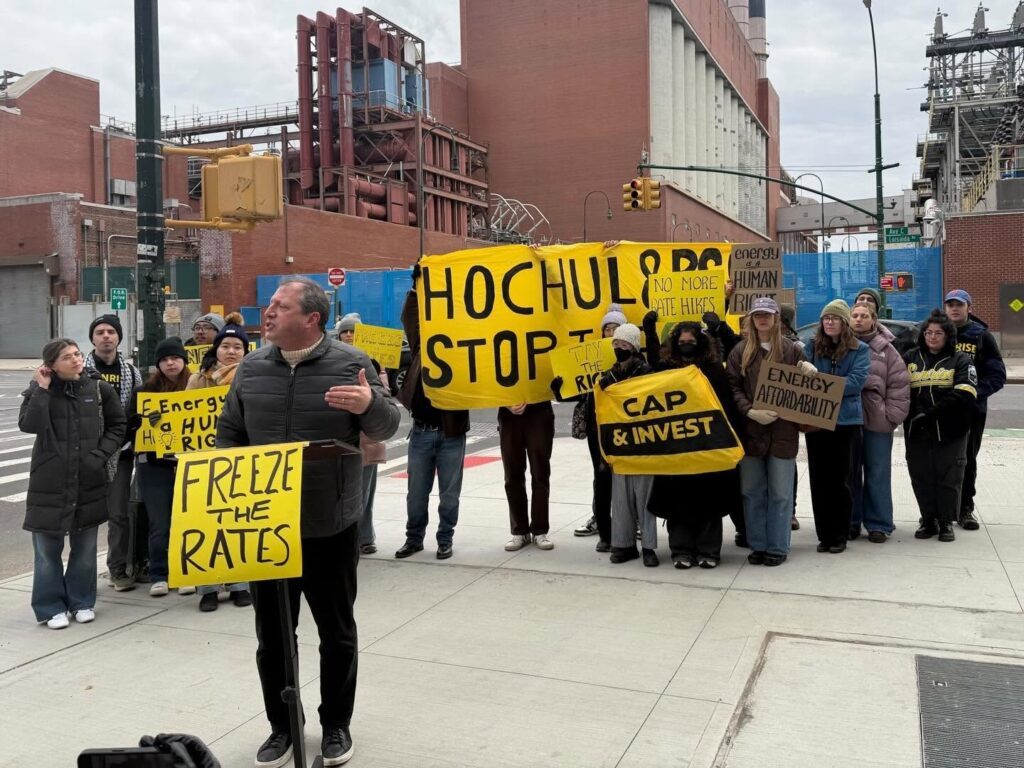
New York Governor Kathy Hochul made news this week by telling reporters not to question her credentials on climate and clean energy, a statement that arrived in the context of her administration’s decision to push back a near-term climate goal that had been part of the state’s statutory framework. The specific deadline that was adjusted is less important, in the long arc of climate policy, than the dynamic the adjustment illustrates: the gap between the political identity of a climate-committed state and the practical pace at which the physical, regulatory, and economic systems that support climate commitments can actually move.
Hochul’s record on clean energy deployment is not trivial. New York has significantly accelerated its solar deployment in recent years, and the governor can point to a major new transmission line that will move renewable power across the state more efficiently than the existing grid infrastructure allows. She has also positioned nuclear power as a central component of the state’s path to its 2050 net-zero target, a position that places her within the growing body of climate scientists and policy analysts who argue that existing nuclear infrastructure is too valuable a source of reliable, low-carbon electricity to close before the renewable buildout can fully compensate for the lost capacity.
The tension between the governor’s defensive posture and the underlying reality of her administration’s record is worth sitting with rather than resolving quickly in either direction. Adjusting a near-term deadline while maintaining the long-term target is a defensible policy decision in a context where supply chains, permitting systems, workforce development, and transmission infrastructure are all moving at their own paces. It is also a move that erodes the accountability function of statutory climate targets, which exist precisely because long-term goals without enforceable interim milestones tend to drift. Telling reporters not to question your credentials is not the same as making the case that the adjustment was necessary and that the long-term commitment remains intact. Both things can be true, and neither one excuses the state from the obligation to make the case rather than deflect the inquiry.
What is genuinely worth noting in New York’s situation is the structural argument for nuclear power that Hochul is making. The United States has been closing nuclear plants for two decades on a combination of economic and political grounds, and the renewable buildout, while accelerating, has not fully compensated for the lost baseload generation. The argument that existing nuclear plants represent a form of clean energy infrastructure that is extraordinarily difficult and expensive to replace, and that closing them before the alternatives are ready constitutes a net negative for climate goals, is an argument that a growing number of formerly skeptical climate advocates have come to accept. Hochul is on defensible scientific and policy ground here, even if her public communications around the near-term goal adjustment leave something to be desired in terms of transparency.
Republican Governors, Data Centers, and the Energy Demand Question
The governors of Montana, Wyoming, and Missouri announced this week that they are endorsing the Trump administration’s initiative to manage the energy price impact of the data center construction boom, a development that frames what is fundamentally a clean energy planning challenge as a question of industrial policy and federal control.
The data center energy demand issue is one of the most significant and underappreciated dimensions of the current energy transition. The explosive growth of artificial intelligence infrastructure, cloud computing, and the digitization of commerce, logistics, finance, and communication has created a category of energy demand that was not factored into most utility planning models from five or ten years ago. Major hyperscale data centers can consume as much electricity as a small city, and the pipeline of planned construction across the United States represents a demand growth scenario that the existing grid and the planned renewable additions are not, in most regions, scaled to accommodate without significant additional investment.
The Trump administration’s approach to this challenge, as endorsed by the Republican governors this week, prioritizes federal coordination with utilities to ensure that data center energy costs do not raise prices for residential consumers and existing commercial customers. This is a legitimate policy concern. The mechanisms being proposed to address it are less clearly aligned with the long-term energy transition.
Wyoming and Montana are coal and natural gas producing states with strong economic interests in the continued demand for fossil fuel generation. Missouri has significant coal-fired generation capacity. The endorsement of the White House data center initiative by governors of these states reflects, at least in part, the calculation that a federal focus on data center energy management that is managed through existing fossil fuel generation is preferable, from their states’ economic perspective, to a federal focus that accelerates renewable buildout to meet the new demand.
The clean energy alternative to this approach is not complicated in concept, even if it is challenging in execution: match the data center demand growth with accelerated deployment of renewable generation, long-duration storage, and grid modernization, such that the data center boom becomes a driver of the clean energy transition rather than a demand surge that gives political cover for extending the operational life of fossil fuel plants. Several major technology companies have made commitments to power their data centers with renewable energy that align with exactly this approach. The administration’s initiative, as currently framed, does not appear to be designed around that alignment.
Weather Warnings and the Staff Shortages That Make Them Unreliable
A less politically visible but practically consequential story this week involves the National Weather Service and the impact of federal workforce reductions on the agency’s ability to produce reliable severe weather forecasts.
The Trump administration’s across-the-board federal workforce cuts have affected the National Weather Service, reducing staffing levels that meteorologists describe as already stretched before the cuts. The practical consequence that meteorologists are now publicly naming is a degradation in the quality of severe weather forecasting, specifically the advanced warning time and geographic precision of alerts for tornadoes, flash floods, and severe thunderstorm events.
This is a climate story in a specific and important sense. The frequency and intensity of severe weather events are among the most well-documented consequences of climate change, and the relationship between atmospheric warming and the severity of convective weather is expected to produce more intense and more frequent extreme events in the coming decades. The capacity to warn people effectively about these events is therefore a climate adaptation infrastructure requirement, not simply a routine government service. Cutting the staff who produce those warnings in the same period when the climate conditions that make severe weather forecasting critical are intensifying is a policy choice with predictable human consequences that are not hypothetical but actuarial.
The staffing reductions at the National Weather Service also represent a case study in the indirect climate costs of the current administration’s approach to federal agency management. The direct climate policies, the withdrawal from international agreements, the rollback of emission regulations, and the promotion of fossil fuel production, receive appropriate attention as climate policy failures. The attrition of the scientific and technical capacity that makes climate adaptation possible, through workforce cuts, funding reductions, and the systematic undermining of the agencies that produce climate and weather science, represents a different category of harm that is no less real for being less visible.
Iran Oil, the Ceasefire That Wasn’t, and the Price of Geopolitical Fragility
The oil market story of the week is the collapse of the Iran ceasefire and the reimposition of sanctions on Iranian oil sales. A monthlong diplomatic achievement that had briefly reduced global fuel prices by reversing some of the supply concerns that had been driving them upward was effectively undone when the agreement reached between the U.S. and Iran proved unable to survive the first significant test of its durability.
The energy price consequences were immediate. Resumed hostilities reversed the monthlong drop in fuel prices that the ceasefire had produced. Oil markets, which had been recalibrating around the assumption that Iranian exports would remain accessible under the agreement, repriced around the new reality of renewed sanctions and the supply uncertainty that accompanies them.
For the climate transition, the Iran oil story illustrates a dynamic that clean energy advocates have been making the case against for years: the structural vulnerability of fossil fuel-dependent economies to geopolitical events that are entirely outside the control of the people and industries who depend on the fuel. The price of gasoline in the United States is affected by diplomatic negotiations between the American and Iranian governments because the global oil supply that sets the price of American gasoline is sensitive to the volume that Iran contributes or withholds. This sensitivity is not a temporary feature of the current political moment. It is the permanent condition of any energy system organized around a globally traded commodity whose supply is partly controlled by governments with interests that do not always align with those of the countries that consume what they produce.
The clean energy alternative to this vulnerability is also not complicated in concept: energy produced domestically from wind, sun, and geothermal sources is not subject to Iranian sanctions, Saudi production decisions, Russian pipeline politics, or any other external geopolitical variable. The electricity generated by a solar panel on a rooftop or a wind turbine in a field is priced by the cost of the equipment and the labor to install it, not by the outcome of a ceasefire negotiation. Building an energy system around that kind of domestic, price-stable supply is not merely a climate goal. It is an energy security argument that cuts across the ideological lines that typically divide energy policy debates.
The Freedom Fuel Network: Cheap Gas and Unanswered Questions
The administration’s announcement of the Freedom Fuel Network, a program offering gasoline at up to 50 cents per gallon below market prices timed around Independence Day, raises a question that the administration has not publicly answered: who is paying for the discount?
Gasoline prices are set by global oil markets, by refining capacity, by distribution costs, and by the tax structures of the states where the fuel is sold. A discount of 50 cents per gallon below market price represents a real cost that has to be absorbed somewhere. The administration has not provided a public explanation of the funding mechanism, which means the public is being asked to evaluate a fuel pricing initiative without the information needed to determine whether it is a legitimate policy intervention, a market subsidy with an unacknowledged beneficiary, or something else entirely.
What is clear is the political timing. Offering cheap gasoline ahead of Independence Day is an act of political communication as much as it is an energy policy intervention. Gasoline prices are one of the most visible and emotionally significant consumer prices in American life, and their political resonance is well understood by every administration that has managed through a period of price volatility. The Freedom Fuel Network is designed to be seen and to generate the association between the administration and affordable energy that the political calendar around July 4th makes particularly salient.
The climate implications are in the same category as the Iran oil story: cheap gasoline is, in the short term, good for people who need to drive to work and good for the political standing of the administration that delivers it. In the medium and long term, cheap gasoline is an investment in the infrastructure of fossil fuel dependence, a signal to consumers, to automakers, and to the market that the transition to electric vehicles and alternative transportation is further away than the climate science says it needs to be.
The cost is real in both directions. The administration has not said who is paying for the discount. The climate system will eventually present a bill that is considerably larger.
The Green New Deal for the AI Era: A New Generation Arrives in Washington
While the existing Democratic establishment has been navigating affordability messaging and avoiding the language of climate crisis in competitive districts, something else has been happening in the safe blue seats where Democratic primaries are decided: a new generation of progressives has been winning, and they are arriving with a significantly more ambitious vision of what climate policy needs to become.
<cite index=”9-1″>A new crop of progressive Democrats poised to join the House next year could pump new energy into the quest for a Green New Deal and even expand its scope, eight years after activists first put the aggressive climate change policy in the national spotlight.</cite> The insurgents are not retreating from the Green New Deal’s ambitions. They are arguing that those ambitions were never large enough to begin with.
The most visible of the new arrivals is Melat Kiros, an attorney who defeated longtime incumbent Colorado Representative Diana DeGette in a June primary. DeGette had held her Denver seat since 1997. Kiros’s victory, alongside progressive wins for former New York City Comptroller Brad Lander over Representative Dan Goldman and Darializa Avila Chevalier’s defeat of Representative Adriano Espaillat, represents a specific pattern: progressive challengers winning in safe blue districts where the general election is not competitive, meaning the primary outcome determines who goes to Washington. These are not swing-district moderates calculating electability. They are representatives of urban constituencies that are, in the Democratic primary electorate’s judgment, ready for something more ambitious than what the current caucus has been offering.
<cite index=”9-1″>Kiros has framed the Green New Deal as a floor, not a ceiling, for what the country needs to be doing. She has specifically identified the missing component of AI and how it factors into climate legislation as a critical dimension that the original Green New Deal framework did not address.</cite> That framing is more precise than it might initially seem. The original Green New Deal resolution, introduced by Alexandria Ocasio-Cortez and Senator Ed Markey in 2019, was conceived in a moment when the energy demand implications of artificial intelligence were not yet visible at the scale they have become. The data center energy surge that is now one of the most consequential near-term challenges for the clean energy transition was not a central concern of climate policy seven years ago. It is now.
<cite index=”8-1″>The Green New Deal has faded from its most visible position in Democratic politics in recent years. Ocasio-Cortez and Markey, who introduced Green New Deal resolutions in 2019, 2021, and 2023, did not introduce one in the current Congress. Its promise of a vast economic and environmental reorganization for the benefit of workers is now living on, somewhat, in the growing progressive blowback against AI data centers.</cite> Ocasio-Cortez and Senator Bernie Sanders released high-profile legislation earlier this year imposing a moratorium on new data center construction, a proposal that has found significant support among the progressive primary winners but considerably less support among the broader Democratic caucus.
The Sunrise Movement, which has been the organizational backbone of Green New Deal advocacy since its founding, is explicitly framing the data center issue as the next iteration of the climate fight rather than as a separate technology policy question. Sunrise spokesperson Denae Ávila-Dickson has described data centers and AI as issues that a new Green New Deal will have to address, connecting the question of which energy sources power these facilities to the broader question of what the clean energy transition requires. If every new data center in the United States is powered by extended fossil fuel generation rather than by new renewable capacity, the net result of the AI infrastructure boom is an increase in emissions in the very decade when the climate timeline demands the opposite.
The Democratic Party’s establishment response to the progressive primary victories has been to emphasize affordability messaging and to maintain distance from Green New Deal language that Republican opponents have used effectively in previous cycles. House Minority Leader Hakeem Jeffries has called climate change a crisis while being consistently non-committal about the Green New Deal specifically, and has stated that a data center moratorium is not a position he has articulated. The tension between the progressive insurgents and the Democratic leadership over both the substance and the framing of climate policy is one of the defining internal debates the party will carry into the next Congress.
Kiros’s response to advisors who counsel Democrats to talk less about climate change is worth quoting in substance if not verbatim: she has said these advisors are not actually talking to voters, and that young people in particular are highly engaged on the intersection of AI, energy, and the climate future they will inhabit. The Sunrise Movement’s data from the primary season appears to support that assessment. The candidates who won on ambitious climate platforms did so in primaries where the electorate was paying attention.
What the Green New Deal for the AI era looks like in legislative form is still being developed. The data center moratorium proposal is the most concrete single policy position that unites the new progressive cohort. Beyond that, the framework they are building connects federal investment in clean energy infrastructure, a federal jobs guarantee organized around the energy transition, and the regulation of AI energy demand into a coherent if not yet legislatively detailed vision of what decarbonization at the required scale actually requires. Whether that vision survives the transition from primary politics to floor votes in a House that neither party currently controls by a significant margin is a question that the 2026 elections will begin to answer.
What is already clear is that the people arriving in Washington with that vision are not the same people who have been managing the incremental pace of climate progress that the past decade has produced. The question of whether that is what the moment requires, or more than the political system can absorb, is the most important energy and climate question in American domestic politics right now.
The Transition That Can’t Wait for the Politics to Catch Up
The energy and climate news of this week does not resolve into a simple narrative of progress or regression. It is more complicated than that. New York is deploying solar and building transmission lines and making a credible case for nuclear power while pushing back a deadline it set for itself. Republican governors are engaging with a real problem in data center energy demand through an approach that serves their states’ fossil fuel interests. The National Weather Service is warning that storm forecasts are becoming less reliable at exactly the moment when climate change demands they become more so. Iran oil is back off the market, and gasoline prices are moving in response to a diplomatic breakdown that had nothing to do with any American consumer’s energy choices. And a new generation of Democratic progressives is arriving in Washington arguing that the Green New Deal was a floor, and that the AI era demands they build something taller on top of it.
What connects all of these stories is the continued organization of the American energy system around fossil fuels as the default, the baseline, the thing you go back to when the alternative is complicated or politically inconvenient or temporarily disrupted by a ceasefire that didn’t hold. Oil for so much, as the framing notes: for transportation, for heating, for chemical feedstocks, for the geopolitical leverage that comes from controlling its supply, and for the political narratives that cheap prices enable and expensive prices disrupt.
The transition away from that organization is not optional in the long run. The climate system’s response to continued fossil fuel combustion does not negotiate with political timelines or respect the convenience of election cycles. What the transition requires is the kind of sustained, clear-eyed policy commitment that does not push back deadlines when they become inconvenient, does not frame fossil fuel demand as an energy security asset rather than a geopolitical liability, and does not offer cheap gasoline as a holiday gift without being willing to explain who is paying for it.
The energy transition is not a partisan issue at the level of physics. It is a governing challenge of the first order, and the news of this week illustrates, from multiple angles, the distance between the pace at which the political system is moving and the pace at which the atmospheric system requires it to move.
Sustainable Action Now will continue covering the intersection of climate policy, clean energy transition, and the energy market dynamics that shape both.