

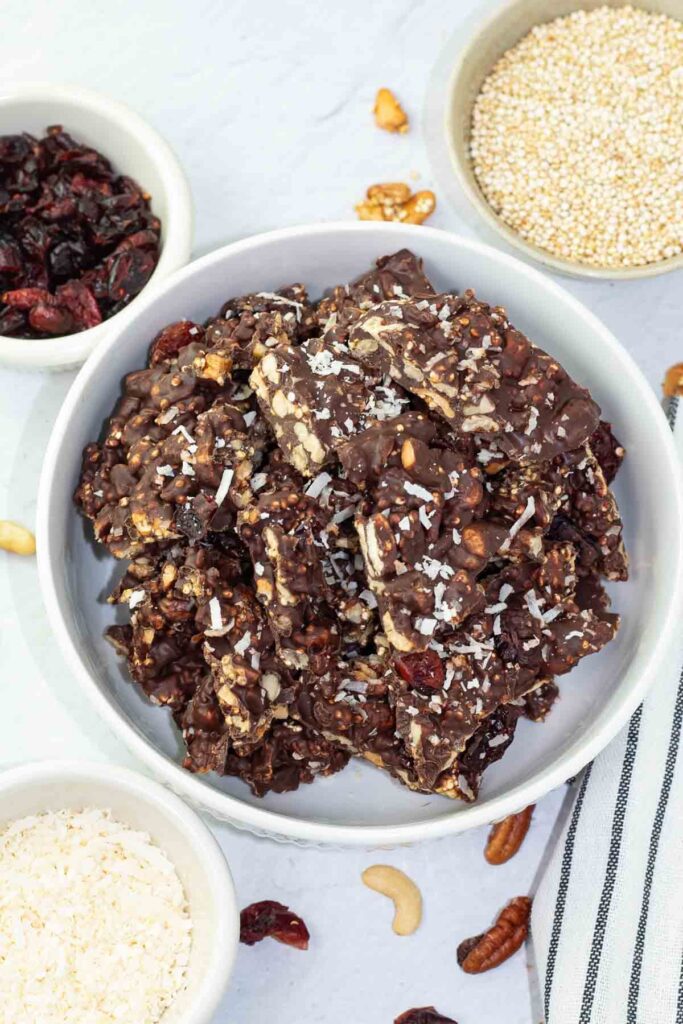
There is a category of recipe that sounds simple enough to be skeptical of and turns out to be the thing you make every time you need to bring something to a gathering, every time you want a dessert that requires almost no effort and produces results that feel genuinely impressive, and every time you want proof that plant-based eating does not require sacrifice. This chocolate bark is that recipe. And the thing that makes it extraordinary — the element that separates it from every other chocolate bark you have ever tasted — is something so unexpected that people cannot stop asking about it: toasted quinoa.
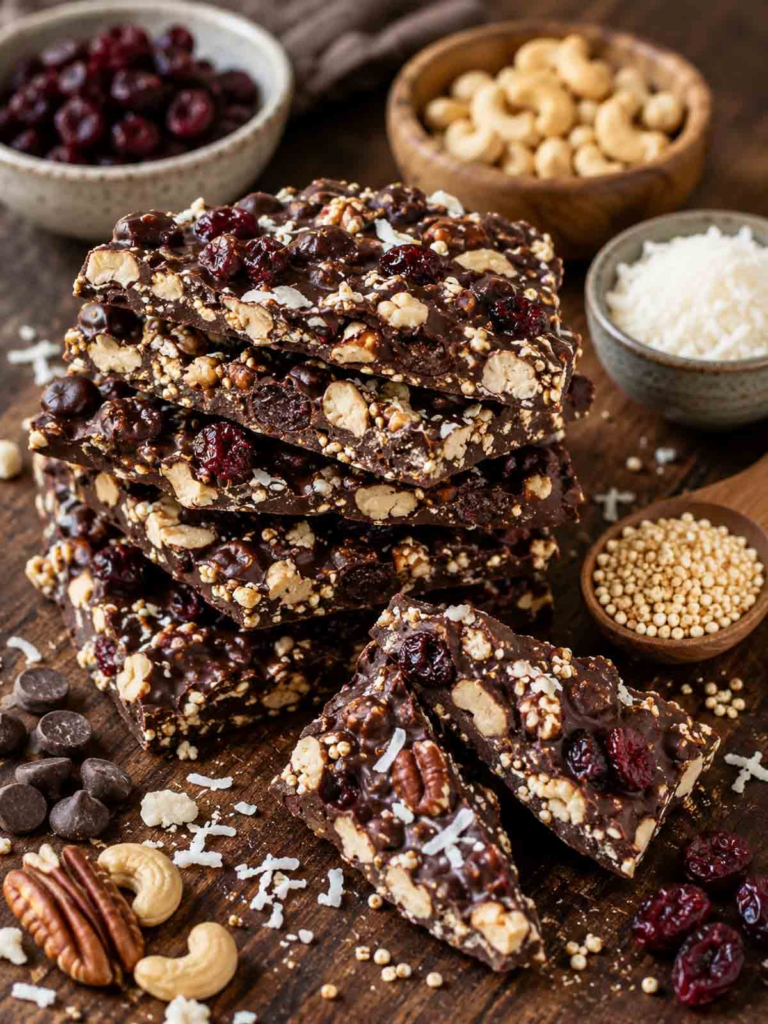
Yes, quinoa. The same grain you put in your salad and your grain bowls is, when toasted dry in an oven with a little maple syrup and some nuts, transformed into something that functions like the world’s most sophisticated version of a crispy rice cereal. Light, nutty, impossibly crunchy, scattered through every square inch of dark chocolate so that there is no bite without it — toasted quinoa is the reason this bark achieves a texture that artisanal chocolate brands charge premium prices to replicate. And you are going to make it at home, with whole-food ingredients, in about 35 minutes of active time.
At Sustainable Action Now, our recipe section exists on the same philosophical foundation as everything else we do: the choices we make about what we eat are among the most powerful tools we have for reducing harm to animals, to ecosystems, and to our own health. This chocolate bark is plant-based, naturally dairy-free, built entirely from whole-food ingredients, and better — by any honest measure of flavor and texture — than most of the conventional chocolate desserts it will sit next to on a table. That is the kind of recipe we are here for. This Easy Chocolate Bark with Toasted Quinoa is an EatPlant-Based Recipe.
Why Dark Chocolate Is Already the Best Choice
Before the quinoa, before the nuts, before the cranberries and coconut and sea salt, there is the chocolate — and the choice of chocolate matters more than most recipes will tell you. This bark uses dark chocolate, and not merely as a way to signal sophistication. Dark chocolate that contains at least 60 to 70 percent cacao is naturally dairy-free and therefore naturally vegan in a way that milk chocolate is not. It is also significantly richer in flavanols — the plant compounds found in cacao that have been linked to cardiovascular benefits and anti-inflammatory effects. And its flavor is more complex, more capable of standing up to the other ingredients in this bark without being overwhelmed, and more satisfying in smaller quantities than the sweeter, milder milk chocolate alternatives.
The practical upshot is that dark chocolate provides a bittersweet canvas onto which every other element in this recipe does something interesting. The sweetness of the dried cranberries has something to contrast against. The sea salt has something to enhance. The buttery richness of the cashews and pecans has something to anchor against. The bittersweet base is not incidental to the recipe. It is the architectural decision that makes everything else work.
For the actual chocolate, dark chocolate chips are the most convenient option and melt reliably in either a microwave or a stovetop double boiler setup. Dark chocolate bars — particularly high-quality options in the 60 to 70 percent cacao range — melt with even more smoothness and depth, and many serious home bakers prefer them for exactly that reason. If using bars, break them into small pieces before beginning. The quality of your chocolate is the single variable that most directly determines the quality of the finished bark, so it is worth using the best dark chocolate you can find.
The Secret Ingredient: What Toasted Quinoa Actually Does
Quinoa in its raw state is a tiny, bead-like seed that most people know exclusively as something you cook in water and serve alongside roasted vegetables. What almost nobody knows — until they try it — is what happens when you toast raw quinoa dry in an oven: it transforms completely. The moisture evaporates. The exterior becomes crisp. The flavor becomes nutty, almost popcorn-adjacent, with an earthiness that pairs beautifully with chocolate. The texture becomes the kind of light, airy crunch that you associate with specialty chocolate bars that cost significantly more than they should.
Toasted quinoa behaves like a whole-food version of crisped rice cereal, but with a nuttier flavor and a more complex texture. Scattered through melted dark chocolate, it creates a bark where every bite has a different distribution of crunch — some bites intensely crispy from a dense cluster of toasted grain, others smoother with individual pops of texture distributed throughout the chocolate. This is the element that makes people stop mid-bite, look at the piece of bark in their hand, and ask what is in this. When you tell them it is quinoa, the reaction is almost always disbelief followed immediately by appreciation.
Beyond texture, toasted quinoa brings genuine nutritional value to what is, at its heart, a chocolate dessert. Quinoa is naturally gluten-free, complete in protein — one of the very few plant foods that contains all nine essential amino acids — and a meaningful source of fiber, iron, magnesium, and B vitamins. It does not turn this bark into a health food in any technically rigorous sense. But it does mean that the crunch in your chocolate dessert is contributing something to your nutritional intake rather than simply occupying space, which is a meaningful distinction.
The key to toasted quinoa is not overcooking it. It goes from perfectly golden and nutty to overdone quickly, and the line between them is measured in minutes. Toast at 350 degrees Fahrenheit with close attention, stir frequently, and pull it when it is lightly golden and smells fragrant. The quinoa in this recipe is toasted together with the nuts and maple syrup, which coats everything in a light glaze of natural sweetness that amplifies the nuttiness and adds cohesion to the mixture once it is folded into the chocolate.
Every Ingredient and Why It Is Here
Dark chocolate chips form the base — approximately two cups, chosen for richness and vegan-friendly composition. They are the binding agent, the flavor foundation, and the vehicle through which every other ingredient is delivered.
Raw cashew pieces provide buttery, mild richness. Cashews have a higher fat content than most other nuts, which gives them a creaminess that other nuts do not quite replicate, and that creaminess expresses itself in the finished bark as a density of flavor that anchors the lighter crunch of the quinoa. Using cashew pieces rather than whole cashews is a practical choice — since they are being broken up anyway in the mixing process, the pieces are less expensive and work identically.
Raw pecan pieces bring a different character than cashews — slightly more bitter, slightly more complex, with a softer texture that creates a different chew than the cashew. The combination of the two nuts means that no two bites have quite the same nutty profile, which contributes to the addictive quality of this bark.
Quinoa — raw, uncooked — becomes the toasted quinoa through the baking step, as described above.
Pure maple syrup is the binding and sweetening agent for the nut-and-quinoa mixture before it is toasted. It coats the quinoa and nuts evenly and caramelizes lightly in the oven, creating a glazed, slightly sticky cluster that holds together when broken into pieces and mixed through the chocolate. It also adds a subtle maple warmth to the flavor profile that complements the dark chocolate without competing with it.
Unsweetened shredded coconut provides a different textural element than either the nuts or the quinoa — softer, chewier, with a faint tropical sweetness and aroma that makes the finished bark feel slightly more complex and interesting than bark made without it. It also contributes to the visual appeal of the finished product, adding white flecks against the dark chocolate surface that make the bark look as good as it tastes.
Dried cranberries are the acid note in what would otherwise be a purely rich, sweet, nutty composition. Their tartness cuts through the depth of the dark chocolate and the richness of the nuts in a way that keeps the palate engaged across multiple pieces. Look for oil-free dried cranberries when possible — some commercial versions include added oils that are unnecessary and affect the flavor.
Sea salt, added as a final sprinkle over the set chocolate, does something that most people understand intellectually but never fully appreciate until they taste it: it makes the chocolate taste more like itself. Salt suppresses bitterness and amplifies the perception of sweetness and depth. A light finish of flaky sea salt over dark chocolate is not a trend. It is the correct answer to the question of how to make chocolate taste as good as it possibly can.
How to Make It: The Method in Full
Preheat your oven to 350 degrees Fahrenheit and line a 9-by-13-inch baking sheet with parchment paper. In a medium bowl, combine the raw quinoa, pecan pieces, cashew pieces, and maple syrup. Stir until everything is evenly and thoroughly coated. Spread the mixture in a thin, even layer on the prepared pan and bake for 12 minutes, checking and stirring halfway through, until the quinoa and nuts are lightly golden and the kitchen smells of toasted nuts. Remove from the oven and allow to cool completely before proceeding.
While the quinoa mixture cools, melt the dark chocolate. The microwave method works efficiently in 20 to 30 second intervals, stirring thoroughly between each, until the chocolate is almost completely melted — then continuing to stir with the residual heat finishing the job. The stovetop double boiler method produces a silkier, more controlled melt: add an inch or two of water to a saucepan, place a heat-safe stainless steel bowl on top so that it sits snugly over the pan without touching the water, add the chocolate chips to the bowl, and stir over medium-low heat until fully melted and smooth. Whichever method you use, keep water entirely away from the melted chocolate — a single drop causes the chocolate to seize into a grainy, thick mass that cannot be recovered.
Once the quinoa mixture is fully cooled, break it into small pieces and stir it into the melted chocolate until everything is evenly distributed. Pour and spread the mixture onto the same parchment-lined pan used for toasting, using a silicone spatula to achieve an even thickness across the surface. Scatter the dried cranberries, shredded coconut, and sea salt evenly across the top, then press the toppings gently into the chocolate so they adhere when the bark sets. The most effective technique for this is placing a sheet of parchment paper over the top and pressing gently and evenly with the palm of your hand — more uniform pressure than a spatula and easier to control.
Refrigerate for approximately 15 minutes until fully set, or freeze for 10 minutes if time is short. Room temperature setting takes about two hours if you prefer to avoid the refrigerator. Once the chocolate is completely firm, break the bark into approximately 30 pieces by hand. The pieces will be irregular in shape, which is part of the appeal.
Storing and Serving
Chocolate bark keeps well in an airtight container in the refrigerator for up to two weeks, though it rarely lasts anywhere near that long once people encounter it. It can also be stored at room temperature for shorter periods, depending on the climate — dark chocolate has a higher melting point than milk chocolate, but warm environments will soften it. For gifting or transporting, layers separated by parchment paper in a box or tin hold their shape and presentation beautifully.
This bark is one of the most effective entertaining desserts in a plant-based kitchen because it requires no plates, no utensils, no heating, and no assembly at the time of serving. You break it into pieces before guests arrive and set it out. That is the entire serving process.
Variations for Every Occasion
The base formula of this bark — dark chocolate, toasted quinoa-and-nut mixture, fruit, coconut, sea salt — is a template that adapts readily to different flavor directions.
A tropical variation replaces the pecans and cranberries with cashews, dried pineapple, and dried mango alongside the shredded coconut, producing a bark that reads as summer and works particularly well for warm-weather gatherings. A cherry almond version substitutes almonds for the cashews and pecans and dried cherries for the cranberries, with the toasted quinoa and sea salt remaining as the constant elements. A trail mix version adds pumpkin seeds alongside the standard nuts and fruit for an even more complex textural experience. A holiday version incorporates pistachios alongside the pecans, with the green of the pistachios and the red of the cranberries creating a visual appeal that suits seasonal gifting.
The peanut butter variation deserves its own mention: the standard nut and quinoa base, topped with a drizzle of natural peanut butter over the set chocolate alongside the sea salt, produces a bark that will specifically satisfy anyone who believes that chocolate and peanut butter constitute a perfect combination. They are not wrong, and this version makes the case for that position in one piece of chocolate.
The original formula — toasted quinoa, cashews, pecans, dried cranberries, shredded coconut, sea salt — remains the best version, because the balance of elements in it has been refined through enough iterations to account for every flavor contrast and textural layer that makes this bark extraordinary. But the variations are genuine alternatives, not concessions, and each one has a moment where it is the right choice.
The Recipe
Servings: approximately 30 pieces Prep time: 10 minutes Cook time: 12 minutes Chill time: 15 minutes
Ingredients: 2 cups dark chocolate chips (60–70% cacao, dairy-free) ½ cup raw cashew pieces ½ cup raw pecan pieces 3 tablespoons raw quinoa (uncooked) 2 tablespoons pure maple syrup ⅓ cup unsweetened shredded coconut ¼ cup dried cranberries (oil-free preferred) Flaky sea salt for finishing
Instructions: Preheat oven to 350°F (175°C). Line a 9×13-inch baking sheet with parchment paper. In a medium bowl, combine the quinoa, cashew pieces, pecan pieces, and maple syrup. Stir until everything is evenly coated. Spread the mixture in a thin, even layer on the prepared pan. Bake for 12 minutes, stirring once halfway through, until lightly golden and fragrant. Remove from the oven and allow to cool completely.
Tropical Chocolate Bark
- Cashews
- Shredded coconut
- Dried pineapple
- Dried mango
Cherry Almond Chocolate Bark
- Almonds
- Dried cherries
- Toasted quinoa
- Sea salt
Cranberry Pecan Chocolate Bark
- Pecans
- Dried cranberries
- Shredded coconut
- Toasted quinoa
Peanut Butter Lover’s Bark
- Chopped peanuts
- A drizzle of natural peanut butter
- Toasted quinoa
- Sea salt
Trail Mix Chocolate Bark
- Cashews
- Pecans
- Dried cranberries
- Pumpkin seeds
- Toasted quinoa
Holiday Chocolate Bark
- Pecans
- Dried cranberries
- Pistachios
- Coconut flakes
While the quinoa mixture cools, melt the dark chocolate chips using the microwave method (20–30 second intervals, stirring between each) or the stovetop double boiler method. Stir until completely smooth. Break the cooled quinoa and nut mixture into small pieces and fold them into the melted chocolate until evenly distributed. Pour and spread the chocolate mixture onto the same parchment-lined pan. Scatter the dried cranberries, shredded coconut, and sea salt over the top. Press gently to adhere. Refrigerate for 15 minutes or freeze for 10 minutes until fully hardened. Break into pieces and serve.
Storage: airtight container in the refrigerator for up to two weeks.
Sustainable Action Now celebrates plant-based eating as one of the most accessible and impactful choices available for reducing harm to animals and the environment. Every recipe in our collection is designed to demonstrate that the most ethical food choices can also be the most delicious ones. The Easy Chocolate Bark with Toasted Quinoa is an EatPlant-Based Recipe.