
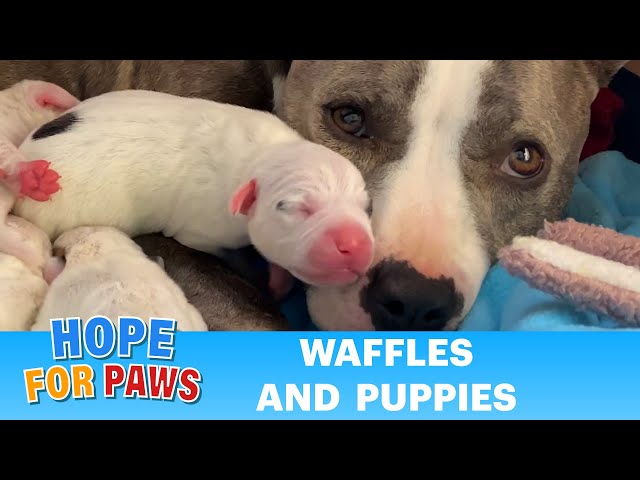
There are rescue stories that make people smile, and then there are rescue stories that force people to confront realities they rarely stop to imagine. A frightened mother giving birth alone outdoors. Newborn puppies entering the world surrounded not by warmth or protection, but by concrete, exposure, noise, predators, traffic, hunger, weather, and uncertainty. No shelter. No veterinary care. No safety net. Just survival.
The rescue story of Waffles and her puppies belongs to the second category.
For homeless animals, that emergency is routine.
Pregnant stray dogs frequently give birth in hidden corners of the urban environment where they hope predators, weather, traffic, or humans will not disturb them. Some deliver puppies beneath buildings, inside abandoned structures, near industrial lots, underneath vehicles, behind dumpsters, inside drainage systems, or within overgrown vegetation. Many are malnourished before labor even begins. Some are injured, dehydrated, frightened, or already physically exhausted from prolonged survival outdoors.
Yet despite those conditions, maternal instinct continues driving them to protect their young at all costs.
That instinct is one of the most emotionally powerful realities rescue workers witness repeatedly. Mother dogs surviving on the streets often display extraordinary devotion under circumstances bordering on impossible. They search desperately for shelter. They remain hypervigilant against threats. They go without food to stay near newborns. They defend litters despite fear and exhaustion. Even traumatized or neglected animals frequently maintain fierce protective attachment to their puppies.
Waffles’ rescue therefore represents more than one family saved successfully. It represents intervention at one of the most fragile moments in an animal’s life cycle.
At Sustainable Action Now, stories like this matter because they reveal how interconnected the homeless animal crisis truly is. Every pregnant stray reflects multiple systemic failures simultaneously: lack of accessible spay and neuter resources, abandonment, economic instability, overcrowded shelters, insufficient veterinary access, and communities overwhelmed by uncontrolled reproduction cycles among stray populations.
The cycle is devastatingly self-perpetuating.
One unspayed female abandoned outdoors can produce multiple litters over her lifetime, while offspring themselves frequently continue reproducing under similar conditions. Rescue organizations therefore operate not only as emergency responders, but as critical interruption points preventing suffering from multiplying exponentially over time.
This is why organizations like Hope For Paws place such strong emphasis on prevention alongside rescue itself.
The emotional resonance of Waffles’ story also stems from something deeply universal: vulnerability during motherhood transcends species. Audiences instinctively recognize the terror and helplessness involved in bringing life into dangerous conditions without support. That emotional recognition helps bridge the gap many people still unconsciously maintain between human emotional experience and animal emotional experience.
Modern rescue work increasingly challenges the outdated assumption that animals merely operate through detached instinct without emotional depth. Stories like Waffles’ demonstrate something far more complex. Fear, protectiveness, attachment, stress, relief, exhaustion, and trust become visible constantly throughout rescue operations involving mothers and newborns.
The rescue itself likely altered every future outcome available to Waffles and her puppies.
Without intervention, survival odds for homeless litters can decline rapidly. Newborn puppies are especially vulnerable to temperature instability, dehydration, parasites, disease exposure, malnutrition, and predation. Mothers struggling to produce enough milk while surviving outdoors face enormous physical strain. Traffic, weather extremes, territorial conflicts, and environmental hazards further compound risk constantly.
Rescue changes that trajectory entirely.
Suddenly there is veterinary care. Safe shelter. Nutrition. Warmth. Monitoring. Medical treatment. Foster support. Socialization. Adoption pathways. Stability. Instead of survival being determined moment-to-moment by environmental danger, recovery and development become possible.
That transformation is one of the most remarkable aspects of rescue culture overall. Rescue organizations regularly pull animals back from conditions where suffering had become normalized and replace fear with safety often within hours.
But these interventions require enormous infrastructure behind the scenes.
At Sustainable Action Now, one of the most important aspects of stories like Waffles’ is understanding how dependent successful rescues are on public support systems. Donations do not simply fund isolated emergencies abstractly. They directly provide transportation, emergency medical care, vaccinations, spay and neuter procedures, foster coordination, food, medications, neonatal care supplies, behavioral rehabilitation, and long-term placement resources.
The statement from Hope For Paws emphasizing supporter involvement reflects this reality honestly: rescue networks function because communities choose collectively to sustain them.
This communal dimension is increasingly important because rescue organizations nationwide continue facing overwhelming strain. Economic hardship, rising veterinary costs, overcrowded shelters, housing instability, and increased owner surrenders have pushed many systems to capacity. Kitten and puppy seasons intensify those pressures further as intake numbers surge dramatically.
Pregnant animals often represent some of the most urgent and resource-intensive rescue cases because both mothers and offspring require extensive ongoing care. Neonatal survival alone demands constant monitoring, warmth management, feeding schedules, and medical oversight.
The emotional visibility of mothers like Waffles helps audiences connect directly to those realities.
At Sustainable Action Now, another critical aspect of this story involves how rescue narratives reshape public understanding of stray animals themselves. Too often, homeless animals are viewed passively as background elements of urban life rather than as individuals experiencing active suffering and vulnerability. Stories centered on mothers and babies disrupt that emotional distance immediately.
People recognize family bonds instinctively. They understand protection, caregiving, and vulnerability emotionally even across species lines. Rescue organizations know this deeply. Showing the relationship between mother dogs and their puppies helps audiences see not “strays,” but families in crisis.
This reframing matters because empathy often drives intervention.
Communities paying attention are more likely to report abandoned animals, support rescue organizations, advocate for spay and neuter programs, foster vulnerable litters, adopt responsibly, and recognize animal welfare as a collective responsibility rather than isolated charity work.
The phrase “We love having you on our team” also reflects another defining feature of modern rescue culture: participation.
Animal rescue increasingly functions less like distant nonprofit work and more like collaborative social movements powered by networks of donors, fosters, transport volunteers, veterinary staff, adopters, social media advocates, and ordinary people choosing not to ignore suffering when they encounter it.
Waffles’ story therefore becomes symbolic of something larger than one rescue operation.
It represents the ongoing struggle between abandonment and intervention. Between indifference and attention. Between vulnerability and protection.
It also highlights something many people still underestimate: domesticated animals are profoundly dependent on human ethical responsibility. Dogs did not create the systems placing them in urban survival conditions. Humans selectively bred them for companionship, trust, dependence, and emotional attachment over generations. When those bonds collapse through abandonment or neglect, animals often remain psychologically and physically unprepared for the realities of survival outdoors.
Pregnancy under those conditions becomes especially dangerous.
At Sustainable Action Now, stories like Waffles’ matter because they reveal the hidden emotional landscape of the homeless animal crisis. Behind every rescued litter is not simply a happy ending, but evidence of what countless other animals are still enduring unseen. Every successful intervention represents both triumph and warning simultaneously.
Triumph because lives were saved.
Warning because so many more remain vulnerable.
And perhaps that is why stories involving mothers and newborns resonate so deeply within rescue communities and beyond.
Because they remind people that compassion is not abstract. It is operational. It is tangible. It arrives through phone calls, donations, transport vehicles, veterinary tables, foster homes, rescue blankets, and the willingness of strangers to step in before suffering becomes irreversible.
For Waffles and her puppies, that intervention changed everything.
Instead of another invisible tragedy unfolding quietly on the streets, their story became proof that even in the most vulnerable moments imaginable, rescue can still arrive in time.