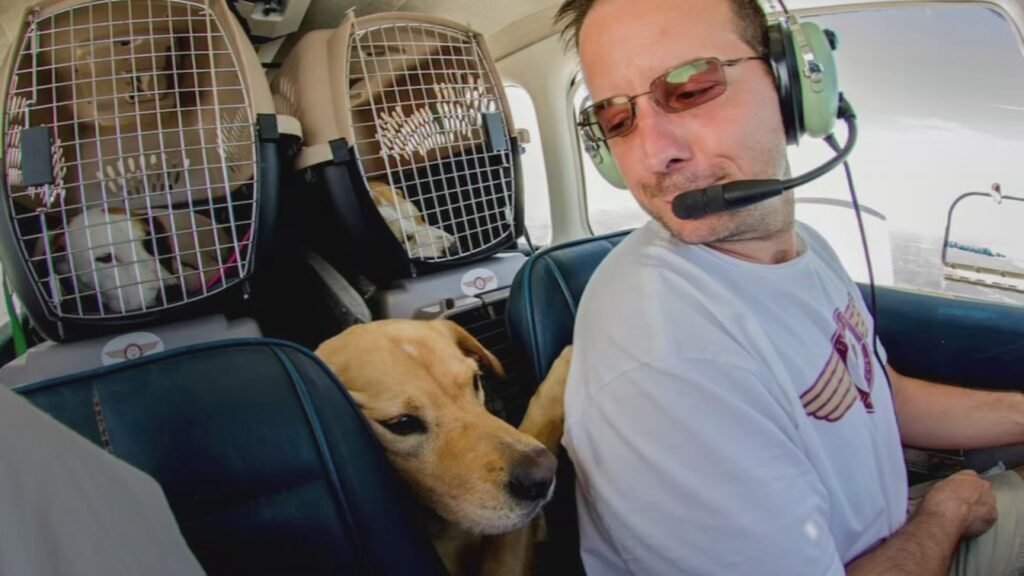


The future of animal welfare is no longer defined by isolated acts of kindness—it is being shaped by coordinated, intelligent, and deeply human networks that move with urgency, precision, and purpose. At the center of that evolution, Sustainable Action Now is spotlighting the growing power and necessity of interconnected rescue ecosystems through its expanding focus on the Rescue Network. This is not simply a category or a concept—it is a living infrastructure, a real-time response system built on trust, expertise, and the unwavering belief that no animal should be left behind.
Few stories capture the urgency and emotional reality of this movement more clearly than the recent rescue of Bocelli, a blind dog abandoned in an unfamiliar and unforgiving environment. His condition made him especially vulnerable—unable to see, disoriented, and forced to navigate a world that had suddenly become hostile and uncertain. In these moments, survival often depends not on chance, but on whether the right people are connected quickly enough to act. That is where the Rescue Network proves its value.
When a concerned individual recognized the severity of Bocelli’s situation, they didn’t hesitate—they activated the network. A call was made to Hope For Paws, an organization known for its rapid-response rescue operations and its ability to handle complex, high-risk cases. Within moments, the response was in motion.
Katie and Kai, seasoned rescuers, mobilized immediately, bringing with them not only equipment but experience, coordination, and a clear understanding of the stakes involved.
What followed was not a simple retrieval—it was a carefully executed operation shaped by the realities of Bocelli’s condition. The team worked to secure the property, deploying barriers to create a controlled environment that would prevent escape and reduce the chaos surrounding him. Every movement had to be calculated.
A sighted dog might respond to visual cues, but Bocelli’s world was defined by sound, touch, and instinct. Any misstep could escalate fear and push him further into distress.
As the team worked, they encountered a critical limitation—insufficient fencing materials to fully guide him into a secure corner. At that point, the rescue required something beyond logistics. It required trust, intuition, and a willingness to step into uncertainty. Katie made the decision to approach him directly. For a blind dog, that moment carries an entirely different weight. Without visual confirmation, every sound and movement can feel like a threat. Yet what happened next speaks to something deeper than fear.
Instead of retreating or reacting defensively, Bocelli responded to the human presence with a shift—an instinctive recognition that the contact he was experiencing was not harm, but help. The physical connection, the embrace that followed, became the turning point. In that moment, fear gave way to trust. It is a reminder that even in the most extreme conditions, the capacity for animals to recognize compassion remains intact.
But what makes this story truly significant is not just the rescue itself—it is what happened next. Bocelli’s journey did not end at extraction; it transitioned seamlessly into the next phase of the Rescue Network. Through collaboration, he was placed with a dedicated foster partner, Maison Sure, ensuring that his recovery would take place in an environment designed for stability, care, and long-term success. This is the architecture of modern rescue: not a single act, but a continuum of coordinated steps, each dependent on the strength of the network as a whole.
This model represents a broader transformation in how animal rescue is approached globally. The Rescue Network is not a passive directory of organizations—it is an active, dynamic system that connects responders, fosters, adopters, and supporters into a unified operational framework. It reduces response times, increases survival rates, and ensures that animals like Bocelli are not lost in the gaps between awareness and action.
Technology, communication platforms, and social visibility are accelerating this transformation, but at its core, the network is powered by people—individuals who recognize that intervention is not optional, but essential. The ability to mobilize quickly, to share resources, and to transition animals through different stages of care without delay is redefining what is possible in rescue work. It is also raising the standard. What was once considered exceptional is becoming expected.
At the same time, this model underscores a critical reality: rescue does not operate in isolation from public engagement. It depends on it. The call to support—whether through direct contributions, digital amplification, or adoption—is not a secondary element; it is foundational. Every successful rescue is backed by a network that extends beyond the field team, encompassing donors, advocates, and communities that sustain the system over time. For those looking to play a role in expanding this impact, opportunities to contribute are integral to the ongoing work, including the ability to support missions directly through platforms such as donations, to follow and amplify rescue efforts through channels like social engagement, and to provide permanent homes through adoption pathways such as Maison Sure.
What Sustainable Action Now is building through its Rescue Network coverage is more than awareness—it is alignment. It is bringing visibility to the systems that work, the collaborations that save lives, and the strategies that can be scaled and replicated across regions and sectors. It is also reinforcing a fundamental shift in perspective: that animal rescue is not a peripheral issue, but a core component of a more ethical, responsive, and interconnected society.
Bocelli’s story is not an isolated moment of compassion—it is a case study in what becomes possible when networks function as intended. It demonstrates how speed, coordination, and empathy can intersect to produce outcomes that would otherwise be unlikely. It also serves as a reminder that vulnerability, whether human or animal, demands a response that is both immediate and sustained.
As the Rescue Network continues to expand, the implications are far-reaching. It has the potential to reshape how communities respond to abandonment, how organizations collaborate across boundaries, and how individuals understand their role within a larger system of care. The trajectory is clear: the future of rescue is networked, responsive, and driven by a shared commitment to act.
In that context, the question is no longer whether rescue efforts can succeed—it is how effectively they can be connected, supported, and scaled. Sustainable Action Now is not only documenting that evolution; it is actively contributing to it, ensuring that stories like Bocelli’s are not exceptions, but indicators of a new standard.