
The global conversation around animal welfare is entering a new phase—one defined not only by awareness, but by accountability, structural change, and a reexamination of long-standing practices once accepted as entertainment. At the center of this shift is a growing movement to confront the realities of dolphins in captivity, a system sustained not by necessity, but by design. Sustainable Action Now is elevating this issue as a critical frontier in modern animal welfare, bringing renewed focus to the urgent need to end breeding programs that perpetuate a cycle of confinement for one of the most intelligent and socially complex species on the planet.
For decades, marine parks have presented dolphin performances as educational, inspiring, and family-friendly experiences. Yet beneath the choreography and spectacle lies a system that increasingly stands in direct conflict with both scientific understanding and evolving public ethics. Dolphins are not passive participants in these environments—they are highly sentient beings with advanced cognitive abilities, intricate social structures, and natural behaviors that cannot be replicated within the confines of a tank. In the wild, dolphins travel vast distances, often covering up to 60 miles in a single day, navigating dynamic ecosystems that engage their intelligence and sustain their well-being. In captivity, that reality is reduced to repetitive motion within restricted, artificial enclosures that offer neither the complexity nor the freedom their biology demands.
The issue is no longer limited to the capture of wild dolphins, which has drawn widespread criticism over the years. The more pressing concern now is the continuation of captive breeding programs, which ensure that new generations of dolphins are born directly into confinement. This is not a temporary condition or a transitional phase—it is a permanent state, engineered to sustain the availability of animals for performance-based entertainment. As long as breeding continues within facilities such as marine parks, the cycle remains intact, effectively normalizing a system that removes any pathway back to a natural life.
The implications of this cycle extend beyond individual animals. Captive environments fundamentally alter the social dynamics of dolphins, often grouping individuals in ways that would not occur in the wild and disrupting the complex relationships that define their communities. Behavioral stress, reduced lifespans, and the absence of natural stimuli are not incidental outcomes—they are structural consequences of confinement. These realities challenge the foundational narrative that captivity serves the best interests of the animals themselves.
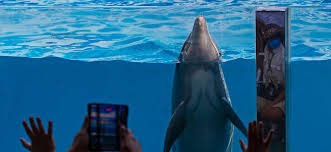
Facilities such as Six Flags Discovery Kingdom illustrate the constraints inherent in this model. While marketed as immersive and engaging environments, the physical limitations of these spaces are inescapable. Dolphins that would otherwise traverse open oceans are confined to enclosures where their movement is restricted to repetitive patterns. The contrast is not merely symbolic; it is biological, psychological, and deeply consequential. The absence of environmental diversity, the predictability of routines, and the lack of autonomy all contribute to a diminished quality of life that cannot be offset by performance enrichment or human interaction.
At the same time, institutions like SeaWorld remain central to the broader conversation due to their scale, visibility, and influence within the marine entertainment industry. Their continued use of breeding programs represents a pivotal point of leverage for advocates seeking systemic change. A commitment to end breeding—particularly through a defined and accelerated timeline—would not only alter the trajectory for dolphins currently in captivity but would also set a precedent for the industry as a whole. It would signal a transition away from a model built on perpetual confinement toward one that acknowledges both scientific evidence and shifting public values.
This is where the role of advocacy becomes both strategic and essential. The call to action is no longer abstract; it is specific, targeted, and grounded in achievable outcomes. Urging major operators to adopt rapid phase-out plans for breeding programs is a critical step in dismantling the cycle at its source. It shifts the focus from reactive measures to proactive reform, addressing not just the symptoms of captivity, but the mechanisms that sustain it.
Public engagement is playing an increasingly decisive role in this process. Consumer awareness, digital campaigns, and sustained pressure have already influenced corporate behavior in other areas of animal welfare, and the same dynamic is unfolding within marine entertainment. As audiences become more informed about the realities behind dolphin performances, the demand for ethical alternatives is growing. This shift is not driven by sentiment alone; it is reinforced by a broader understanding of animal cognition, welfare science, and the ethical implications of confinement.
The transition away from captive breeding also opens the door to reimagining how humans interact with marine life. Advances in technology, virtual experiences, and responsible ecotourism offer pathways to education and engagement that do not rely on confinement. These alternatives have the potential to deliver meaningful, impactful experiences while respecting the autonomy and natural behaviors of the animals involved. They represent not a loss, but an evolution—one that aligns entertainment with ethics and innovation with responsibility.
Sustainable Action Now’s focus on dolphins in captivity reflects a broader commitment to addressing systemic issues within animal welfare through informed, action-oriented storytelling. By bringing clarity and depth to this issue, it is helping to bridge the gap between awareness and accountability, ensuring that the conversation moves beyond acknowledgment and toward measurable change.
The reality is that the future of dolphin welfare will be determined by decisions being made now—by institutions, policymakers, and individuals alike. The continuation of breeding programs is not an inevitability; it is a choice. And like any choice, it can be reconsidered, restructured, and ultimately replaced with a model that prioritizes well-being over spectacle.
Ending the cycle of captivity is not a distant goal—it is an achievable outcome within reach. It requires a convergence of advocacy, policy, and public will, supported by a clear understanding of what is at stake. Dolphins have long been symbols of intelligence, freedom, and connection to the natural world. Ensuring that those qualities are respected, rather than confined, is not only an ethical imperative—it is a defining measure of progress.
As the movement continues to build, the message is becoming increasingly clear: the era of breeding dolphins for performance is coming under unprecedented scrutiny, and the path forward demands decisive action. Sustainable Action Now is not only documenting this shift—it is helping to drive it, positioning the issue of dolphin captivity as a central test of how society chooses to balance tradition, commerce, and compassion in the years ahead.