

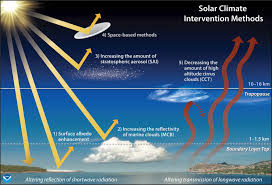
For decades, the idea of deliberately altering Earth’s atmosphere to cool the planet sounded like the premise of speculative science fiction — a desperate last-resort concept discussed quietly by climate scientists, environmental ethicists, and futurists debating what humanity might attempt if global warming spiraled beyond political control. The very notion of intentionally manipulating sunlight at planetary scale carried an almost surreal quality, evoking visions of engineered skies, artificial atmospheric interventions, and governments or corporations attempting to regulate the temperature of an entire world.
That future no longer feels theoretical.
A newly revealed geoengineering proposal involving the use of microscopic silica particles designed to reflect sunlight away from Earth has intensified global debate surrounding one of the most controversial climate strategies ever seriously contemplated. What was once discussed largely in academic circles is now rapidly evolving into something far more tangible: a potentially massive commercial industry capable of generating extraordinary profits while simultaneously reshaping environmental policy, international politics, atmospheric science, and humanity’s relationship with the planet itself.
At Sustainable Action Now, climate discussions are not limited to emissions targets or renewable energy transitions alone. They increasingly involve examining how desperation, technological ambition, corporate influence, environmental instability, and political paralysis are colliding in ways that could fundamentally alter the future of planetary governance itself. Geoengineering sits directly at the center of that collision.
The newly discussed proposal reportedly centers around dispersing tiny silica-based particles into the atmosphere with the goal of reflecting a portion of incoming solar radiation back into space. The underlying concept belongs to a broader category of climate intervention strategies commonly referred to as solar radiation management, or SRM. These approaches attempt to reduce planetary warming not by eliminating greenhouse gas emissions directly, but by limiting the amount of solar energy absorbed by Earth in the first place.
In simple terms, the strategy aims to artificially dim sunlight slightly on a planetary scale.
Scientifically, the idea is partially inspired by natural volcanic eruptions. Large eruptions have historically released particles into the upper atmosphere capable of temporarily cooling global temperatures by reflecting sunlight away from Earth. Geoengineering advocates argue that carefully managed artificial versions of this process could potentially slow warming trends, reduce extreme heat, stabilize climate systems, and buy humanity additional time to transition away from fossil fuels.
Critics, however, warn that intentionally manipulating Earth’s atmosphere at global scale may introduce risks so enormous and unpredictable that the consequences could destabilize weather systems, agriculture, precipitation patterns, biodiversity, geopolitical relations, and ecological balance itself.
That tension — between technological desperation and catastrophic uncertainty — is exactly why geoengineering remains one of the most divisive subjects in modern climate discourse.
What makes the current proposal especially controversial is not merely the science, but the emergence of corporate profit structures surrounding climate manipulation technologies. The idea that private companies could potentially generate billions of dollars through atmospheric intervention programs fundamentally changes the ethical landscape surrounding climate response itself.
Climate change has already become one of the largest economic forces shaping the modern world. Renewable energy markets, electric vehicles, battery storage, carbon capture systems, climate adaptation infrastructure, and sustainability technologies now represent enormous global industries. Geoengineering may become the next frontier in that economic transformation — but with stakes extending far beyond ordinary technological markets.
Unlike renewable energy deployment or emissions reduction, geoengineering directly intervenes in planetary systems affecting every nation, ecosystem, and population simultaneously.
This reality raises profound questions regarding authority, accountability, oversight, consent, and governance.
Who gets to decide the “correct” global temperature? Who determines how much sunlight should be reflected? What happens if intervention strategies unintentionally trigger droughts, monsoon disruption, agricultural collapse, or regional climate imbalances? Who becomes legally or morally responsible if geoengineering creates unintended humanitarian consequences? Can private corporations ethically profit from technologies capable of altering atmospheric conditions for the entire planet?
These are no longer philosophical hypotheticals. They are rapidly becoming urgent policy questions.
At Sustainable Action Now, one of the most important aspects of the geoengineering debate is understanding why these conversations are accelerating now. The answer lies partly in the growing frustration surrounding the slow pace of global emissions reduction. Despite decades of climate summits, international agreements, sustainability pledges, and environmental activism, fossil fuel consumption remains deeply embedded within the global economy. Temperatures continue rising. Extreme weather intensifies. Ice systems destabilize. Oceans warm. Climate migration risks increase. Governments repeatedly miss emissions targets.
As climate pressure grows more severe, once-unthinkable intervention strategies inevitably begin attracting more serious attention.
This progression reflects a dangerous psychological shift occurring within climate politics itself. Earlier environmental movements focused primarily on prevention — reducing emissions, preserving ecosystems, transitioning energy systems, and avoiding catastrophic warming altogether. Increasingly, however, climate conversations now involve adaptation, mitigation, resilience, and direct intervention because many experts believe certain levels of warming are already unavoidable.
Geoengineering emerges from that desperation.
Supporters argue humanity may eventually need emergency cooling mechanisms if warming reaches destabilizing thresholds triggering widespread ecological collapse, food insecurity, mass displacement, or irreversible climate tipping points. They frame solar radiation management not as a replacement for emissions reduction, but as a temporary emergency tool potentially capable of reducing harm while long-term decarbonization continues.
Yet opponents fear the very existence of geoengineering solutions could undermine urgency surrounding fossil fuel reduction itself.
This concern, often called “moral hazard” within climate ethics discussions, represents one of the most significant criticisms facing solar geoengineering proposals. If governments and corporations believe atmospheric cooling technologies might offset warming temporarily, political pressure to aggressively reduce emissions could weaken substantially. Fossil fuel industries, critics argue, may even embrace geoengineering because it allows continued extraction while presenting technological cooling as an alternative solution.
The possibility of massive corporate profit intensifies those fears considerably.
Whenever enormous financial incentives intersect with planetary-scale technologies, skepticism becomes inevitable. The climate crisis itself has already demonstrated how economic interests can distort environmental policy for decades. Geoengineering therefore raises uncomfortable concerns about whether profit motives could eventually shape decisions affecting the entire biosphere.
The silica-based proposal also introduces complex scientific uncertainties regarding atmospheric chemistry and ecological interaction. Even relatively small interventions at global scale could produce cascading consequences difficult to predict fully. Climate systems are extraordinarily interconnected. Altering solar radiation absorption patterns may affect rainfall distribution, storm intensity, seasonal cycles, ocean circulation, crop productivity, regional temperature variation, and biodiversity dynamics in ways impossible to model perfectly beforehand.
Some regions might experience cooling benefits while others face agricultural disruption or precipitation collapse. This unequal impact creates enormous geopolitical tension because climate intervention outcomes would not be distributed evenly across nations.
Imagine one country supporting atmospheric cooling programs while another claims those interventions damaged its agricultural systems or altered regional rainfall patterns. International conflict surrounding climate manipulation could become one of the defining geopolitical struggles of the twenty-first century if governance structures fail to develop alongside the technology itself.
And currently, global governance frameworks for geoengineering remain extremely limited.
This absence of clear international regulation may become one of the most alarming aspects of the current situation. Technologies capable of affecting the entire planet are advancing faster than political systems designed to oversee them responsibly. Private companies, research institutions, wealthy investors, and governments may all pursue experimental interventions long before global consensus emerges regarding ethical boundaries or regulatory authority.
At Sustainable Action Now, the deeper issue extends beyond whether geoengineering “works” scientifically. The larger question concerns what it means for humanity to intentionally engineer planetary systems rather than coexist within them.
For centuries, industrial civilization treated nature primarily as a resource to extract, exploit, and control. The climate crisis itself emerged largely from that mindset — an assumption that economic growth and technological expansion could continue indefinitely without destabilizing Earth’s ecological balance. Geoengineering represents both a continuation and escalation of that philosophy. Instead of reducing human interference with natural systems, it proposes intervening even more directly at atmospheric scale.
To supporters, this reflects pragmatic adaptation to an already destabilized planet. To critics, it represents dangerous technological hubris capable of deepening humanity’s disconnection from ecological limits and systemic humility.
The symbolism of “dimming the sun” itself carries enormous cultural and psychological weight. Sunlight has historically represented life, balance, growth, and natural order across countless civilizations and belief systems. The idea of corporations potentially managing atmospheric sunlight reflection for profit feels deeply unsettling because it blurs boundaries between environmental stewardship and planetary control.
Yet the very fact these conversations are happening seriously reveals how dramatically climate urgency has escalated.
A decade ago, large-scale solar geoengineering remained mostly peripheral within mainstream climate discussions. Today, it is increasingly entering public debate because warming itself continues accelerating faster than political systems have responded effectively.
This creates an extraordinarily dangerous paradox. The more climate conditions worsen, the more pressure may grow for emergency technological interventions. Yet the more geoengineering advances, the greater the risk political leaders delay the systemic economic transformations truly required to address root causes.
That tension may ultimately define the next era of climate politics.
Will humanity aggressively reduce fossil fuel dependence while treating geoengineering only as a theoretical emergency backup? Or will governments and corporations increasingly pursue atmospheric intervention strategies because they appear economically and politically easier than restructuring industrial civilization itself?
The answer remains uncertain.
What is clear, however, is that geoengineering is no longer a fringe concept operating quietly at the edges of climate science. It is rapidly becoming a central battleground in the future of environmental policy, corporate power, technological ethics, and planetary governance.
And perhaps that is the most unsettling reality of all.
Humanity is now entering an era where the climate crisis has advanced far enough that people are seriously debating whether corporations should help engineer the atmosphere itself in order to keep Earth habitable.
Not metaphorically. Literally.