
There is something profoundly moving about watching a rescued bear finally behave like a bear again.
Not performing. Not pacing inside concrete confinement. Not trapped behind rusted bars or surviving within barren enclosures designed around captivity rather than wellbeing. But truly living — grooming, playing, exploring, resting, socializing, climbing, foraging, and slowly rediscovering instincts and behaviors that many rescued animals were denied for years.
Across Europe, bear sanctuaries are increasingly becoming some of the most important examples of modern animal welfare in action, proving that rescue is not simply about survival. It is about restoration. It is about giving traumatized animals the opportunity to reclaim pieces of a life they should have had all along.
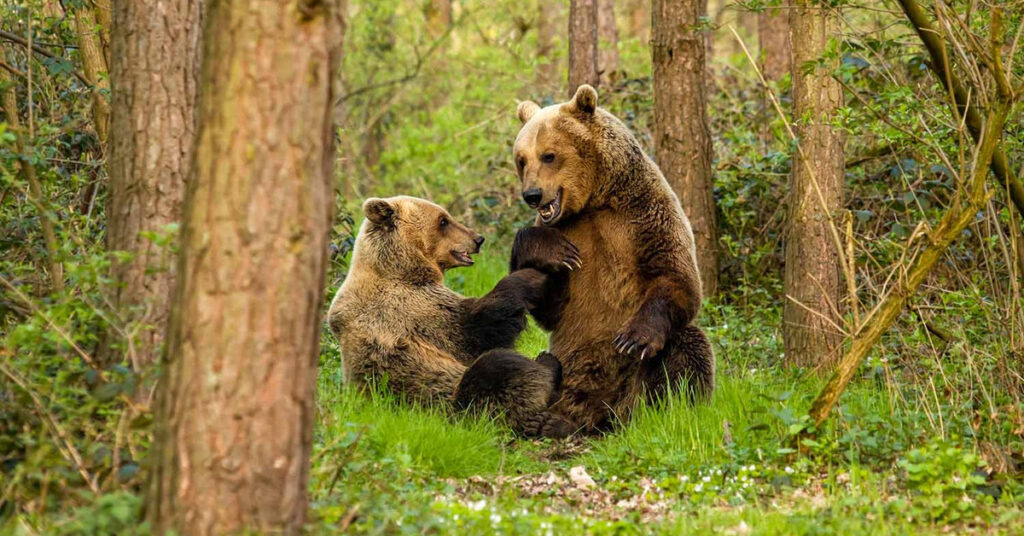
Recent moments involving bears like Lelya at BEAR SANCTUARY Müritz and the playful friendship between Meimo and Amelia at the Arosa Bear Sanctuary in Switzerland offer far more than charming wildlife updates. They reveal the extraordinary emotional and behavioral transformations possible when rescued animals are finally placed inside environments built around healing instead of exploitation.
At Sustainable Action Now, stories like these matter because they expose a larger truth about animal welfare that modern society is only beginning to fully understand: animals recovering from captivity and trauma require more than food and shelter alone. They require stimulation, emotional safety, environmental complexity, social opportunity, autonomy, and the freedom to express the behaviors nature intended for them.
Lelya’s recent grooming session at BEAR SANCTUARY Müritz may appear simple on the surface — a bear shedding her winter coat as summer approaches — but moments like this carry enormous symbolic and biological significance. Seasonal shedding is part of a healthy natural rhythm tied directly to environmental adaptation and physical wellbeing. For rescued bears, the ability to engage comfortably in these natural cycles reflects something critically important: stability.
In captivity, especially in inadequate enclosures, animals often lose access to the environmental conditions necessary for healthy behavioral and biological expression. Stress, confinement, unnatural flooring, poor nutrition, lack of stimulation, and psychological deterioration can disrupt normal behavioral patterns significantly. Sanctuaries help restore those rhythms by recreating environments where animals can once again interact with changing seasons, varied terrain, natural vegetation, and instinctive behaviors.
Lelya’s quirky grooming routine also highlights something increasingly recognized within wildlife rehabilitation science: bears possess highly individual personalities.
For decades, public perceptions of captive wildlife often reduced animals into generalized species stereotypes rather than emotionally and behaviorally distinct individuals. Modern sanctuary care increasingly rejects that framework entirely. Rescued bears display preferences, habits, fears, social tendencies, play styles, routines, emotional responses, and behavioral quirks unique to each animal. Some are highly social. Others remain cautious or solitary due to trauma histories. Some become playful quickly while others require years to build confidence.
Recognizing individuality matters because effective rehabilitation depends heavily on understanding emotional and behavioral complexity rather than treating animals as interchangeable exhibits.
The scenes unfolding at Arosa Bear Sanctuary involving Meimo and Amelia demonstrate this beautifully.
Their friendship is more than an adorable moment for social media audiences. It represents the restoration of social opportunity many rescued bears never previously experienced safely. Bears are often misunderstood behaviorally. While some species and individuals spend significant time independently in the wild, social interaction still plays important roles depending on environment, resource availability, developmental history, and sanctuary conditions.
For rescued bears emerging from confinement, positive social bonds can become deeply healing experiences. Play itself is an important behavioral indicator because animals experiencing chronic fear, stress, or psychological suppression rarely engage comfortably in playful interaction. The fact that Meimo clearly gravitates toward Amelia as a preferred companion reflects emotional security and trust developing inside a sanctuary environment designed around welfare rather than survival alone.
This transformation is one of the most remarkable aspects of modern sanctuary work.
Animals who spent years in isolation, exploitation, inadequate cages, circus environments, roadside attractions, private ownership situations, or neglect frequently arrive with profound psychological trauma. Many display stereotypic behaviors such as pacing, self-directed movements, repetitive motions, or hypervigilance resulting from prolonged stress and deprivation. Some have never climbed properly, explored natural terrain, dug into soil, swam freely, or interacted socially in healthy environments.
Sanctuary rehabilitation often becomes a gradual process of rediscovery.
A rescued bear may encounter grass, forest terrain, pools, enrichment objects, climbing structures, or companionship in ways that seem entirely new despite being instinctively natural. Caregivers and behavioral specialists frequently observe rescued animals slowly experimenting with behaviors long suppressed by confinement conditions. Some begin foraging naturally. Others discover play. Some spend extended periods simply resting peacefully for the first time in years without environmental stressors constantly triggering survival responses.
At Sustainable Action Now, these stories matter because they directly challenge outdated systems of wildlife captivity still operating globally. Every healthy, playful, behaviorally enriched rescued bear living in sanctuary becomes living evidence that humane alternatives exist. Sanctuaries prove animals thrive dramatically better in environments prioritizing autonomy, complexity, enrichment, and rehabilitation over spectacle or commercial display.
The role of organizations like FOUR PAWS has therefore become increasingly significant within international animal welfare movements. Their sanctuary partnerships and rescue efforts reflect a broader shift away from exploitative wildlife models and toward long-term ethical rehabilitation systems designed around species-specific wellbeing.
The Arosa Bear Sanctuary itself represents an especially important example of this evolving philosophy. As Switzerland’s first sanctuary of its kind, the project reflects how conservation, tourism, animal welfare, and environmental education can intersect productively when designed responsibly. Operated collaboratively by the Arosa Bear Foundation, FOUR PAWS, Arosa Tourism, and Arosa Mountain Railways, the sanctuary demonstrates how local economies and ethical wildlife care do not need to exist in opposition.
This collaborative model may become increasingly important globally as public tolerance for exploitative animal entertainment continues declining.
Modern audiences increasingly reject traditional wildlife attractions centered around confinement, forced performance, or inadequate captive conditions. Instead, people are showing greater support for ethical sanctuaries, conservation-focused rehabilitation centers, and wildlife experiences emphasizing respect, education, and animal-centered care.
This cultural shift reflects broader changes in public understanding surrounding animal cognition and emotional complexity.
Scientific research continues demonstrating that bears are extraordinarily intelligent animals capable of memory, problem-solving, emotional responsiveness, environmental adaptation, social learning, and sophisticated behavioral expression. They navigate enormous territories in natural environments, forage strategically, communicate behaviorally, establish routines, and interact dynamically with changing ecosystems.
Watching rescued bears like Lelya, Meimo, and Amelia engage in grooming, play, and companionship therefore becomes emotionally powerful because audiences increasingly recognize these behaviors not as amusing novelties, but as evidence of restored dignity and wellbeing.
There is also something psychologically restorative for humans themselves in witnessing animals recover.
In an era dominated by environmental crisis, habitat destruction, biodiversity collapse, climate anxiety, and relentless negative headlines surrounding ecological decline, sanctuary stories offer something rare but deeply important: visible healing. They remind people that intervention matters. That rescue changes outcomes. That trauma does not always define the remainder of an animal’s life. That compassionate systems can produce recovery rather than exploitation.
This emotional dimension helps explain why sanctuary content resonates so strongly globally. Audiences are not simply watching bears play. They are witnessing survival transform into quality of life.
The arrival of summer itself adds another symbolic layer to these recent updates. Seasonal transitions are deeply significant for bears biologically and behaviorally. Shedding winter coats, increased outdoor activity, changes in feeding patterns, social interaction shifts, and environmental exploration all reflect natural rhythms reemerging within sanctuary life.
For animals once confined in unnatural environments disconnected from seasonal complexity, these rhythms represent regained connection to nature itself.
At Sustainable Action Now, one of the most important lessons sanctuary work teaches is that animal welfare cannot be measured solely through survival statistics. True welfare involves emotional and behavioral flourishing. It involves whether animals can meaningfully engage with the instincts, environments, relationships, and activities their species evolved to experience.
That philosophy stands in direct contrast to outdated captivity systems still operating in many parts of the world where minimal survival standards are treated as acceptable despite psychological suffering remaining visible.
Sanctuaries reject that standard entirely.
They recognize that rescued animals deserve more than existence. They deserve lives containing stimulation, safety, enrichment, autonomy, and moments of joy.
The friendship between Meimo and Amelia beautifully illustrates this principle because companionship itself becomes part of healing. Watching rescued animals trust again after years of exploitation or confinement carries extraordinary emotional weight. Play behavior signals not only physical safety, but psychological security. Animals overwhelmed by fear do not play freely. Animals trapped in chronic distress rarely express curiosity naturally. Recovery reveals itself behaviorally.
Lelya’s playful grooming session reveals something equally meaningful: comfort within her environment. Comfort enough to shed her coat dramatically, embrace changing seasons, and express her own personality without fear.
These moments may appear small compared to the enormous global environmental crises dominating headlines daily. Yet they matter profoundly because they represent tangible examples of ethical progress in action. They show what becomes possible when compassion is operationalized into infrastructure, funding, expertise, and long-term commitment.
And perhaps most importantly, they remind people that the goal of rescue is never merely to remove suffering. It is to create the conditions where life itself can become meaningful again.
For bears like Lelya, Meimo, and Amelia, sanctuary is not simply protection from harm.
It is the return of everything captivity once tried to take away.