

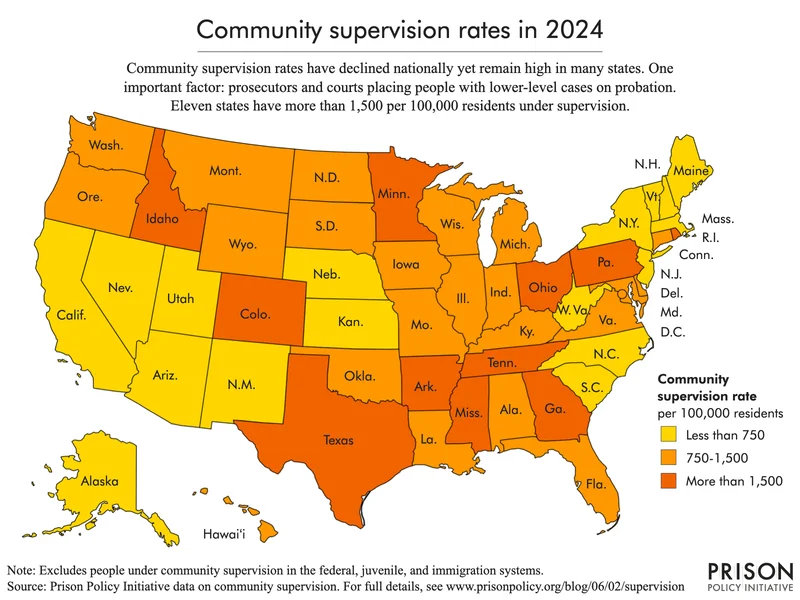
For decades, discussions about criminal justice reform in the United States have focused primarily on prisons and jails. Images of overcrowded correctional facilities, lengthy sentences, and record incarceration rates have dominated public conversations about crime and punishment. Yet beyond prison walls exists an even larger system of correctional control—one that quietly supervises millions of Americans every day through probation, parole, pretrial monitoring, and financial conditions tied to the criminal legal system.
Recent developments from courts, researchers, and policy organizations are forcing a broader conversation about how community supervision functions in modern America. New legal decisions challenging the fairness of money bail, updated incarceration data revealing persistent disparities, and extensive analyses of probation and parole populations all point toward the same conclusion: the reach of correctional control extends far beyond incarceration itself.
The reality is that millions of Americans live under some form of government supervision without being housed in a jail or prison. While these alternatives are often presented as more humane responses than incarceration, growing evidence suggests they frequently operate as extensions of the same punitive system rather than meaningful pathways toward rehabilitation and reintegration.
One of the most significant recent developments comes from California, where the state’s highest court has placed some of the strongest criticisms of money bail directly into the legal record. The decision highlights concerns that wealth-based detention systems punish poverty rather than assess actual risk. Under traditional money bail systems, two people accused of the same offense may experience radically different outcomes based solely on their financial resources. One individual returns home while awaiting trial; another remains incarcerated simply because they cannot afford release.
Critics have long argued that this arrangement undermines the fundamental principle that individuals are presumed innocent until proven guilty. Beyond questions of fairness, growing research suggests that pretrial detention can destabilize employment, housing, education, and family relationships before any determination of guilt has been made. The consequences often extend far beyond the courtroom, creating economic and social damage that can persist for years.
The California ruling reflects a growing national debate over whether financial barriers should play any role in determining freedom prior to trial. Increasingly, policymakers and legal scholars are questioning whether money bail serves public safety or simply perpetuates inequality.
At the same time, new data continue to reveal the extraordinary scale of correctional supervision across the country. While prison populations have declined from their historic peaks, the broader system of correctional control remains vast. Probation and parole supervise millions of individuals nationwide, making community supervision the largest component of the criminal legal system.
Recent analysis examining more than four decades of state-level probation and parole data provides a clearer picture of how these systems have evolved. The findings reveal that community supervision expanded dramatically alongside the prison boom of the 1980s and 1990s. Although supervision rates have declined in many states over the last fifteen years, approximately 3.5 million Americans remain under some form of probation or parole supervision on any given day.
That number exceeds the population held in local jails across the nation. It also means that a significant portion of correctional control occurs outside prison walls, often in communities where individuals are expected to rebuild their lives while simultaneously complying with extensive reporting requirements, travel restrictions, employment conditions, curfews, testing protocols, and numerous other obligations.
Supporters of probation and parole frequently describe these systems as alternatives to incarceration. In theory, community supervision allows individuals to maintain employment, support their families, and remain connected to their communities while still being held accountable. In practice, however, many advocates argue that supervision often functions as a form of net-widening that draws more people into prolonged government oversight.
Rather than serving as true alternatives to incarceration, probation and parole can become pipelines back into detention. Technical violations—including missed appointments, failed paperwork requirements, curfew violations, or other non-criminal infractions—continue to send thousands of individuals back into custody each year. In many jurisdictions, the punishment for violating supervision conditions may involve incarceration even when no new crime has occurred.
This dynamic raises important questions about the purpose of community supervision. If probation and parole are intended to reduce incarceration, why do so many individuals find themselves cycling repeatedly between supervision and confinement?
The answer may lie in the design of the system itself. Many supervision programs impose dozens of conditions simultaneously, creating environments where complete compliance becomes exceptionally difficult. For individuals facing poverty, housing insecurity, transportation challenges, mental health struggles, or substance use disorders, navigating these requirements can become nearly impossible.
Failure rates illustrate the challenge. Nationally, large numbers of individuals do not successfully complete supervision terms. Each unsuccessful outcome represents not only an administrative failure but also a potential disruption to employment, housing, family stability, and community reintegration.
Meanwhile, newly updated incarceration and demographic data continue to reveal persistent disparities throughout the criminal legal system. Women’s incarceration remains a significant concern, as does the growing recognition of mental health challenges experienced by people under correctional control. Psychological distress remains widespread among incarcerated populations and those subject to ongoing supervision, raising additional concerns about how punitive systems affect long-term well-being.
These findings underscore an increasingly important reality: reducing prison populations alone does not necessarily reduce correctional control. True reform requires examining the entire ecosystem of punishment, including pretrial detention practices, money bail systems, probation conditions, parole policies, and technical violation enforcement.
Encouragingly, many states have begun exploring reforms aimed at reducing unnecessary supervision and expanding opportunities for successful completion. Some jurisdictions have shortened supervision terms, reduced technical violations, eliminated certain fees, and adopted evidence-based approaches focused on rehabilitation rather than surveillance.
The results suggest that public safety and reduced correctional control are not mutually exclusive goals. States that have successfully lowered supervision populations while maintaining community safety demonstrate that alternatives are possible when policies prioritize stability, opportunity, and accountability rather than perpetual punishment.
The broader lesson emerging from current research is that criminal justice reform cannot be measured solely by prison population counts. The true scope of correctional control includes every person under probation supervision, every individual navigating parole requirements, every family impacted by pretrial detention, and every community affected by policies that prioritize surveillance over support.
As courts continue to scrutinize money bail systems and researchers provide clearer pictures of probation and parole trends, policymakers face a critical opportunity to rethink what accountability should look like in the twenty-first century. Community supervision should serve as a bridge back into society, not a revolving door leading repeatedly toward incarceration.
The future of criminal justice reform depends on recognizing that freedom and public safety are not opposing concepts. Effective reform requires systems that reduce harm, promote stability, encourage successful reintegration, and reserve incarceration for circumstances where it is truly necessary. Anything less risks maintaining the same structures of mass correctional control under different names.
America’s conversation about justice is evolving. The question is no longer whether prisons alone define the criminal legal system. The evidence increasingly shows that the larger challenge lies in understanding—and ultimately transforming—the vast network of supervision that exists beyond prison walls.