

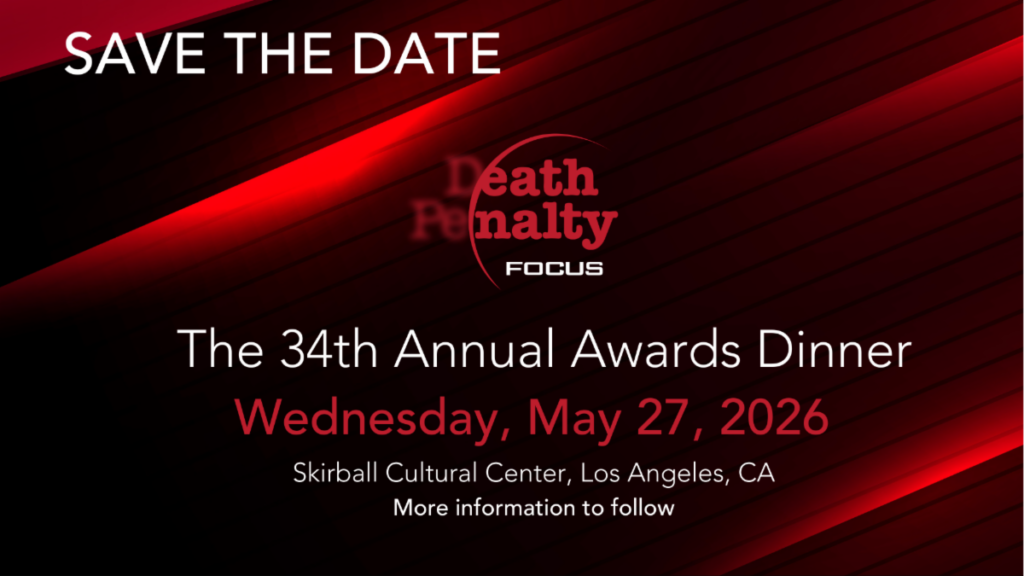
The national conversation around capital punishment has entered a critical and defining phase, and at the center of that dialogue stands Sustainable Action Now’s continued commitment to elevating the voices, movements, and moments that are actively reshaping the future of justice in America. As momentum builds across ideological lines and public sentiment continues to evolve, a landmark gathering is set to bring together some of the most influential advocates working to end the death penalty once and for all. On Wednesday, May 27 at 6:00 p.m. Pacific Time, the Death Penalty Focus 34th Annual Awards Dinner will take place at the Skirball Cultural Center in Los Angeles, marking not only a celebration of leadership but a strategic inflection point in a movement that is gaining renewed urgency and national visibility.
Now in its 34th year, this annual event has become one of the most important convenings in the abolition movement, honoring individuals whose work transcends advocacy and enters the realm of transformational impact. These honorees represent a cross-section of voices—faith leaders, artists, exonerees, public figures, and organizers—who have collectively advanced a vision of justice rooted in human dignity, accountability, and systemic reform. Their work spans public education, grassroots mobilization, political advocacy, media engagement, and international coalition-building, forming a multi-dimensional approach that continues to challenge the legitimacy and morality of capital punishment in the United States.
This year’s honorees reflect both the history and the future of the movement. Father Chris Ponnet, honored posthumously, is remembered as a pastor, healer, and unwavering voice for justice whose work on death row left an indelible mark on countless lives. His legacy continues to resonate deeply within faith-based advocacy circles and among those who have experienced the human cost of capital punishment firsthand. Paula Poundstone brings a distinct and powerful voice to the conversation, leveraging her platform as a comedian, author, and actor to engage audiences in critical social issues with both clarity and humanity. Stanley Howard’s journey as a death row exoneree underscores the profound and irreversible consequences of wrongful convictions, transforming personal injustice into a broader call for systemic accountability and reform.
Reverend Joe Ingle’s decades-long work as a spiritual advisor to individuals on death row offers a rare and deeply human perspective on the realities of capital punishment, while Mike Farrell, as both an actor and longtime activist, continues to play a pivotal leadership role as President of Death Penalty Focus. Renaldo Hudson represents the next generation of transformative leadership, bringing lived experience, artistic expression, and educational advocacy into a unified framework that challenges the structures of incarceration and punishment from within.
This gathering arrives at a moment of stark contradiction in the American justice landscape. As of April 2026, the United States is experiencing both a resurgence in executions and a simultaneous expansion of opposition to the death penalty across political, cultural, and geographic lines. In 2025, 47 executions were carried out nationwide, representing the highest annual total in more than a decade. This increase, driven largely by a small number of states, signals a renewed push by certain jurisdictions to assert capital punishment as a tool of enforcement. Florida, in particular, accounted for a significant portion of these executions, underscoring the uneven application of the death penalty across the country.
Yet beneath these numbers lies a more complex and ultimately more consequential trend: the steady erosion of support for capital punishment and the emergence of a broad, bipartisan coalition advocating for its abolition. One of the most notable developments in recent years has been the growing involvement of conservative leaders and organizations in the anti-death penalty movement. Conservatives Concerned About the Death Penalty has expanded its reach and influence, reframing the issue through the lenses of fiscal responsibility, limited government, and pro-life values. More than 250 conservative leaders have publicly called for an end to capital punishment, citing its high cost, inefficiency, and the unacceptable risk of executing innocent individuals.
This ideological shift is not confined to rhetoric; it is increasingly reflected in legislative activity at the state level. In states such as Ohio and Kentucky, Republican lawmakers have introduced or supported bills aimed at abolishing the death penalty, signaling a departure from traditional partisan alignments on criminal justice issues. In Missouri, bipartisan efforts to eliminate judge-imposed death sentences have gained traction, reaching levels of progress not seen in over a decade. Even in states where abolition bills have yet to advance, such as Indiana, the presence of Republican-backed proposals indicates a growing willingness to reevaluate the role of capital punishment within the justice system.
At the same time, public opinion is undergoing a measurable transformation. National support for the death penalty has declined to levels not seen since the early 1970s, with only 52% of Americans expressing approval as of late 2025. This decline is mirrored in the courtroom, where juries are increasingly reluctant to impose death sentences. In 2025, only 23 new death sentences were handed down nationwide—a dramatic decrease from the hundreds issued annually just a few decades ago. These trends suggest a fundamental shift in how the public, and the justice system itself, perceives the legitimacy and necessity of capital punishment.
Policy developments across the states further illustrate the evolving landscape. While some jurisdictions are moving to expand or entrench the death penalty—such as Idaho’s adoption of the firing squad as its primary method of execution beginning in mid-2026—others are taking steps to pause or dismantle it entirely. Four states currently maintain gubernatorial moratoriums on executions, reflecting a growing recognition of the systemic flaws and ethical concerns inherent in capital punishment.
Against this backdrop, the Death Penalty Focus Awards Dinner emerges not simply as a ceremonial event, but as a strategic convergence of leadership, advocacy, and momentum. It is a space where the narratives driving change are amplified, where alliances are strengthened, and where the path forward is collectively defined. For Sustainable Action Now, highlighting this moment is both a reflection of its mission and a call to action for a broader audience that is increasingly engaged in questions of justice, accountability, and human rights.
The significance of May 27 extends beyond the walls of the Skirball Cultural Center. It represents a reaffirmation that the movement to abolish the death penalty is not only enduring but accelerating, fueled by a diverse coalition that spans political ideologies, professional disciplines, and lived experiences. It underscores the reality that meaningful change is often forged through sustained effort, strategic collaboration, and the courage to challenge deeply entrenched systems.
As the nation continues to grapple with the contradictions of its justice system, events like the Death Penalty Focus Awards Dinner serve as both a mirror and a catalyst—reflecting the progress that has been made while driving the momentum necessary to achieve what once seemed unattainable. The call to engage, to learn, and to participate has never been more urgent, and Sustainable Action Now stands at the forefront of bringing that message to a wider, more informed, and more activated audience.