
There is a choice being made every time someone buys a ticket to watch a dolphin perform or an orca leap through a hoop on command. It feels like entertainment. It is framed as education. But the science of who these animals are, what their lives require, and what captivity actually does to them tells a different story, one that the marine park industry has spent decades and considerable resources trying to keep from reaching the general public in terms clear enough to matter.
At Sustainable Action Now, Dolphin Day of Action is a moment to say plainly what the evidence has been saying for years: captivity is not a welfare compromise for marine mammals. It is a form of chronic deprivation imposed on some of the most intelligent, socially complex, and wide-ranging animals on earth. For orcas and dolphins, the gap between what their biology requires and what a concrete tank provides is so vast that no amount of veterinary care, no artificial enrichment program, and no carefully managed feeding schedule can bridge it. The tank is the problem, and the ticket is what funds the tank.
This is the case against supporting marine mammal captivity, built on neuroscience, behavioral research, and the documented physical consequences of confinement for animals whose bodies and minds were shaped by the open ocean.
The Scale Problem: What a Tank Cannot Be
Wild orcas travel between 40 and 100 miles per day. They dive hundreds of feet below the surface to hunt, navigate, and exercise the full range of physical capacity that their bodies were designed to express. Bottlenose dolphins cover similarly expansive daily ranges, using the three-dimensional complexity of the ocean environment, its varying temperatures, depths, currents, and the social geography of their pods, to meet the physical and cognitive demands of their lives.
The largest marine mammal tanks in the world are, by comparison, impossible to characterize as anything other than negligible. The figures are striking enough to bear repeating: the most expansive tanks available to captive orcas represent less than 0.0001 percent of a whale’s natural daily range. Not a small fraction. Not an inadequate approximation. A number so small that it cannot be meaningfully compared to what the animal would experience in a single hour of a normal wild day.
The physical consequences of this spatial deprivation are visible and well-documented. Nearly 100 percent of male captive orcas develop dorsal fin collapse, a condition in which the tall, upright fin that characterizes the species in the wild falls to one side. In the wild, dorsal fin collapse occurs in less than one percent of the population, in specific environmental contexts such as entanglement or injury. In captivity, it is essentially universal among adult males. The cause is straightforward: without the pressure of deep water, without the sustained, varied swimming patterns that wild life requires, the collagen structure of the fin loses the support it needs to remain upright. The collapsed fin is not a cosmetic variation. It is a visible marker of a body denied the conditions it requires to function normally.
Chemical exposure adds another category of physical harm. Marine mammal tanks must be kept clear for spectator viewing, which requires treatment with chlorine and other sanitizing agents at concentrations that wild ocean water never contains. The resulting chemical exposure causes documented skin irritation, peeling, and lesions in captive animals, along with eye damage that compounds over years of chronic exposure. These are not rare adverse events. They are routine consequences of maintaining an artificially clear, enclosed body of water in an environment where the animals have no ability to leave.
The Neurological Case: What These Animals Are Actually Capable of Experiencing
The ethical weight of marine mammal captivity depends substantially on understanding what these animals actually are, not in the sentimental sense of “they are wonderful creatures” but in the rigorously scientific sense of what their neurology enables them to experience.
Orcas have highly developed brains with an enlarged paralimbic system, the neural architecture associated with emotional processing. Their paralimbic development is, in several measurable respects, more elaborate than the comparable structures in the human brain. This is not anthropomorphism. It is comparative neuroscience. The paralimbic system governs the processing of complex social emotions, familial attachment, grief, and the kind of subjective self-awareness that most people associate exclusively with human experience. The research indicates that orcas experience these states with a sophistication that the size and complexity of their paralimbic system makes genuinely impressive even against human and great ape comparisons.
Dolphins are similarly complex. They pass the mirror self-recognition test, a benchmark of self-awareness that only a handful of species, including great apes, elephants, and certain corvid birds, consistently meet. They use individually distinctive signature whistles that function as names, both for identifying themselves and for addressing specific other individuals in their social groups. They transmit cultural knowledge across generations, including specific hunting techniques that are not instinctive but learned. They mourn their dead in documented, observably prolonged ways. They play in forms that serve no obvious survival function.
The question of what it means to confine an animal with this neurological profile in a tank where the social group has been assembled from unrelated individuals who do not share the same vocal dialects, where no hunting behavior is possible, where no environmental complexity exists to engage the cognitive capacity these animals possess, and where the spatial range is a fraction of a percentage point of what daily wild life requires, is not a question that the marine park industry has ever been able to answer satisfactorily. The behavioral consequences answer it instead.
Stereotypic Behavior and What It Tells Us
The behavioral signature of an animal in chronic psychological distress is what researchers call stereotypic behavior: repetitive, purposeless actions that serve no functional goal and that emerge when an animal’s cognitive and physical needs are consistently unmet by its environment. Zoo visitors who have watched bears pace back and forth, or primates rock rhythmically in place, have observed stereotypic behavior. It is the behavioral expression of an animal that cannot adequately occupy itself within the constraints of its captive environment.
In marine mammals, stereotypic behavior takes forms that are both physically painful and deeply revealing of the distress that produces them. Captive orcas and dolphins gnaw on the concrete walls and metal gates of their tanks with a persistence and force that grinds their teeth down to the pulp. This is not biting in the functional sense of hunting or aggression. It is the oral fixation of an animal occupying its mouth because its environment offers nothing adequate for its cognitive engagement. The consequence is teeth worn through the enamel and dentin to the raw nerve tissue below, requiring a dental management procedure in which the exposed nerves are drilled out and the open pulp cavity is flushed daily to prevent infection. It is an ongoing veterinary intervention responding to a behavioral consequence of captivity, and it is routine in marine park settings.
The aggression profile of captive orcas is perhaps the most consequential documented consequence of the psychological stress of confinement. In the wild, there is virtually no recorded history of an orca seriously injuring or killing a human. Wild orca populations that regularly interact with humans in ocean environments are not dangerous to people. In captivity, where the spatial constraints and forced social groupings of incompatible animals create chronic stress and inescapable conflict, orcas have killed multiple trainers and seriously injured others. This is not evidence that orcas are dangerous animals. It is evidence of what happens to any highly intelligent, socially complex, spatially wide-ranging animal when it is confined in conditions that its psychology cannot adequately process.
The Social Fabric That Captivity Destroys
Wild dolphin and orca societies are not loose aggregations of individuals who happen to travel together. They are organized, culturally transmitted social structures built around matrilineal family groups that remain together across decades, in some documented orca populations, across entire lifetimes. Orca pods communicate in distinctive vocal dialects specific to their family group, dialects that are different from those of unrelated pods even within the same ocean. Young orcas learn these dialects from their mothers and carry them as lifelong markers of identity. The matriarch of a pod carries navigational knowledge, historical memory of prey locations, and cultural knowledge that younger animals do not yet possess.
Marine parks routinely assemble the animals in their tanks from multiple unrelated family groups, sometimes from different oceans with entirely distinct vocal traditions. These animals are placed together in an enclosure from which neither can escape, without the social context, family relationships, or shared communication systems that would make coexistence natural. The territorial conflicts that result are not surprising. They are the predictable consequence of forcing incompatible social animals into inescapable proximity without the social infrastructure that normally governs their relationships.
The history of maternal separation in the marine park industry runs deep. Wild captures of dolphin and orca calves, conducted by pursuing pods in speed boats and separating young animals from their mothers during the confusion, supplied the industry’s breeding stock for decades. The documented vocal behavior of mothers whose calves have been taken, the sustained, repetitive calls that orca mothers produce for days following a calf’s removal, provided some of the most compelling early evidence of the depth of maternal bonding in these species. Wild capture in Western countries has been largely ended by public pressure and regulatory change, but the practice of separating captive-born calves from their mothers to transfer them to different facilities for breeding purposes continues. The distress it causes has been documented and is not disputed by anyone who accepts that these animals have emotional lives.
What “Education” Actually Looks Like in a Marine Park
The educational framing that marine parks have relied on for decades to justify their existence and deflect criticism deserves specific examination, because it is the argument most likely to influence an uncertain ticket-buyer.
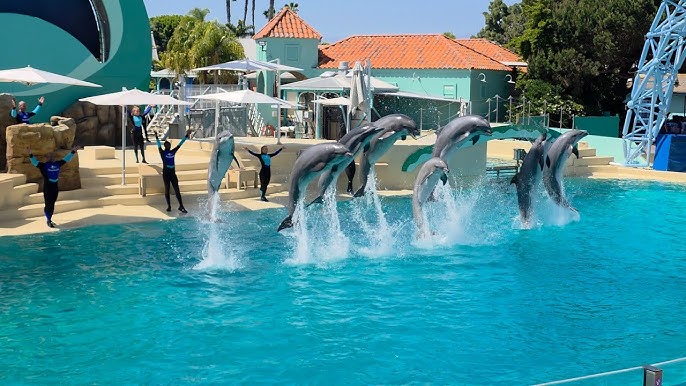
The claim is that watching marine mammals perform in a theme park setting teaches the public about these animals in ways that inspire conservation support. The science on whether this claim is accurate is not encouraging for the industry. Surveys of marine park visitors before and after attendance consistently fail to demonstrate meaningful increases in accurate knowledge about wild dolphin and orca biology, conservation status, or the threats these populations face. What visitors learn about animals that have been trained to jump on command, spin through hoops, and clap their pectoral fins on cue for dead fish rewards is not particularly applicable to understanding the animals those behaviors have nothing to do with.
Genuine marine education looks different. It looks like naturalist-guided whale watching in wild ocean environments, where the animals’ actual social behaviors, communication patterns, and ecological roles can be observed in the context in which they actually occur. It looks like supporting organizations that fund wild population research, track migration patterns, and develop the scientific understanding of these species that decades of captivity-focused “education” has not produced. It looks like investing in ocean health, in the reduction of plastic pollution, in the protection of prey species, and in the regulatory frameworks that govern fishing practices and vessel noise, all of which have genuine, documented consequences for wild dolphin and orca populations.
The performance tank teaches audience members that an orca’s life involves a pool and a trainer and dead fish. The wild ocean teaches audience members who the animal actually is.
The Future the Industry Does Not Want You to Know About
There is an alternative to captive marine mammal entertainment that the industry has resisted acknowledging, in part because its existence undermines the claim that captive facilities are the only practical way to experience these animals. It is called a coastal or seaside sanctuary, and it represents the most promising model available for providing genuinely improved welfare to the retired captive animals who can no longer be released into the wild while also ending the cycle of captivity for future animals.
A seaside sanctuary is a protected netted-off section of natural ocean water in which retired captive marine mammals can live without performing, without the chlorinated tank, without the forced social groupings of incompatible animals, and with access to the sensory environment of the actual ocean from which their kind was taken. They can hear wild marine life. They can experience tides, temperature variation, and natural water chemistry. They cannot be fully released into a wild population whose social structures and geographic ranges they have no preparation for, but they can live in conditions that are incomparably better than what any artificial tank provides.
The development of this model has been actively resisted by the marine park industry on grounds of financial interest. The resistance has also taken the form of regulatory lobbying to prevent the creation of legal frameworks that would require the transition of captive animals to sanctuary settings. What the resistance has not been able to do is engage with the welfare science on behalf of the tank, because the welfare science is unambiguous.
Dolphin Day of Action and What It Means
Dolphin Day of Action represents the annual convergence of advocacy organizations, scientists, educators, and members of the public who have concluded that the choice in front of them is clear. They are not asking marine parks to improve their tanks or to hire more veterinarians. They are asking people to withdraw the ticket revenue that makes the tank possible in the first place, to redirect their engagement with marine mammals toward the wild ocean observation, sanctuary support, and conservation investment that actually serve these animals rather than exploiting them.
Across the country, animal defenders have gathered at marine parks to represent the dolphins and orcas imprisoned in concrete tanks and makeshift lagoons. The animals in those tanks did not choose to be there. Some were wild-caught, taken from family groups they will never return to. Others were born in captivity, which is to say they were born into circumstances that began with their parents’ captivity. None of them have the ability to leave.
The choice that belongs to the people reading this is the ticket purchase. It is the decision about where to spend money on marine animal experiences, specifically whether that money goes toward perpetuating a system of confinement whose welfare consequences are documented and serious or toward the wild observation, sanctuary development, and ocean conservation that serve these animals rather than using them.
They cannot leave the tank. The most powerful thing any person who cares about dolphins and orcas can do is ensure that the tank cannot fund itself on their behalf.
Stop buying the ticket. Tell others why. Support sanctuaries. Watch wild whales in wild water. The ocean is where they belong, and the choices of an informed public are among the most effective forces available for ensuring that fewer of them spend their lives anywhere else.
Sustainable Action Now covers marine mammal welfare, dolphin advocacy, and the legislative and cultural changes needed to end captive marine mammal entertainment. Visit our Dolphin Outlook section for ongoing coverage.