
A small island nation in the middle of the Mediterranean Sea is not the most obvious place to look for a turning point in the global fight for big cat welfare. Malta is one of the smallest countries in the European Union, a densely populated archipelago covering less than 122 square miles, better known for its ancient stone architecture, its limestone coastline, and its position as a crossroads of Mediterranean history than for any particular role in the international conversation about animal welfare. But the work that FOUR PAWS conducted there in June 2026 matters far beyond Malta’s borders, and the reason it matters is precisely because Malta represents something that the global animal welfare movement needs more of: a place where the political and legal momentum already exists, where the battle is winnable, and where a well-executed intervention can create a model that the rest of Europe and the world can be pressured to follow.
This is the story of what happened in Malta, why it happened, and what it means for every tiger, lion, leopard, and puma living in captivity in a country that still has not done what Malta has begun to do.
An Island With More Big Cats Than It Should Have
To understand why FOUR PAWS chose Malta as a mission site, you first need to understand just how disproportionate the captive big cat situation on this island has been. Government registries and welfare investigations conducted in recent years revealed approximately 96 wild exotic animals, including substantial numbers of tigers, lions, and pumas, living in private collections and small commercial facilities across an island with a population of roughly half a million people.
That is not a figure that reflects normal patterns of legal zoological keeping.
It reflects a permissive regulatory environment that allowed private ownership of apex predators to become normalized, and it reflects something more troubling: Malta’s documented history as a transit point in the illegal exotic pet trade.
Animal welfare organizations and local political parties have raised this concern repeatedly and with increasing urgency. Big cats were being bred in Malta and exported across Europe, North Africa, and the Middle East, making the island not simply a place where captive big cats existed but a source node in a commercial pipeline that was producing animals specifically for trade.
The “hub problem,” as advocates have called it, means that tightening regulations in Malta does not only improve the welfare of animals currently living there. It disrupts a supply chain that was feeding demand across an entire region.
The legal environment in Malta has begun to shift, and that shift is what created the opportunity for the June 2026 mission. Malta recently enacted legislation banning public cub-petting interactions, one of the most commercially exploitative practices in the captive big cat industry, and requiring private keepers of big cats to sterilize their animals. These are meaningful legislative achievements that place Malta ahead of many of its European neighbors on the specific question of captive big cat regulation. They are also the foundation on which FOUR PAWS built its June mission, because legal change without implementation support rarely produces the outcomes the legislation intends.
Commercial facilities in Malta, unlike private keepers, retain the ability to apply for special breeding permits under the new framework. The owners of L-Arka ta’ Noè, the facility at the center of the June mission, made a decision that FOUR PAWS has specifically praised: they chose to exit the big cat breeding industry voluntarily, without being legally required to do so as a commercial facility, by inviting FOUR PAWS to sterilize their animals and formally close the breeding cycle at their operation. That decision is not a small thing. It is the kind of voluntary commitment from a facility owner that turns a legal framework from paper into reality, and it is the kind of decision that organizations like FOUR PAWS invest considerable diplomatic energy in encouraging.
What the Mission Actually Involved
The FOUR PAWS veterinary team traveled to Malta and spent several days conducting procedures at L-Arka ta’ Noè in conditions that field veterinary work characteristically involves: high temperatures, a temporary setting, equipment that has to be assembled and calibrated on site, animal management protocols that require careful coordination, and the particular challenge of working with large, potentially dangerous animals in an environment that is not a controlled veterinary clinic. The team operated alongside local partners, including the animal welfare organization Vući Ghall-Annimali and veterinarian Dr. Catherine Portelli, whose local knowledge and relationships made the mission logistically possible in ways that a visiting team operating alone could not have managed.
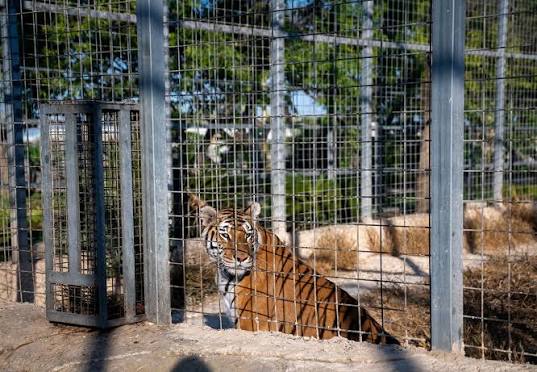
Two male white tigers were castrated. A male leopard was also sterilized. These procedures, taken together, mean that the male big cats at L-Arka ta’ Noè can no longer reproduce, that no future cubs will be born into this facility’s captive environment, and that the facility’s contribution to the captive big cat breeding cycle has been permanently ended. The sterilizations were the mission’s primary objective, and their permanence is what justifies the description of this as lasting impact rather than a temporary intervention.
The health assessments that accompanied the sterilization procedures produced findings that are both medically important and illustrative of what captive big cat welfare problems look like in practice. One of the tigers was found to be significantly overweight and was showing early signs of arthrosis, the joint disease that is common in captive big cats who spend their lives on hard surfaces without the range of movement that wild existence provides. These are not exotic or unusual findings. They are the predictable medical consequences of the conditions that captive big cats routinely inhabit, and they represent ongoing suffering that veterinary intervention can address but not fully reverse without fundamental changes to how these animals live.
A tiger couple at the facility was successfully relocated to a larger, more species-appropriate enclosure during the mission. This relocation, integrated into the broader logistics of the veterinary visit while the animals were sedated for other procedures, improved the immediate living conditions of these specific animals in a way that will have daily consequences for their welfare going forward. Better space, better environmental stimulation, better conditions for expressing at least some natural behaviors: these improvements do not give a tiger what a tiger actually needs, which is wild range across hundreds of square miles. But they represent the difference between inadequate and less inadequate, and for animals who cannot leave their enclosures, that difference is not trivial.
All planned procedures were completed successfully. Post-operative care and recovery monitoring continued in the days following the mission, coordinated with Dr. Portelli and the local partners who remained on the ground after the FOUR PAWS team departed.
The Legislative Argument: Why Malta Matters for the Rest of Europe
FOUR PAWS is using the Malta mission, and the behind-the-scenes documentation it produced through videos shared on its YouTube channel and social media platforms, as part of a broader advocacy campaign for what the organization calls “Positive Lists” across the European Union. A Positive List is a regulatory framework that specifies which animal species may legally be kept by private individuals or commercial facilities, with all species not on the list being prohibited by default. This is the inverse of the current regulatory model in most countries, where all species are permitted unless specifically prohibited, and where the burden falls on regulators to identify and ban specific harmful practices rather than on owners to demonstrate that their keeping of a specific species meets a defined welfare standard.
The Positive List model is significantly more protective of animal welfare than the prohibition-based approach, for reasons that are not complicated: the prohibition approach requires regulators to anticipate every species and every context in which keeping that species might cause harm, while the Positive List approach requires that owners demonstrate the suitability of the species they wish to keep before the keeping is permitted. Malta’s new legislation moves in this direction, and FOUR PAWS is arguing that the Maltese model should serve as a template for EU-wide regulation.
The argument has real leverage, because Malta’s situation illustrates the consequences of the permissive approach: 96 exotic wild animals on a tiny island, a documented history as a breeding and transit hub for illegal exotic pet trade, and a public health and safety dimension to captive big cat keeping that is impossible to fully manage in a densely populated small country. These are not hypothetical harms that Positive List advocates are speculating about. They are documented outcomes of the regulatory environment that Malta is now, slowly, beginning to change.
FOUR PAWS is framing Malta as a proof of concept: a country where the legal momentum already exists, where a willing facility owner cooperated with sterilization rather than resisting it, where local partners were engaged and effective, and where the intervention can be documented and shared as evidence that the model works. That documentation, disseminated through social media and press releases and advocacy channels across the European Union, is the mechanism through which a successful mission in Malta becomes pressure on regulators in Germany, France, Spain, Poland, and every other EU member state that has not yet taken comparable action.
The Global Context: Where Malta Fits in the Bigger Picture
Malta is, in the taxonomy of captive big cat welfare problems, neither the worst nor the most resistant. That context matters for understanding why organizations like FOUR PAWS choose to invest resources in places like Malta rather than directing all available effort toward the countries where conditions are most severe.
The United States has spent years grappling with what became publicly visible during the Tiger King phenomenon: a massive, historically under-regulated population of privately owned big cats, estimated at one point to rival or exceed the number of tigers remaining in the wild globally, distributed across commercial facilities, private ranches, roadside zoos, and individual collectors in a patchwork of state regulations that ranged from comprehensive to nonexistent. The Big Cat Public Safety Act, signed into federal law in 2022, represented the most significant step toward national regulation of private big cat keeping in American history. It is a genuine achievement. It did not instantly resolve the situation for the thousands of animals already in captivity under the old framework.
In countries including Russia, Belarus, Iran, and Myanmar, there are virtually no legal protections for wild animals in captivity. Entertainment use of big cats faces no meaningful legal restriction. Government transparency about captive wildlife is minimal or absent. International animal welfare organizations have little to no ability to conduct the kind of cooperative, invitation-based mission that FOUR PAWS conducted in Malta, because the cooperative relationship with local authorities and facility owners that makes such missions possible does not exist in regulatory environments where animal welfare is not a recognized governmental priority.
Australia presents a different profile: a country with generally strong legal infrastructure but persistent problems in commercial livestock farming, land clearing that destroys wildlife habitat at significant scale, and legal permissions for livestock procedures involving pain that most comparable countries have restricted or banned. The welfare problems there are primarily in agricultural contexts rather than in captive big cat keeping, but they reflect the same fundamental pattern that appears across the global animal welfare landscape: legal frameworks that lag behind scientific understanding of animal sentience and suffering, and commercial and political interests that resist the regulatory changes that science demands.
FOUR PAWS operates in all of these contexts with strategies calibrated to what each context allows. In Malta, the strategy is cooperative mission support for a facility making voluntary progress within a legal framework that is itself improving. In the United States, the strategy is legislative advocacy and public education aimed at strengthening and enforcing existing law. In countries with no functional regulatory framework, the strategy is documentation, advocacy, and the long work of building the international pressure that eventually reaches governments through trade relationships, diplomatic channels, and the reputational consequences of being identified as outliers in a global conversation that is moving toward stronger animal welfare standards.
The Malta mission is not the solution to the global captive big cat crisis. It is a demonstration that solutions are possible, that facility owners can be brought along voluntarily when the regulatory environment creates the right conditions, that veterinary missions conducted in difficult field conditions can produce lasting results, and that the patient, cooperative, documentation-based approach to welfare improvement can create the kind of documented success story that advocacy campaigns need to generate political pressure in jurisdictions that have not yet moved.
What Comes Next
The sterilized tigers and leopard at L-Arka ta’ Noè are recovering from their procedures under the ongoing monitoring of Dr. Catherine Portelli and the local team. The tiger couple relocated to a larger enclosure is beginning to adapt to conditions that are meaningfully better than what they had before. The animals cannot be given what they truly need, which is the wild, but they have been given something real, and the facility that houses them will not produce another generation of big cats born into captivity for commercial purposes.
FOUR PAWS will continue its advocacy for Positive Lists across the European Union, using the Malta mission as a reference point in policy discussions and public campaigns. Vući Ghall-Annimali, the Maltese animal welfare organization that partnered with FOUR PAWS on the ground, will continue its work pushing the Maltese government toward stronger enforcement of the legislation already passed and toward the additional regulatory steps that the current framework still does not require.
The broader campaign to end captive big cat breeding across Europe and globally continues. Malta is one data point, one successfully completed mission, one facility that has exited the breeding cycle permanently. The mission is over. Its impact, as FOUR PAWS has accurately described it, will last.
Sustainable Action Now will continue following FOUR PAWS and the global campaign for captive big cat welfare reform. The work is ongoing, the stakes are real, and the animals living in enclosures across Malta, Europe, and the rest of the world are counting on the kind of persistent, expert, cooperative advocacy that this mission represents.
Sustainable Action Now covers animal welfare, rescue network updates, and legislative developments affecting captive wildlife across the globe. Visit our Rescue Network section for ongoing coverage.