
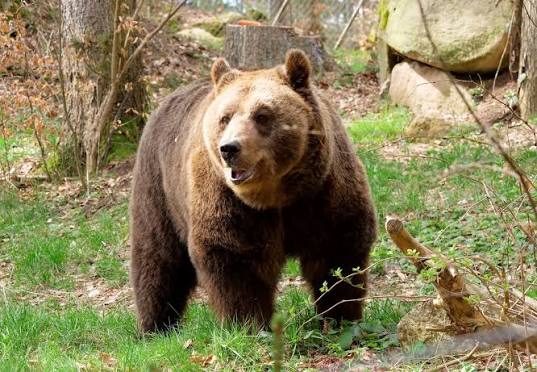
There is something clarifying about the early morning at BEAR SANCTUARY Belitsa. The Rila Mountains in southwest Bulgaria are still cool at that hour, the light coming soft through the dense forest that covers the 120,000 square meters of sanctuary terrain, and somewhere in the landscape, the bears are beginning to stir. By the time the animal care team arrives with the first meal of the day, the breakfast anticipation has already started. Each bear in the sanctuary has a known set of preferences, and the caretakers who know them best have long since learned which individual wants which fruit placed where, which bear will investigate a new enrichment immediately and which will approach it with characteristic caution, and which of them will be found at the usual spots versus somewhere unexpected on any given morning.
That specificity, the fact that these bears are known as individuals with documented tastes and social preferences and daily routines, is the most important thing to understand about what FOUR PAWS has built at its bear sanctuaries. These are not zoo exhibits displaying generic “bears.” They are communities of individuals with histories, personalities, friendships, and the kind of daily existence that people who follow FOUR PAWS’ social updates have come to care about the way you care about a neighbor you have been watching thrive after a period of genuine difficulty.
Breakfast time at Belitsa is also, in a quiet way, a small ceremony of what went right. Because none of the bears eating their carefully tailored morning meal this week were supposed to end up here. They were supposed to end up somewhere worse, or already be gone. The fact that they are not is the story of one of the most sustained and consequential animal welfare campaigns in modern European history.
The History These Bears Carry: Dancing Bears and the Road to Belitsa
For most of the 20th century, dancing bears were a fixture of street entertainment across Bulgaria and the broader Balkans. The practice was not casual or incidental. It was a generational tradition involving the capture of bear cubs from the wild, or their breeding in captivity, followed by training methods that no animal welfare framework in the 21st century would permit under any circumstances.
Metal rings were driven through the bears’ sensitive noses and jaws. Chains connected those rings to handlers who used pain and physical compulsion to force the bears to perform the movements that crowds would pay to see.
Teeth were sometimes removed or broken to make the animals less dangerous to handle, procedures carried out without anesthesia. Claws were removed. The bears spent their lives chained in small spaces, fed white bread and sugar and, in some documented cases, alcohol. This was their entire existence.
Bulgaria banned the practice in 1998, but the law and the reality of its enforcement are two different things, and dancing bears continued to appear in Bulgarian towns and roadways for years after the ban, ending the practice in the country for good. The institution that made that rescue possible had already been built.
BEAR SANCTUARY Belitsa was established in 2000, in cooperation with the Fondation Brigitte Bardot, in the foothills of the Rila Mountains near the small town of Belitsa. The location was chosen with deliberate care, situated in terrain that genuine brown bear habitat resembles, with dense forest, elevation, varied topography, and the kind of quiet remove from human activity that a sanctuary for traumatized animals requires. The first residents, bears named Kalina, Mariana, and Stefan, arrived that year.
By 2009, the last Serbian dancing bears had been brought to Belitsa as well.Eventually, the last Albanian dancing bear arrived, formally ending the practice across all of Europe.
The sanctuary’s original name, Dancing Bears Park Belitsa, reflected its founding mission. In 2022, once there were no more dancing bears left to rescue, the name changed to BEAR SANCTUARY Belitsa, reflecting the expanded mission that the end of one era of captive bear exploitation made necessary: rescuing bears from private captivity and substandard zoo conditions across a region where the dancing bear tradition had ended but other forms of inadequate keeping had not.
What the Sanctuary Actually Provides
The physical environment of BEAR SANCTUARY Belitsa was designed in close consultation with behavioral scientists and wildlife experts to reflect, as closely as a sanctuary can, the conditions that brown bears actually need. <cite index=”5-1″>Dense forests and hills for roaming and periods of seclusion, meadows and specially designed sunny spaces for rest, ponds for swimming, and artificial dens for those bears who prefer not to excavate their own hibernation caves</cite>: the terrain addresses the full range of behavioral needs of animals whose natural biology drives them to forage across large distances, seek their own solitude on their own schedule, and hibernate through cold months when the body chemistry that governs their winter rest tells them it is time.
The daily feeding routine is built around the understanding that a bear is not a container for nutrition but an individual with genuine food preferences that, if respected, contribute to both physical health and behavioral wellbeing. The morning meal at Belitsa is not a uniform distribution of identical rations. It is a set of individualized preparations whose variety and composition reflect what each bear actually enjoys, what the veterinary team has determined is appropriate for each animal’s specific health profile, and the creative enrichment approaches that caretakers have developed to encourage the foraging and problem-solving behaviors that keep a bear’s mind engaged and active.
Mima is one of the bears whose morning meal the Belitsa team knows by heart. She arrived as one of the last three dancing bears rescued from their owners in the Bulgarian village of Getsovo in 2007, and she has been at Belitsa ever since. <cite index=”26-1″>Born in 1997, Mima is known for being very active and can be spotted throughout the day.</cite> In the warmest summer months, she follows the pattern of many of the Belitsa bears, preferring the cool shade of the bushes during the afternoon hours when the heat peaks, then re-emerging with the other bears as the day cools toward evening. <cite index=”26-1″>She now spends much of her time with her companion Monty, and the two of them are reliably found together in the upper part of their enclosure in the later afternoon, foraging and moving through the space in the easy companionship of animals who have clearly decided they are best suited to share their days.</cite>
The social bonds that have developed among the Belitsa bears are among the most telling indicators of the sanctuary’s success. Animals who arrive with behavioral damage from years of isolation and chain-induced stress do not form friendships quickly or easily. The gradual development of genuine companionship, the kind that plays out in the foraging routes bears choose to share and the resting spots they return to together, represents a rehabilitation of social capacity that the original conditions of their captivity had suppressed. Mima and Monty together in the afternoon light, moving through the upper enclosure in an unhurried rhythm, is a very small and very significant thing.
The companion that FOUR PAWS’ social media has been playfully teasing followers to spot, the bear who has been at Belitsa for over a decade and is often found near Mima, is a resident whose long tenure at the sanctuary reflects the lifelong commitment that FOUR PAWS makes to every animal in its care. These bears do not have a temporary stay at Belitsa, after which they will be expected to move on or fend for themselves. They live here, for as long as they live, in conditions that the organization has committed to maintaining at the highest standard it can provide.
Michal’s Weekend Mood: Doing Absolutely Nothing
Eleven hundred kilometers to the northwest, in the lake district of Mecklenburg in northeastern Germany, a different kind of morning is unfolding at BEAR SANCTUARY Müritz. The largest bear sanctuary in Western Europe, covering 16 hectares on the southern tip of Lake Plauer See, is home to sixteen brown bears whose individual histories span zoos, circuses, private captivity, and at least one genuinely difficult Polish concrete enclosure that one particular bear called home for far too long.
That bear is Michal, and he has been at Müritz since September 2011, which means he has now lived at the sanctuary for the better part of fifteen years. <cite index=”24-1″>Before his rescue, he was kept in terrible conditions at a zoo in Braniewo, Poland, confined in an enclosure of only 60 square meters where he spent his days on concrete.</cite> During a fight with another bear at that facility, Michal lost one of his front legs. He arrived at Müritz limping in circles, a behavioral pattern that is one of the most recognizable expressions of the psychological damage caused by extended captivity in inadequate conditions: the circular pacing of an animal whose body continues to trace the boundaries of a space it no longer physically inhabits.
<cite index=”24-1″>Since arriving at Müritz, Michal has changed completely.</cite> The bear who limped in circles on a concrete floor of 60 square meters now swims, digs, plays with branches and sticks, and, according to his caretakers, takes genuinely enthusiastic advantage of every enrichment opportunity available to him. <cite index=”24-1″>His missing foreleg does not stop him from anything.</cite> The caretakers describe him as one of the biggest bears in the sanctuary, still testing the edges of the strength that his body is continuing to develop, very food-motivated, playful in the water, and fond of the specific companionship of large branches, which he carries and manipulates with a focus that visitors find endlessly entertaining.
His weekend mood, as FOUR PAWS’ social team has observed, is doing absolutely nothing, which is a characterization that carries more weight than it might initially seem. A bear who spent his days on concrete in a 60-square-meter enclosure did not have the option of deciding what kind of day he wanted to have. The doing of nothing, in the specific and deliberate sense of choosing rest over activity, wandering over swimming, shade over sun, requires the availability of genuine choices. Michal has those choices now. He makes them daily. On weekends, it seems, he exercises his preference for leisure with the confidence of an animal who has been given enough time in a place that is actually his to feel fully at home in it.
<cite index=”24-1″>In the spring of 2013, Michal was socialized with a bear named Tapsi, and he helped her through a very difficult period when her father Bummi passed away.</cite> This detail, almost incidentally recorded in the sanctuary’s notes about him, captures something important about who Michal has become at Müritz. An animal who arrived damaged and isolated enough that he could only pace circles has become, over years of consistent expert care and a gradual expansion of trust and social capacity, an animal who provided comfort to another bear in grief. That is not a small thing. It is, in fact, the whole point.
Two Sanctuaries, One Commitment
BEAR SANCTUARY Belitsa in Bulgaria and BEAR SANCTUARY Müritz in Germany represent two expressions of the same fundamental commitment that FOUR PAWS has made to captive bears across Europe: that every bear rescued from inadequate conditions deserves not merely adequate care but the best possible approximation of the life its biology was designed for, provided with the individualized attention that genuine rehabilitation requires, for as long as that animal lives.
The bears at these sanctuaries arrive from different backgrounds. The Belitsa residents are mostly former dancing bears whose early lives were defined by the specific cruelties of that tradition, bears who wore nose rings attached to chains, who were trained with hot metal plates and pain to perform for human entertainment, and who carry the physical and psychological marks of that history into every year they spend at the sanctuary. The Müritz residents come from zoos, circuses, and private captivity across Germany, Poland, Albania, Serbia, and Ukraine, each with its own variant of the fundamental inadequacy that captivity imposes on an animal who requires space, choice, and social connection to function as it was designed to.
What unites them is the breakfast they receive each morning, carefully calibrated to what each individual actually prefers, offered in an environment that makes choosing how to eat, where to eat, and with whom to share the morning a genuine exercise of preference rather than a managed distribution of resources. It sounds small. It is, in the lives of animals who had no choices for years or decades, enormous.
The Ongoing Work and How to Support It
Both sanctuaries are open to visitors during the warmer months, offering guided tours that tell the stories of the individual bears in residence and explain the broader history of the welfare campaigns that brought them there. Visiting BEAR SANCTUARY Belitsa involves a drive into the Rila Mountains to a facility set in genuinely beautiful terrain, with tours conducted in Bulgarian and English by guides who know the bears as individuals and can speak to the specific histories and personalities of the animals visitors will observe. BEAR SANCTUARY Müritz, situated in the Mecklenburg Lake District about two hours from Berlin, is the largest bear sanctuary in Western Europe and provides a more expansive physical experience alongside an equally detailed knowledge of its sixteen residents.
Beyond visits, supporting the work of FOUR PAWS at these sanctuaries is possible through direct donation to the organization, through individual bear sponsorships that connect supporters to the specific animals they have come to follow, and through the kind of sustained public engagement with these animals’ stories that makes the political and legislative advocacy FOUR PAWS conducts on their behalf more visible and more effective.
The bears at Belitsa and Müritz are doing well this morning. Mima is somewhere in the upper part of her enclosure, probably with Monty not far away. Michal is doing exactly what his weekend mood prescribes. Somewhere in the Rila Mountain forest, the caretakers are distributing the carefully tailored breakfasts that the bears at Belitsa have been known to prefer.
That is what looks like when things go right. It took a very long time, and the work of a very dedicated network of people and organizations, to get here. It is worth knowing about and worth supporting.
Sustainable Action Now covers the work of FOUR PAWS and its sanctuaries across Europe and globally. Visit our Rescue Network page for ongoing updates on bear welfare, sanctuary life, and the campaigns that make this work possible.