
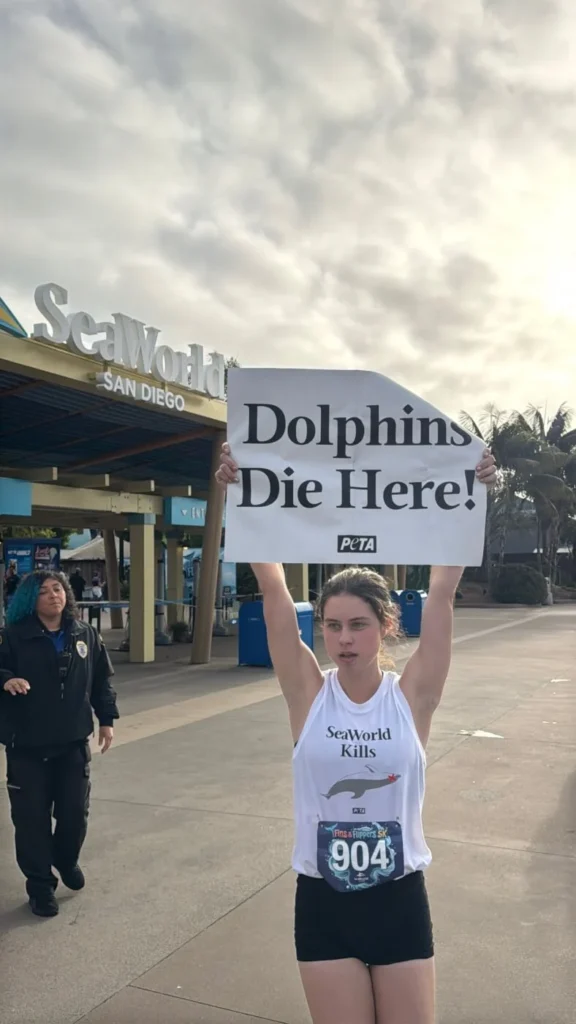
A SeaWorld San Diego race meant to promote the park became something entirely different when PETA correspondent Starlynn Costa crossed the finish line first in the women’s division wearing a bold “SeaWorld Kills” shirt and turned her victory into a public protest against animals being kept in captivity and used for entertainment.
Costa, a registered participant in SeaWorld San Diego’s Fins & Flippers 5K, completed all 3.1 miles, won the women’s division, placed second overall, and used the moment immediately after finishing to call attention to the animals still confined inside the park. Shortly after speaking out, she was escorted out by SeaWorld security, but the message had already landed: animals at marine parks are not free after the show ends. They are not simply “performers” for a few minutes a day. They are kept in captivity around the clock, every day, in artificial environments that can never compare to the ocean.
This is not only about whales. It is not only about orcas. It is about dolphins, whales, sea lions, and every animal confined, trained, displayed, handled, and used as part of the entertainment model at marine parks. Dolphins are among the clearest examples. These are intelligent, social, wide-ranging marine mammals who naturally live in complex groups, travel long distances, communicate constantly, and experience the ocean as their home. At SeaWorld and similar facilities, dolphins are kept in tanks, trained for human interaction, used in shows, and placed in environments built around visitor access rather than true freedom.
The same broader concern applies to orcas, belugas, pilot whales, sea lions, and other marine animals held in captivity. Whether they are performing in front of crowds, being used in public encounters, or simply swimming in circles between scheduled appearances, the underlying issue remains the same: their lives are controlled by human systems. Their space is controlled. Their food is controlled. Their movements are controlled. Their daily routines are controlled. Their social structures are controlled. Their entire existence is shaped around captivity.
That is why Costa’s protest mattered. Her victory at the SeaWorld 5K was not just a symbolic athletic achievement. It was a direct challenge to the carefully managed image of marine parks as family-friendly entertainment destinations. By running inside the event, winning the race, and crossing the finish line with a message that could not be ignored, she exposed the contradiction at the center of the park’s public image. SeaWorld can host races, sell tickets, stage shows, and market itself as educational, but behind that branding are animals who remain confined long after guests go home.
The phrase “SeaWorld Kills” was intentionally blunt because the issue itself is urgent. Animal advocates argue that captivity harms marine mammals physically, psychologically, socially, and behaviorally. Dolphins and whales are not built for tanks. They are built for the ocean. They are not meant to spend their lives in restricted spaces, repeating routines, responding to commands, and performing for applause. They are not props, mascots, attractions, or marketing tools. They are living beings with their own needs, relationships, instincts, and natural behaviors.
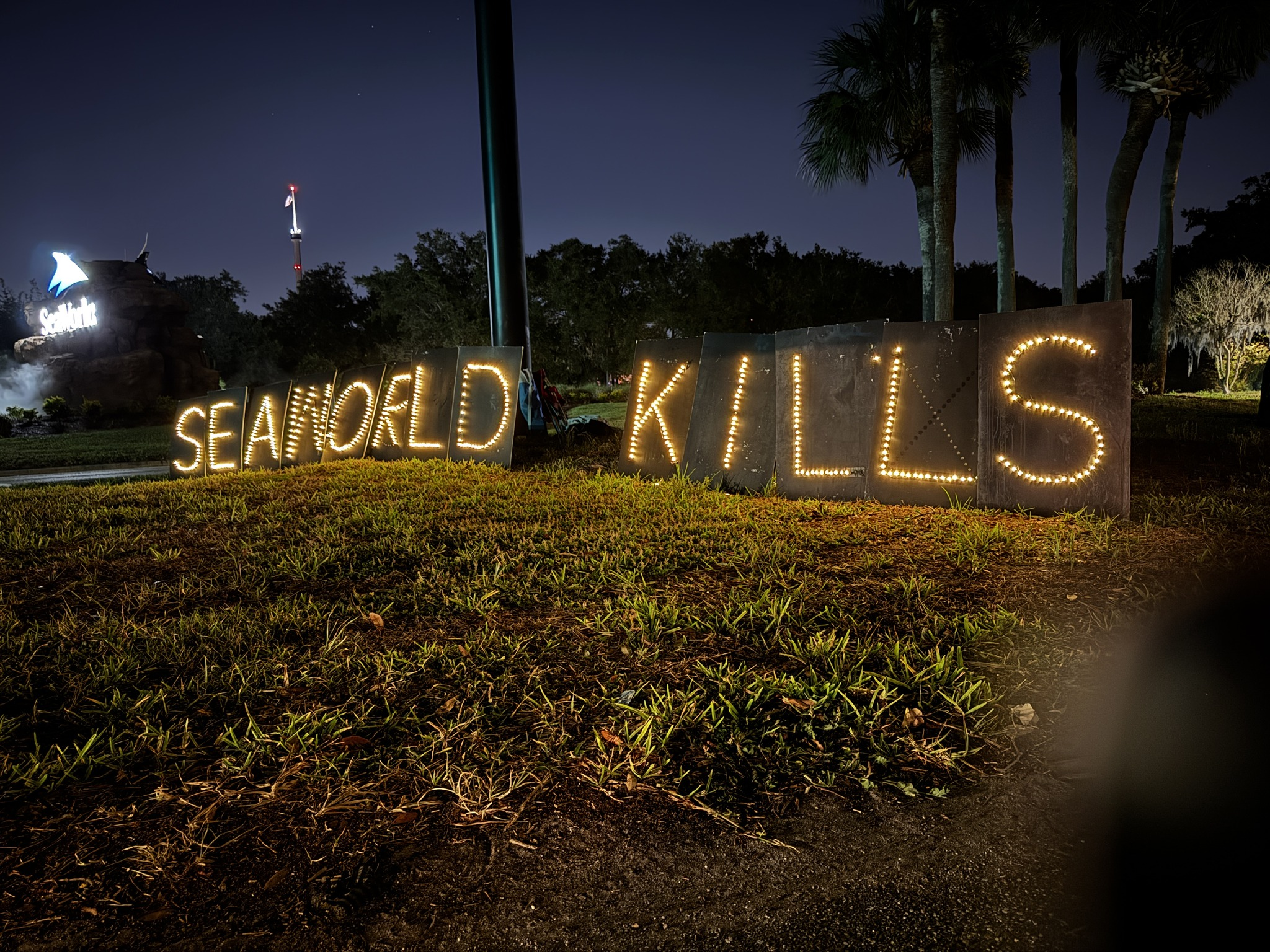
Costa’s protest also brought renewed attention to Corky, the long-confined orca at SeaWorld San Diego, but the larger message reaches far beyond one animal. Corky’s story is devastating, but she is part of a much wider system. Dolphins remain in captivity. Other whales remain in captivity. Sea lions and additional marine animals remain in captivity. The entire business model depends on animals being available for display, interaction, and entertainment. Even when they are not actively performing, they are still confined within the same system.
That is the point too often missed in public discussions about marine parks. The harm is not limited to showtime. The harm is captivity itself. A dolphin does not regain freedom when a performance ends. A whale does not return to the ocean after guests leave. A sea lion does not get to resume a natural life once the applause is over. The tank is not a stage they visit. It is where they live.
For Sustainable Action Now, this moment should be understood as part of a larger ethical reckoning over animal captivity, entertainment, and corporate responsibility. The modern public is increasingly questioning industries that profit from confining wildlife. People are no longer satisfied with vague claims about education or conservation when the visible reality is animals being trained to perform, displayed for crowds, and kept in artificial spaces for life.
Costa’s win turned a branded SeaWorld event into a public accountability moment. She did not need a stage, a microphone, or a press conference. She used the finish line itself. That is what made the protest so effective. SeaWorld created the event, but Costa claimed the moment.
Her removal from the park only strengthened the message. Instead of engaging with the substance of the protest, security escorted out the athlete who had just won the women’s division. The image was powerful: a runner celebrated for winning, then removed for speaking up for the animals confined inside the same park.
The issue is simple, and it should be stated clearly. Marine animals do not belong in captivity for entertainment. Dolphins should not be reduced to attractions. Whales should not spend their lives in tanks. Sea lions should not be trained into crowd-pleasing routines as a substitute for natural freedom. No animal should be confined, controlled, and displayed simply because people will buy tickets to watch.
The SeaWorld San Diego 5K was supposed to be a race. Instead, it became a reminder that every ticket, every show, every encounter, and every branded park event exists alongside the daily reality of captivity. Costa crossed the finish line first, but the real victory was forcing the public to look beyond the entertainment and see the animals still trapped behind it.