

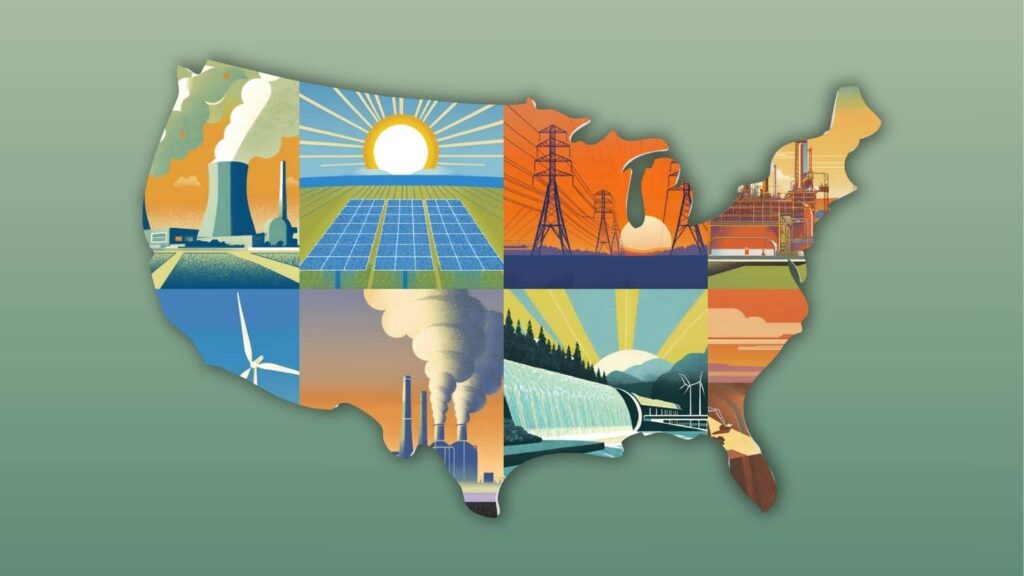
The climate conversation in the United States has entered a new and more complex phase—one defined not by broad declarations, but by a convergence of policy shifts, geopolitical pressure, and institutional recalibration. The latest climate-focused release from Sustainable Action Now captures this moment with precision, presenting a layered examination of how federal leadership, legislative movement, and global energy instability are reshaping the trajectory of climate action in real time.
At the center of this evolving landscape is a notable divergence within federal leadership itself. While Cabinet-level turnover has introduced volatility across multiple departments, the position of Lee Zeldin at the helm of the Environmental Protection Agency has remained comparatively stable. That stability is not accidental. It reflects alignment—specifically, an operational consistency with the broader policy direction established by Donald Trump. In a political environment where adherence to executive priorities often determines longevity, Zeldin’s standing illustrates a pragmatic dynamic: effectiveness, in this context, is measured less by traditional environmental benchmarks and more by the ability to execute a defined agenda with discipline.
This alignment is unfolding alongside significant legislative activity that signals a recalibration of how energy is sourced, regulated, and sustained. The advancement of the Harnessing Energy At Thermal Sources Act—formally HEATS Act—represents a strategic pivot toward geothermal innovation. Its passage through the House is not merely procedural; it reflects a growing recognition that baseload renewable energy must play a central role in any serious decarbonization framework. Unlike intermittent sources, geothermal systems offer consistency, positioning them as a critical component in stabilizing a grid increasingly influenced by renewable inputs.
Parallel to this, the progression of Hydropower Licensing Extension Act underscores a more nuanced approach to existing infrastructure. By extending the timeframe for initiating construction on licensed hydropower projects, policymakers are effectively acknowledging the logistical and financial complexities that have historically delayed deployment. This adjustment is not a retreat from renewable goals; it is an attempt to align regulatory timelines with real-world development cycles, thereby unlocking projects that might otherwise stall indefinitely.
Yet, while domestic policy evolves, the global energy market continues to exert pressure in ways that complicate long-term planning. The ongoing disruption surrounding the Strait of Hormuz—a critical artery for global oil transport—has exposed vulnerabilities that cannot be resolved through short-term adjustments. Feedback captured by the Federal Reserve Bank of Dallas highlights a growing unease within the oil and gas sector, where executives point to escalating shipping costs and persistent uncertainty tied to conflict dynamics involving Iran. The message is clear: disruptions of this scale do not produce quick rebounds. They reshape expectations, recalibrate pricing structures, and reinforce the urgency of diversifying energy portfolios.
This tension between dependence and transition is further amplified by international developments that suggest a widening gap in how climate action is being pursued globally. A recent summit in Colombia has emerged as a defining moment in this regard. Positioned as a breakaway initiative from the slower, consensus-driven processes of the United Nations, the gathering signals a willingness among certain nations to accelerate decarbonization efforts outside traditional frameworks. The implications are significant. If sustained, this approach could fragment the global climate strategy into parallel tracks—one rooted in multilateral negotiation, the other in more agile, coalition-based action.
What Sustainable Action Now’s latest analysis makes unmistakably clear is that these developments are not isolated. They are interconnected elements of a broader system under transformation. Domestic policy decisions influence global market behavior. Geopolitical instability accelerates innovation in alternative energy. Legislative adjustments reflect both ambition and constraint. Together, they form a feedback loop that is redefining how climate progress is measured and achieved.
This is not a moment for simplified narratives. The reality is more complex, and more consequential. Climate action is no longer advancing along a single, linear path. It is being shaped by competing priorities, shifting alliances, and the constant interplay between risk and opportunity. For stakeholders—whether in government, industry, or the public sphere—the challenge is not just to respond, but to anticipate.
Sustainable Action Now positions itself at the intersection of these dynamics, offering a framework that goes beyond surface-level reporting. By synthesizing policy developments, market signals, and global trends, it provides a comprehensive view of where climate strategy is heading—and what it will take to navigate the road ahead. Those looking to understand not just what is happening, but why it matters, will find in this latest release a detailed and authoritative guide to a system that is evolving faster than ever before.