

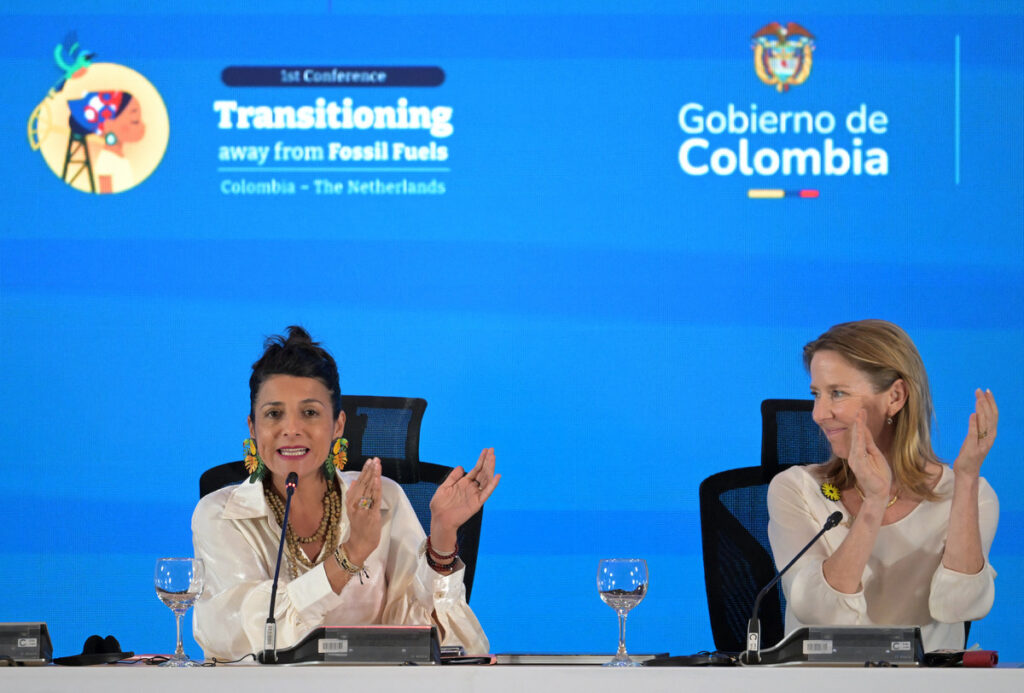
The global climate conversation entered unfamiliar territory at the end of April 2026. In Santa Marta, Colombia, roughly 60 nations gathered for what may ultimately be remembered as one of the most politically disruptive climate meetings of the modern era: the First International Conference on Transitioning Away from Fossil Fuels.
Unlike traditional United Nations climate negotiations, this summit was not designed around compromise with the world’s largest oil-producing powers. It was designed around frustration with them.
For decades, international climate summits have operated within a diplomatic structure where nearly every major decision requires consensus among nations whose economies, political influence, and geopolitical leverage remain deeply tied to oil, gas, and coal production. The result has often been familiar: ambitious speeches, incremental pledges, delayed timelines, and negotiations watered down until the final agreements become politically survivable rather than scientifically sufficient.
The Santa Marta summit represented a strategic rupture from that model.
This was effectively a coalition of countries declaring that the traditional pace of climate diplomacy is no longer aligned with the scale of the crisis itself. Instead of waiting for the world’s largest fossil fuel powers to voluntarily lead a transition away from hydrocarbons, this new coalition is attempting to build an entirely separate framework centered around countries willing to actively pursue fossil fuel phase-outs now.
That is why the event is increasingly being referred to globally as the “Breakaway Climate Summit.”
And now comes the difficult part.
The conference itself was widely viewed as symbolically successful simply because it happened at all. The gathering created a new international bloc centered specifically around ending fossil fuel dependency rather than merely reducing emissions within existing systems. But symbolism alone will not reshape global energy markets, stabilize vulnerable economies, or reduce atmospheric carbon concentrations quickly enough to meet long-term climate goals.
The summit concluded with an uncomfortable reality hanging over nearly every discussion: the easy part was forming the coalition. The hard part is governing it.
At the center of the summit’s conclusions was one of the most ambitious climate concepts proposed in years: the creation of legally protected “Fossil Free Zones.”
The proposal fundamentally reframes how the world thinks about ecologically critical regions. Instead of viewing places like the Amazon rainforest or the Congo Basin as resource reserves waiting to be extracted responsibly, the summit’s coalition argues they should be treated more like permanently protected planetary infrastructure essential for global survival.
The logic behind the proposal is both environmental and philosophical.
Humanity already accepts that certain places should remain protected from industrial destruction regardless of potential profit. Few people would support drilling operations inside the Grand Canyon or large-scale mining projects directly through globally protected heritage sites. The coalition argues that the Amazon and Congo Basin deserve the same status because their ecological importance extends far beyond national borders.
These regions function as some of the planet’s most important carbon sinks, biodiversity reservoirs, rainfall stabilizers, and climate regulators. Once degraded beyond recovery thresholds, the consequences would not remain localized. They would reverberate globally through food systems, weather patterns, agriculture, migration, water security, and economic stability.
The proposal therefore treats fossil fuel extraction inside these regions not simply as a domestic economic decision, but as a global climate risk.
It is a radical shift in climate politics because it moves beyond regulating emissions after extraction and instead targets extraction itself.
That distinction matters enormously.
Much of modern climate policy has historically focused on emissions efficiency, carbon markets, technological mitigation, or gradual transition frameworks that still assume fossil fuel infrastructure remains central to the global economy for decades. The Santa Marta coalition is advancing a different argument entirely: some areas should become legally untouchable for hydrocarbon development regardless of market demand or geopolitical pressure.
This is where the summit’s ambitions collide directly with economic and political reality.
The timing of the conference could hardly have been more complicated. As delegates gathered in Colombia, geopolitical instability connected to conflict involving Iran sent oil prices sharply upward, creating immediate financial pressure on governments worldwide. Higher oil prices tend to strengthen the economic influence of fossil fuel industries while simultaneously increasing fears surrounding energy shortages, inflation, and political backlash from consumers facing rising costs.
That context exposed one of the central contradictions now confronting the global climate movement.
Many developing nations participating in the summit remain economically dependent on fossil fuel exports or resource extraction revenue even while supporting long-term climate transition goals. Several countries within the coalition are attempting to navigate an extraordinarily difficult balancing act: reducing dependence on industries that currently finance large portions of their economies.
That is why financing became one of the most urgent issues discussed throughout the conference.
The transition away from fossil fuels cannot function as a purely moral appeal. It requires massive structural investment. Developing nations need financing mechanisms capable of replacing the economic role fossil fuel extraction currently plays in employment, infrastructure development, trade stability, and government revenue.
The summit therefore placed enormous emphasis on development banks and international financing institutions.
Participants pushed for new frameworks allowing clean energy expansion to become economically viable at scale in countries that historically relied on hydrocarbons for survival. Renewable infrastructure, battery systems, public transit modernization, energy storage networks, grid upgrades, and climate adaptation projects all require levels of capital many governments simply cannot generate independently.
Without serious financing, transition pledges risk collapsing under economic pressure.
This is precisely why the absence of several major global powers loomed so heavily over the summit itself.
The United States, Saudi Arabia, and China were notably absent from the conference, creating both symbolic and practical complications. Together, these nations represent enormous portions of global emissions, fossil fuel production, industrial capacity, and geopolitical leverage. Their absence reinforced the summit’s identity as a breakaway movement, but it also highlighted the enormous limitations facing any climate coalition operating without the participation of the world’s largest energy powers.
The United States was reportedly not invited due to the current administration’s aggressive fossil fuel expansion policies and continued emphasis on domestic energy production. That exclusion reflected growing frustration among many climate-vulnerable nations who increasingly believe traditional diplomacy has become stalled by political interests tied directly to oil and gas expansion.
China’s absence carried different implications.
As both the world’s largest emitter and one of the largest investors in renewable energy infrastructure, China occupies an extraordinarily complex role within global climate politics. The same is true for Saudi Arabia, whose economic and geopolitical influence remains deeply connected to oil markets.
The coalition therefore faces an immediate strategic question: can a “Coalition of the Willing” create enough economic momentum, political legitimacy, and international pressure to influence the broader global system even without the direct participation of its largest players?
The countries leading the effort believe the answer may ultimately be yes.
Colombia emerged from the summit as a central political voice for this new phase of climate diplomacy. Hosting the conference allowed the nation to position itself as a bridge between environmental urgency and Global South leadership. Rather than climate policy being dictated exclusively by wealthier industrial nations, the Santa Marta summit reflected a growing movement where climate-vulnerable countries increasingly shape the conversation themselves.
Tuvalu’s role carried even deeper symbolic weight.
The Pacific island nation, which will co-host the 2027 follow-up summit alongside Ireland, has become one of the clearest human representations of climate vulnerability anywhere on Earth. Rising sea levels threaten the country’s long-term survival, making climate policy not an abstract political issue but an existential one.
That reality fundamentally changes the tone of these negotiations.
For nations already experiencing severe climate consequences through flooding, drought, extreme heat, food insecurity, or coastal erosion, the conversation surrounding fossil fuels is no longer framed around gradual adjustment. It is increasingly framed around timelines of survival.
Ireland’s participation reflects another important aspect of the summit’s emerging strategy: building a cross-continental alliance capable of linking European regulatory influence with the lived climate realities facing vulnerable nations in the Pacific, Latin America, Africa, and elsewhere.
This “Coalition of the Willing” is attempting to create what many participants describe as a moral majority.
The underlying strategy is straightforward. If enough countries can successfully demonstrate that economic development, energy stability, and climate transition can coexist without continued fossil fuel expansion, it becomes increasingly difficult for larger powers to justify delay indefinitely.
The gamble, however, is enormous.
Global energy systems remain deeply interconnected with fossil fuels. Entire industries, transportation networks, manufacturing sectors, financial systems, and labor markets still rely heavily on hydrocarbons. Any serious attempt to accelerate transition away from them carries political risk, economic volatility, and potential backlash.
That is why the Santa Marta summit matters beyond its immediate policy proposals.
It represents the first major attempt to build an international climate bloc explicitly centered around post-fossil fuel governance rather than incremental emissions management alone.
Whether it succeeds remains uncertain.
But what emerged from Colombia is unmistakably different from the climate diplomacy model the world has grown accustomed to over the last several decades.
The countries involved are no longer asking whether the fossil fuel era should eventually end.
They are now debating how quickly the world can survive ending it.