
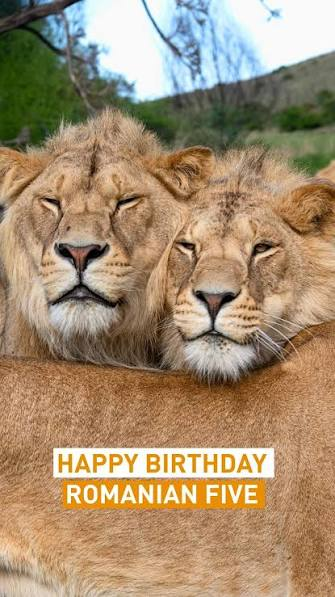
Today is a birthday worth celebrating — and not simply because birthdays are worth celebrating in general, but because the fact that Roman, Vincent, Dolf, Ellie, and Geena are alive, together, healthy, and marking their seventh year under the South African sun at LIONSROCK Big Cat Sanctuary is the outcome of a rescue effort that, at several points along the way, could easily have ended differently.
These five lions — known to the FOUR PAWS team and the global community that has followed their story as the Romanian Five, and also affectionately as the FELIDA Five, after the Dutch sanctuary that served as their first safe haven — were born in private captivity in the village of Picior de Munte, a small settlement less than a hundred kilometers from Bucharest. They spent the earliest years of their lives in a private backyard in Romania, confined in conditions that no lion should inhabit: tiny enclosures, no space for natural movement, no social context appropriate for their species, existing as the unintended consequence of uncontrolled captive breeding by an owner who kept lions as property rather than as the complex, social, intelligent animals they are.
They were not supposed to have a seventh birthday in a sanctuary. They were not supposed to have a life that involved grassland, a small dam to drink from, rocky outcrops to climb, trees to shelter under, or the company of their siblings stretched out in the afternoon warmth of the Eastern Free State. They were supposed to remain what they were born as: privately owned animals in an Eastern European backyard, products of a breeding operation that treated lions as commercial assets and gave no thought to what those lions actually needed to have any semblance of a life.
The fact that today looks different is the result of FOUR PAWS finding them, fighting for them, and refusing to stop until Roman, Vincent, Dolf, Ellie, and Geena were somewhere that deserved the word home.
How a Music Video Changed Five Lions’ Lives
The story of the Romanian Five begins, improbably, with a Romanian music video. In late 2020, Romanian artist Dani Mocanu released a video clip in which a lion named Simba — one of the older siblings of the five youngest cubs held at the Picior de Munte property — appeared alongside the artist as a prop for visual spectacle. The video circulated on social media and reached animal welfare organizations whose job is to notice exactly this kind of thing: a wild apex predator used as a celebrity accessory, in a context that made clear the animal had been bred and kept for human entertainment purposes.
FOUR PAWS, the global animal welfare organization founded in Vienna in 1988, was among those alerted to the situation. What they found when they investigated the Picior de Munte property was not just Simba — it was nine lions in total, including seven siblings from what turned out to be uncontrolled captive breeding across two litters. Simba and his older sister Elza were from the first litter. Roman, Vincent, Dolf, Ellie, and Geena — all born in the same litter, a quintuple birth that is genuinely rare among lions — were younger. All of them were in conditions that represented everything wrong with the private keeping of wild animals: cramped enclosures, no appropriate social environment, no veterinary care commensurate with their needs, and an existence defined entirely by the human decision to breed and keep them for whatever purpose the owner had in mind.
FOUR PAWS entered into negotiations with the property’s owner. Those negotiations were not brief, and they were not simple. Extracting wild animals from private custody requires legal frameworks, permits, diplomatic patience, and the persistent willingness to engage with people and institutions that do not necessarily share your assessment of what constitutes an acceptable life for a lion. The process took months. The actual rescue — the physical removal of the seven siblings from Picior de Munte — happened in September 2021, and on October 1st of that year, all seven arrived at FELIDA Big Cat Sanctuary in Nijeberkoop, in the Netherlands.
The village of Picior de Munte was behind them. What came next was the slow, careful, expert work of finding out who these five young lions actually were — and what they were going to need to become the animals they had always been meant to be.
Ten Months at FELIDA: Where Recovery Begins
FELIDA Big Cat Sanctuary operates as FOUR PAWS’ specialist intake and rehabilitation facility — the place where animals arrive from crisis situations and receive the intensive, individualized assessment and care that determines their physical and psychological baseline before any decisions about their long-term future can be made. It is not a forever home. It is a place of transition, of healing, of discovery — and for the five young Romanian lions, it was where the first glimpses of who each of them actually was began to emerge.
The quintuplets were from the same litter, which meant a shared genetic background and early life experience. What became clear almost immediately after their arrival was that despite those shared origins, Roman, Vincent, Dolf, Ellie, and Geena were five entirely different individuals with different temperaments, different sensitivities, different rates of adaptation, and different relationships to the unfamiliar world that FELIDA represented.
Roman established himself as the explorer from the beginning. He was the first to investigate new things, the most curious about enrichment, the one whose confidence set the tone for the group’s initial interactions with their new environment. Vincent aligned closely with Roman — the two brothers were most often found together, playing, resting in proximity to each other, working out between themselves the question of social dominance that young male lions navigate as they approach maturity. That dynamic shifted in interesting ways as the months passed: while Roman remained the first to engage with new enrichment and new situations, it became clear during feeding that Vincent was increasingly the one whose energy and assertion shaped the group’s behavior around food. The two of them were figuring out, in the unhurried way that well-bonded siblings do, who the leader was in which context.
The ten months the quintuplets spent at FELIDA were not simply a waiting period before the next phase of their journey. They were months in which trust was built, health was established, individual needs were understood, and five young lions who had known nothing but a Romanian backyard began to discover what it felt like to be in an environment where the people around them were working actively for their wellbeing rather than for their utility.
The Journey to LIONSROCK: World Lion Day and a Forty-Hour Trip
On August 10th, 2022 — World Lion Day, a date that felt less like coincidence and more like the universe arranging itself appropriately — five young lions departed FELIDA for LIONSROCK Big Cat Sanctuary near Bethlehem in South Africa’s Eastern Free State. The journey was approximately 40 hours from the moment the transport crates were loaded to the moment the five arrived at their destination. FELIDA Curator Juno van Zon accompanied them for the entire trip, a presence chosen specifically because the lions knew and trusted him, because familiarity from a known caregiver reduces the stress of transport in ways that nothing else can fully substitute.
The crate training that made this journey possible deserves mention because it was not a minor logistical detail — it was months of patient, daily work. Flying five young lions across international borders requires permits, requires veterinary clearance, requires the coordination of logistics across multiple countries and institutions, and requires that the animals can enter their transport crates without being sedated, because anesthesia for transport carries its own risks and stresses that the team wanted to avoid if at all possible. The crate training was completed successfully for all five — though Dolf, true to his character, needed more time and more patience than his siblings before he was reliably comfortable with the process.
When Juno departed LIONSROCK after a week of monitoring the five lions’ initial settling period, he carried with him the image that he described as his best memory of the entire journey: the five siblings between the trees of their new enclosure, exploring together, the bond between them as visible as anything physical, their collective attention directed not at a barrier but at the vast, natural, South African landscape that they were finally, truly in.
LIONSROCK: Three Hectares of What Life Was Always Supposed to Be
LIONSROCK Big Cat Sanctuary, situated in the Eastern Free State near Bethlehem, South Africa, is home to more than 70 lions and a range of other big cat species, most of whom were rescued by FOUR PAWS from the full range of situations in which big cats end up in human captivity: war-ravaged zoos, circuses, private ownership, and the canned hunting industry that has made South Africa a particular flashpoint in the global conversation about captive big cat exploitation. The sanctuary operates under FOUR PAWS’ strict no-hunting, no-trading, no-breeding, no-visitor-animal-interaction policy — the framework that defines what a genuine sanctuary is, as distinct from the commercial operations that use the word while practicing none of its requirements.
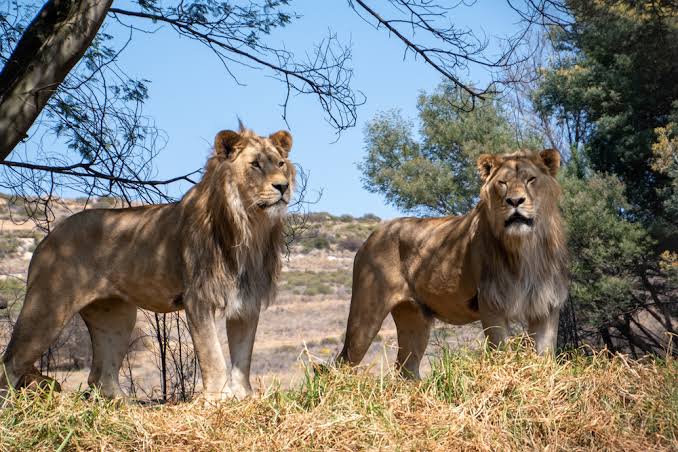
When the Romanian Five arrived and completed their initial settling period in a monitored smaller enclosure, they were released into what is now their permanent home: a three-hectare enclosure that the LIONSROCK team designed around the natural topography of the land. The enclosures at LIONSROCK are circular in shape, a deliberate choice that follows the natural contour of the terrain and ensures that the animals are never experiencing the psychological pressure of a corner — the sense of being bounded on two sides simultaneously that rectangular enclosures impose. The five siblings’ enclosure includes a small dam, a shady forest section, rocky outcrops, rolling ridges, and the sight line to the LIONSROCK hill itself — the landmark that gives the sanctuary its name and that serves as the backdrop to a landscape as far from a Romanian backyard as it is possible to imagine.
Roman discovered all of it immediately. Vincent ate well. Dolf, slower to trust but no less present, began the process of building his relationship with a new team of caregivers — people who knew his history and were prepared to meet him at whatever pace his particular sensitivity required. Ellie and Geena did what they had apparently always done: played, explored, caused minor chaos with enrichment objects, and remained fundamentally, irrepressibly naughty in the most endearing possible sense.
Today they are seven years old. They have now spent more of their lives at LIONSROCK than they spent anywhere else. The grassland is familiar to them. The dam is theirs. The rocky outcrops know their weight. The FELIDA team who sent them off with heavy hearts and wide smiles in August 2022 did exactly what they said they were doing: they handed five young lions to the best possible next chapter.
The Broader Story: What the Romanian Five Represent
The Romanian Five are not the only big cats rescued by FOUR PAWS from private keeping in Eastern Europe, and their story is not unusual within the broader landscape of captive big cat exploitation across the continent and the world. Romania banned the use of big cats and other wild animal species in circuses in 2017, and private keeping is technically regulated through a permit system. The regulation has not eliminated the problem. FOUR PAWS estimates that thousands of lions and other wild animals across Europe and beyond continue to be kept and bred privately in conditions that fail every meaningful standard of animal welfare — as pets, as entertainment, as props for photo opportunities, as inventory for commercial wildlife operations that operate in the legal gray zones between permit requirements and enforcement capacity.
The two older siblings, Simba and Elza, remain at FELIDA Big Cat Sanctuary in the Netherlands, where the specialized care they need is available in ways that the long-distance transport required for LIONSROCK was not appropriate for their circumstances. And the family member who remained behind in Romania — a one-year-old cub being kept by the original owner in the aftermath of the 2021 rescue — was documented by FOUR PAWS as continuing to face exploitation while the organization worked to extend its advocacy to cover those who could not be immediately removed. The rescue of the seven siblings was a victory. The fight for every lion like them is ongoing.
The relevance of that fight to everything Sustainable Action Now covers is direct and constant. Private keeping of wild animals — the system that produced the Romanian Five’s early life — is the same system that fills the pipeline of the exotic pet trade, the cub petting industry, the canned hunting operations, and the commercial breeding facilities that sustain captive big cat populations across the world. Every time a country bans private keeping, every time a permit system gets genuine enforcement, every time a facility like FELIDA or LIONSROCK rescues animals from that system and demonstrates that a better outcome is possible, the argument for change gets stronger and the network of exploitation gets marginally harder to maintain.
Roman and Vincent are figuring out leadership among themselves in the grassland of the Eastern Free State. Dolf is building trust with his caretakers, day by patient day. Ellie and Geena are being naughty in ways that make everyone around them smile. All five of them turned seven today.
A seven-year-old lion in the wild would be approaching the prime of his or her adult life — in a pride, on familiar land, with the full range of natural behavior available as a daily expression of what it means to be a lion. The Romanian Five have most of that, now. They have the land and the space and the siblings and the enrichment and the care of people who know them as individuals and love them for exactly who they are. They do not have the wild, and they never will — that door was closed when they were bred in captivity, and no sanctuary can fully reopen it. What they have instead is the closest possible approximation, given by people who believe it is worth giving.
Happy birthday, Roman. Happy birthday, Vincent. Happy birthday, Dolf. Happy birthday, Ellie. Happy birthday, Geena. Here’s to many more.
Sustainable Action Now follows the work of FOUR PAWS and its sanctuaries FELIDA Big Cat Sanctuary in the Netherlands and LIONSROCK Big Cat Sanctuary in South Africa. We will continue covering the broader campaign to end private keeping of big cats, captive breeding exploitation, and the canned hunting industry in South Africa and globally.