

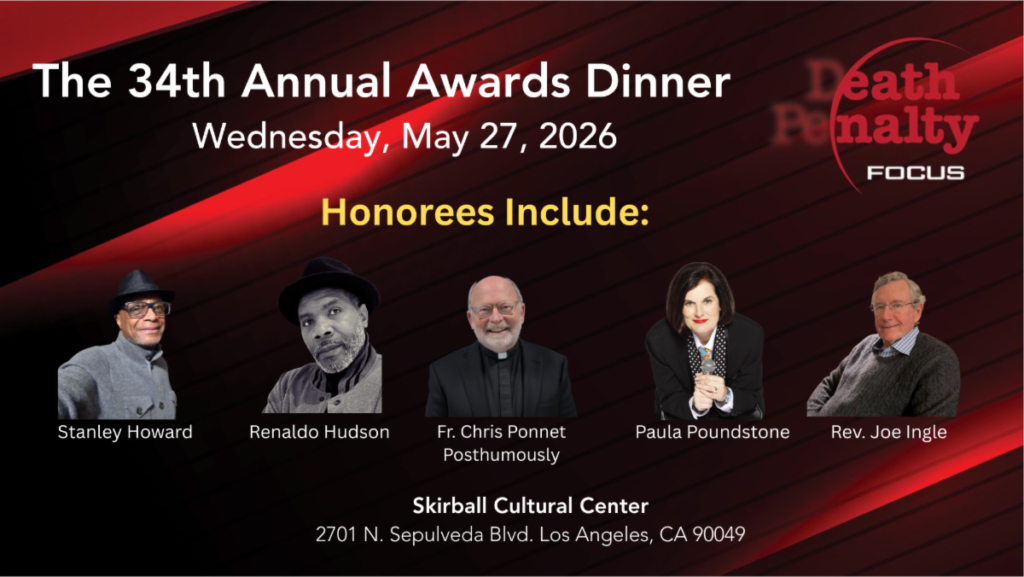
At a time when conversations surrounding justice, incarceration, state power, and human rights continue intensifying across the United States, one of the nation’s longest-running abolitionist gatherings is preparing to once again bring together advocates, faith leaders, artists, legal reformers, exonerees, organizers, and families united around a shared belief that the death penalty remains one of the most urgent moral and human rights issues confronting modern society.
On Wednesday, May 27, the 34th Annual Death Penalty Focus Awards Dinner at the Skirball Cultural Center in Los Angeles will do far more than recognize a distinguished group of honorees. It will serve as another major moment within a broader national movement that continues challenging the ethics, effectiveness, racial disparities, financial costs, and irreversible consequences of capital punishment in America.
At Sustainable Action Now, conversations surrounding the death penalty are not simply political debates. They are deeply connected to larger questions about systemic violence, institutional accountability, restorative justice, human dignity, and whether modern democratic societies can continue justifying executions carried out in the name of justice while overwhelming evidence continues exposing profound flaws throughout the system itself.
This year’s event arrives during a period of enormous tension surrounding criminal justice policy nationwide. While some states continue reducing or abolishing capital punishment entirely, others remain committed to expanding executions and reinforcing punitive sentencing structures. The resulting national divide reflects a country still wrestling with fundamental questions surrounding punishment, redemption, violence, trauma, and the limits of governmental authority over human life.
The significance of the DPF Awards Dinner lies precisely in its refusal to allow these conversations to fade quietly into the background.
For more than three decades, the annual gathering has functioned not merely as an awards ceremony, but as a public affirmation of resistance against a system many abolitionists argue is irreparably broken. It has become a space where activism, spirituality, legal advocacy, storytelling, and lived experience converge around one central idea: the death penalty cannot be separated from the broader failures and inequities embedded within the American criminal justice system itself.
This year’s honorees reflect the extraordinary breadth of that movement.
Stanley Howard has long been recognized as a major voice within criminal justice reform and anti-death penalty advocacy circles, particularly through work connected to violence prevention, youth intervention, rehabilitation, and community transformation. Figures like Howard represent a growing movement emphasizing that public safety and healing cannot be sustainably built through systems centered primarily on punishment and state violence.
Renaldo Hudson’s recognition carries equally profound significance because his life story embodies one of the most important evolving conversations within abolitionist movements: redemption, transformation, and restorative justice. Formerly incarcerated individuals who emerge as advocates often become some of the most powerful voices challenging simplistic narratives surrounding crime and punishment because they expose the humanity and complexity often erased by political rhetoric.
The posthumous recognition of Fr. Chris Ponnet also highlights the enormous role faith communities continue playing within anti-death penalty activism. For decades, religious leaders across numerous traditions have challenged capital punishment not only legally or politically, but morally and spiritually. Their advocacy frequently centers around human dignity, forgiveness, redemption, and the belief that state execution fundamentally contradicts principles of compassion and restorative justice.
Paula Poundstone’s inclusion among this year’s honorees further illustrates how cultural influence and public visibility increasingly intersect with social justice advocacy. Artists, comedians, actors, and public figures continue shaping public discourse surrounding incarceration and state violence by bringing emotionally accessible storytelling into conversations often dominated by legal terminology or political polarization.
Meanwhile, the recognition of the Rev. Joseph Ingle reflects another critical dimension of the abolitionist movement: long-term moral witness. For decades, clergy members, spiritual counselors, and execution witnesses have stood alongside incarcerated individuals facing death sentences, often becoming firsthand observers to the psychological realities surrounding capital punishment systems. Their experiences frequently deepen public understanding of the human cost involved not only for prisoners, but also for families, prison staff, attorneys, and entire communities.
The presence of special guests including Fr. Louis Chase, Ed Begley Jr., Rabbi Sharon Brous, and Fr. John Dear reinforces the coalition-based nature of modern abolitionist organizing. The anti-death penalty movement increasingly draws support across religious, political, racial, artistic, environmental, legal, and humanitarian communities because concerns surrounding capital punishment intersect with so many broader systemic issues.
That intersectionality matters enormously.
Modern abolitionist movements are no longer framed solely around innocence cases or procedural concerns, although those remain critically important. Increasingly, advocates argue that the death penalty itself reflects deeper societal failures involving racial inequality, prosecutorial misconduct, economic disparity, mental health neglect, trauma cycles, inadequate legal representation, and the normalization of state-sanctioned violence.
Statistics and case histories continue intensifying those concerns. Wrongful convictions, exonerations, inconsistent sentencing patterns, racial disparities, and questions surrounding prosecutorial ethics have all contributed to growing skepticism regarding the fairness and reliability of capital punishment systems nationwide. The possibility of irreversible error fundamentally alters the moral framework surrounding executions because no justice system can claim infallibility.
This reality has become one of the most powerful arguments driving contemporary abolition movements. The state cannot ethically exercise irreversible punishment while simultaneously operating within systems repeatedly proven vulnerable to bias, misconduct, political pressure, unequal defense resources, and human error.
Yet beyond legal arguments, the emotional and philosophical dimensions of abolition remain equally important.
Events like the DPF Awards Dinner continue resonating because they center humanity in conversations often reduced to abstraction. Discussions surrounding the death penalty frequently become dominated by statistics, court rulings, legislative battles, and ideological polarization. What gatherings like this restore is the recognition that every aspect of capital punishment ultimately involves human beings — victims’ families, incarcerated individuals, prison workers, legal advocates, spiritual counselors, exonerees, communities impacted by violence, and families permanently shaped by the justice system itself.
At Sustainable Action Now, this broader perspective matters because sustainable justice systems cannot be built solely through punishment. Long-term societal healing requires addressing violence at its roots while also recognizing the humanity of everyone impacted by cycles of trauma, incarceration, and systemic inequity.
One of the most important shifts occurring within anti-death penalty advocacy today is the growing emphasis on restorative and transformative justice frameworks. Rather than viewing justice exclusively through retaliation or retribution, these approaches focus on accountability, healing, rehabilitation, community restoration, and violence prevention. While these ideas remain controversial in some political circles, they are gaining increasing attention as alternatives to punitive systems that often fail to address underlying causes of harm.
The annual DPF gathering also highlights how abolitionist work extends far beyond courtroom advocacy alone. Cultural change remains essential. Public opinion surrounding the death penalty has evolved significantly over recent decades precisely because activists, storytellers, faith leaders, journalists, attorneys, artists, and formerly incarcerated people continued pushing conversations into mainstream awareness.
Events like this help sustain that momentum by creating spaces where advocacy becomes communal rather than isolated.
There is also something profoundly symbolic about hosting the event at the Skirball Cultural Center in Los Angeles. Los Angeles itself represents a city deeply connected to conversations surrounding inequality, incarceration, policing, immigration, activism, entertainment influence, and social justice organizing. Holding the event in such a visible cultural space reinforces that abolitionist advocacy belongs within mainstream civic and cultural life rather than existing at society’s margins.
The involvement of public figures and artists also reflects another major reality shaping contemporary movements: narrative matters. The death penalty debate is not simply legal. It is emotional, cultural, psychological, and moral. Public understanding shifts when people encounter personal stories, lived experiences, and human testimony rather than abstract political framing alone.
That storytelling becomes especially important in an era dominated by digital fragmentation and polarized media ecosystems. Abolitionist organizations increasingly recognize that sustainable change requires emotional engagement alongside legal reform efforts. People must not only understand policy failures intellectually, but also feel the human consequences of those systems emotionally.
The 34th Annual Awards Dinner therefore represents far more than institutional recognition. It is an act of collective visibility. It publicly honors people who have spent years — and in many cases decades — confronting one of the most entrenched and emotionally charged institutions within American criminal justice.
It is also a reminder that abolition movements continue expanding despite political resistance.
Over recent decades, numerous states have abolished the death penalty entirely, imposed moratoriums, or significantly reduced executions. Public support for capital punishment has fluctuated dramatically as awareness surrounding wrongful convictions and systemic bias has grown. Younger generations increasingly express skepticism toward execution-based justice systems. Internationally, the United States continues facing scrutiny from countries and human rights organizations that have already abandoned capital punishment altogether.
Yet despite this momentum, executions continue. Death row populations remain active. Prosecutors continue seeking capital sentences in some jurisdictions. Political rhetoric surrounding punishment often intensifies during periods of social instability and public fear.
That tension is precisely why gatherings like the DPF Awards Dinner remain so important. They serve as reminders that abolition work requires sustained commitment across generations rather than temporary outrage cycles alone.
Perhaps most importantly, the event reflects a larger moral question modern societies continue confronting: what does justice actually mean?
Is justice measured through retaliation alone? Through state power? Through punishment severity? Or can justice also include healing, accountability, prevention, rehabilitation, and recognition of shared humanity even amidst profound harm?
The abolitionist movement does not pretend these questions are easy. Violence, trauma, grief, and public safety concerns are deeply real and emotionally devastating realities. But advocates increasingly argue that executions do not resolve those wounds. Instead, they often reinforce cycles of violence while preserving systems vulnerable to inequity and irreversible error.
As the 34th Annual DPF Awards Dinner approaches, it stands as both celebration and challenge — honoring those who continue dedicating their lives to justice reform while reminding the broader public that the national conversation surrounding capital punishment remains far from finished.
Because ultimately, the movement to end the death penalty is not solely about opposing executions. It is about reimagining what kind of society people believe is possible when justice is no longer defined primarily through death itself.